

Translating Quantum Food Futures | May 2026
Published: 23 May 2026
An update on the first interdisciplinary workshop in a three part series exploring how quantum technologies may shape the future of food.
Written by Dr Saihong Li, Translating Quantum Food Futures Project Lead
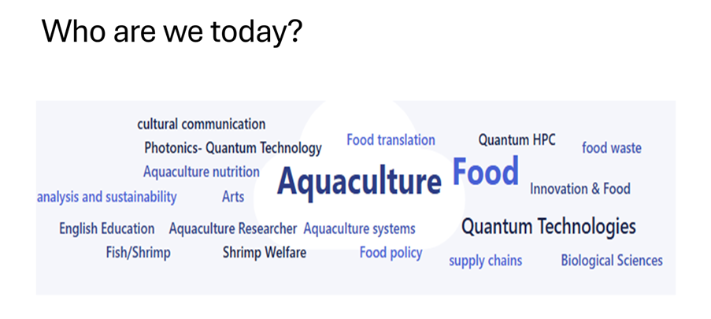
The first workshop in the Translating Quantum Food Futures (TQ-FOODS) series took place at the Bayes Centre in Edinburgh on 4 May 2026, bringing together 24 participants in person and a few people online from quantum science, food and nutrition research, aquaculture, policy, the humanities, and the arts.
Supported by the Quantum ARC and SCAF, TQ-FOODS explores how emerging quantum technologies can be responsibly understood, culturally translated, and meaningfully integrated into food and nutrition systems. The project is especially interested in how complex scientific ideas move beyond laboratories and into wider social, cultural, and public contexts.
The workshop was designed to open up new interdisciplinary conversations around food security, sustainability, communication, and innovation. The morning began with a series of talks introducing key developments in quantum computing and related technologies, including quantum light, Raman spectroscopy, and entropy benchmarking in near-term devices. These sessions provided a technical foundation for the wider discussions that followed.
The focus then shifted to food systems and real-world applications. Speakers addressed aquaculture sustainability, food security, salmon traceability, food policy, aquaculture nutrition, and precision aquaculture.
Together, these sessions raised a central question for the day: where might quantum technologies bring tangible benefits to food systems, and what kinds of evidence, communication, and collaboration are needed to make that possible?
Much of the discussion centred on aquaculture as a particularly promising area for future exploration. Participants considered how quantum technologies might contribute to challenges such as fish health and welfare, nutrient tracing, stock counting, water quality monitoring, and end-to-end supply-chain traceability. At the same time, the workshop did not treat innovation as automatically beneficial. Important questions were raised about environmental impact, social relevance, public understanding, and how emerging technologies are interpreted across different sectors and communities.
One of the strengths of the event was the range of perspectives in the room. Alongside scientists and food researchers, colleagues from the humanities, social sciences, and the arts helped broaden the discussion beyond technical feasibility alone. Their contributions highlighted the importance of language, metaphor, visualisation, ethics, and cultural meaning in shaping how new technologies are understood and adopted.
As Dr Saihong Li, the project lead, reflected: “What made the workshop so valuable was not only the range of expertise in the room, but the willingness to ask difficult questions together. We are especially interested in problems that no single discipline can solve alone.”
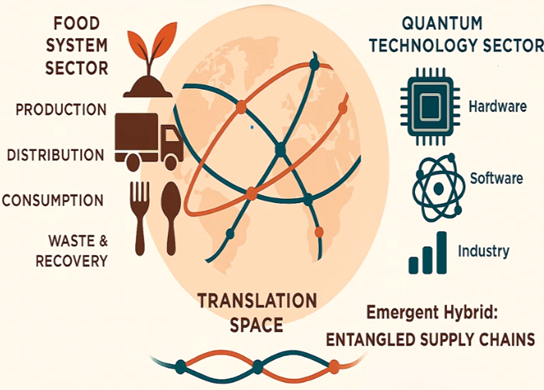
The Edinburgh event marks the beginning of a three-part workshop series. The second workshop will take place in Stirling on 23 June 2026, where participants will continue building interdisciplinary connections and identifying the most promising themes for future collaboration.
First published: 23 May 2026