

A look back on the Unconference
Published: 21 October 2026
Reflections from the Unconference held as part of the SCAF Annual Event 2026 in Aberdeen.
As part of the Annual Event 2026, SCAF held an Unconference with the programme devised and co-produced by attendees, to foster collaboration and knowledge exchange across disciplines and sectors. Thanks to Sarah Najera Espinosa, Aishat Momodu, Eneyi Oshi, Jemimah Otwori, Lydia Stewart, Alistair Trail, Ellie Michael and Tim Yeomans, who delivered a variety of sessions, including creative workshops, presentations and group discussions.
The topics covered this year ranged from reformulation to food sovereignty via new product development.
Below are thoughts and reflections from the day shared by our facilitators. Key takeaway messages included the value of creative methods for engaging communities and the positive impact of multidisciplinary collaboration in helping projects to evolve.
“What is an unconference?” - An unconference is a welcoming, participant-driven meeting where attendees create the agenda, lead discussions, and shape the content around the interests they share. Unlike traditional conferences, which typically have scheduled speakers and more structured agendas, unconferences bring people’s ideas together to tackle real community challenges and encourage meaningful participation.
Sarah Najera Espinosa guided a group conversation reflecting on dietary labels, terminologies and communication around plant-forward eating. The session explored the different terminologies being used to help drive dietary transitions towards more plant-based diets.
Sarah: 'In my team, we have been using "plant-forward diets" to avoid the term "plant-based diets". I was surprised that most people did not know what it meant and found it unhelpful. There is no single term suitable for discussing dietary transitions, but it is important to communicate carefully to avoid unintended consequences arising from a lack of clarity, confusion, or terminology saturation.’
Communicating and engaging effectively with stakeholders is crucial to the transition to a better food system in Scotland. Lydia Stewart ran a workshop to demonstrate a participatory creative arts approach that captures the impacts of the food system on people and was used in a research programme investigating health inequalities in underserved areas of Glasgow. This methodology forms part of a UKRI-funded project: Community food markets as a driver for equitable, sustainable food systems, which aims to establish how access to community-led fresh food markets can improve nutrition and food security in these areas.
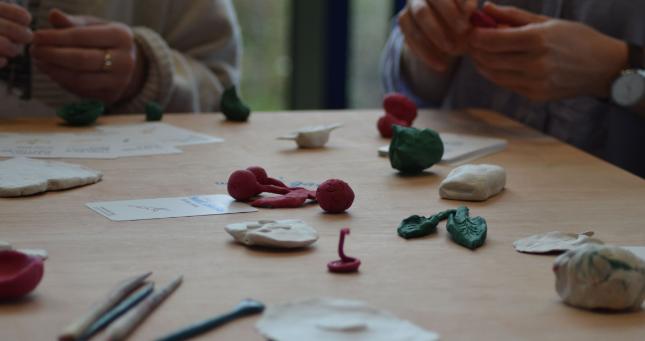
Lydia: ‘The session was designed to give people a first-hand experience of our participatory creative methods for engaging with the public in understanding the complexity of food systems. The creative method uses clay, pens and a tabletop to visualise food stories and map common and convergent relationships. It was incredible to see the way people were drawn to the tactile nature of the engagement. The session was a strong reminder of the value creative methods can offer even in other disciplinary fields.’
Continuing the theme of consumer engagement, Aishat Momodu explored who needs to be at the table to help create the food people want to eat. Drawing on lessons from her PhD research, Aishat facilitated a round table discussion exploring reformulation and consumer acceptance. The discussion considered who should be involved, whose voices are often missing, and how researchers can move beyond studying acceptability towards co-designing healthier, acceptable and practical food products.
Aishat: ‘What struck me most was that there is still some confusion about what food reformulation means and how it is different from fortification. Healthier reformulation is not just about changing the product; it is also about creating an environment that makes healthier choices easier. So perhaps the question is not only, “How can we make food products healthier?” but also, “How can we create a food system that makes healthier and more sustainable choices easier for everyone?”’
Creating pathways to develop new food products is another important aspect to consider. Alistair Trail presented an overview of the SRUC New Product Development Service, which collaborates with small and medium-sized enterprises to develop innovative food prototypes for the UK market, and introduced ONE SeedPod, the new Food Innovation Hub based in Aberdeen. While Tim Yeomans shared the journey of developing a range of innovative seed butters, from initial concept and grant-funded product development through to market testing, research partnerships, and future commercialisation opportunities.
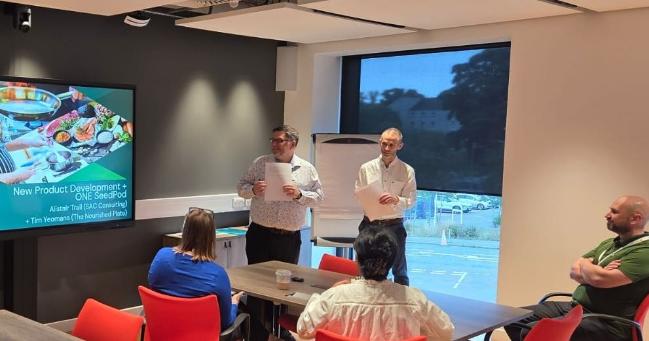
Alistair: ‘The session was excellent with a number of the audience members interested in the process of developing new novel and innovative food products and the challenges of bringing these to market.
Tim: ‘The session highlighted the value of collaboration between industry, research institutions, and product developers. Successful food innovation requires more than just a good idea. It is a journey of continuous learning, where clear values, consumer feedback, scientific expertise, and strong partnerships help transform a concept into a product with real commercial and societal potential.'
Stepping back from new products and focusing on traditional and culturally important foods, Jemimah Otwori facilitated a roundtable discussion that asked whether Scotland is building a food system that provides food sovereignty for a multicultural population. The purpose of the session was to understand the drivers of food insecurity among ethnic minority groups in Scotland, looking beyond access to food and focusing on access to culturally meaningful food. Participants explored access to culturally important foods, premiums attached to these foods, and factors that adversely affect access to them.
Jemimah: 'Participants suggested a variety of sources, including shops catering to cultural groups, pop-up events, mobile food sellers, open-air markets, farm shops, convenience stores, speciality shops and online shops, as well as some mainstream supermarkets. The discussion identified that accessing culturally important food comes with a premium, which is mostly absorbed by consumers.'
Eneyi Oshi led a small-group discussion that examined the Scottish food system from a different angle, focusing on resilience. The session sought to identify methods to measure the resilience of community food systems.
Eneyi said: 'Participants from research, policy, farming and community work described resilience in quite different terms, and the conversation kept circling the gap between a shared definition and a locally specific one, and between what matters and what can actually be counted. Maybe the point is not to make the unmeasurable measurable at any cost, but to be honest about what measurement captures and what it leaves out.'
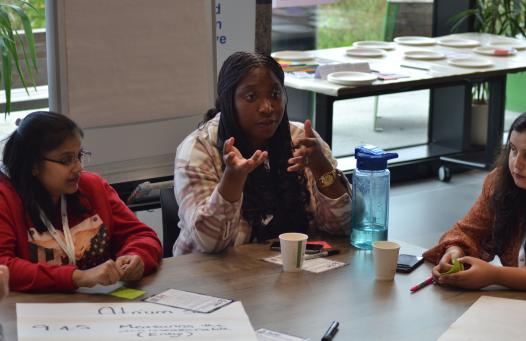
Finally, Ellie Michael explored food literacy and what food education might look like in Scotland in 2040. Ellie delivered an interdisciplinary mapping and futures-concept exercise to explore different understandings of food literacy and to collectively identify priorities for future food education in Scotland.
Ellie: ‘After presenting an overview of the current status of school food education in Scotland, outcome five of the Good Food Nation plan and the European Union’s three food literacy dimensions were used to provide structure for the discussion sessions, debating what knowledge, skills and values might shape food education in Scotland. Balancing the scientific with the social and cultural led me to challenge some of my own assumptions and make further connections. Whilst the session focused predominantly on school food education, it highlighted the need for broader debate on population-level food education.‘
Thanks to all the attendees on the day. Please share your event feedback and suggestions here.
First published: 21 October 2026