Is the UK backsliding on climate and energy?
Published: 20 November 2026
20 November 2026: As recent developments in UK energy policy have renewed debate about the relationship between climate objectives and other pressures like energy security and economic priorities, Dr Hannah Salamon examines the complex and non-linear nature of climate progress.
20 November 2026: As recent developments in UK energy policy have renewed debate about the relationship between climate objectives and other pressures like energy security and economic priorities, Dr Hannah Salamon examines the complex and non-linear nature of climate progress.
Blog by Dr Hannah Salamon
This blog is part of a series of insights the Centre for Public Policy will publish around COP31.
In October, the UK approved the Jackdaw gas field in the North Sea. This came after heated debate between those who see the decision as beneficial for UK energy security, jobs creation, and cost of living, and those who see this as a step backwards in the transition to a green energy system and one with negative environmental consequences.
Even more controversial is the Rosebank oil field, also in the North Sea. Rosebank has not yet been approved and may indeed be denied. Because oil is sold on the international market, increasing production at Rosebank will not impact the UK’s energy security or bills. Oil has even worse environmental impacts than gas, pushing critics to insist that its approval contrasts starkly with the UK’s climate goals. These developments prompt the question: Is the UK backsliding on its energy policy? The answer may be that progress towards net zero is not linear.
Climate backsliding happens when countries go back on targets or goals that they set to address climate change. Forces like climate change denial - which come mostly from the far right - can play a role in climate backsliding, but so do more practical factors, like competing policy concerns or budgetary constraints. In the UK, decisions around expanding fossil fuels are controversial because they are taking place against the backdrop of what is meant to be a green energy transition, or the process by which the UK weans off fossil fuels. This includes increasing green energy production, expanding the electricity grid, and rolling out electricity-based alternatives, like electric vehicles and heat pumps, at scale. Approving fossil fuels seemingly runs counter to aims of the transition.
Yet in the UK, there has been some meaningful progress towards a green transition. Its emissions are nearly half of the 1990 baseline. The UK Parliament continues to demonstrate commitment to meeting goals by passing the carbon budget into law with a goal of 87% emissions reductions by 2042. The proposed Energy Independence Bill aims to reduce energy bills and to explicitly end new licences for oil and gas drilling. An investment of £12bn has just been secured for one of the largest UK offshore wind projects in history, set to provide enough energy to power 3 million homes by 2030.
Yet, policies in line with climate change adaptation and mitigation are regularly faced with competing priorities. Consideration and approval for Jackdaw and potentially Rosebank illustrate this; emissions from these projects are weighed against economic benefits. The ongoing conflict in the Middle East has limited access to oil, causing threats to energy security for states and rising energy costs for businesses and households. Consequently, the UK Government has announced that it is going back on initial funding commitments for carbon capture and storage, diverting the funds to defence.
The UK’s delegation to this years’ COP31 in Turkey includes no less than the Prime Minister, the Foreign Secretary, and the Secretary for Energy Security and Net Zero. While many cast doubt on the effectiveness of the international mechanism (i.e. citing the significant influence of fossil fuel interests or chastising countries for not delivering on their nationally determined contributions), COP has kept organised, global attention on climate change, generated initiatives in climate finance and redistribution of resources to developing countries, and set clear global targets. The high-level makeup of the UK’s delegation indicates continued dedication to both participating in and leading international cooperation around climate mitigation and adaptation. And back at home, there is still potential for the UK to say no to new oil drilling in Rosebank.
When it comes to climate change mitigation and adaptation, the reality is that upward, linear movement is rarely how progress is made. Perhaps, expecting a seamless transition to a low or no-carbon economy is too high of a standard to hold governments to, when they are constantly pressured with competing concerns. Overcoming simultaneous policy and political challenges while working towards the collective action problem of climate change poses a massive challenge. In the UK context, the mix of continued commitment to climate change mitigation and adaptation alongside policy decisions to address other priority areas that run counter to climate goals exemplifies that progress can be undone, is non-linear, and requires constant commitment and re-commitment to the long-term existential challenge of climate change.
Author
Dr Hannah Salamon is a Research Associate at the University of Glasgow's Centre for Public Policy, and leads the Centre's research on climate policy. She has a particular interest in the role of women in climate action, the transition to net zero, and deliberative democracy.
Photo by Aleksi Partanen on Unsplash
First published: 20 November 2026
This blog is part of a series of insights the Centre for Public Policy will publish around COP31.
UofG Spotlight podcast
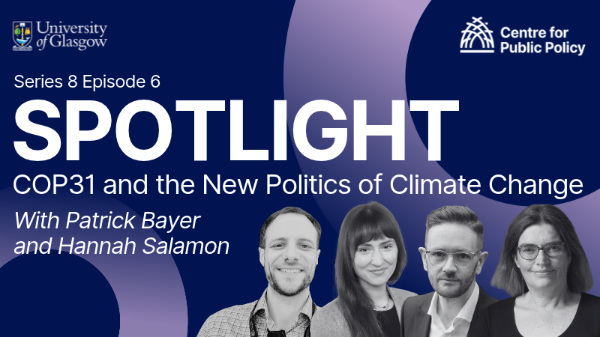
Listen to Dr Hannah Salamon on our latest UofG Spotlight podcast episode, COP31 and the new politics of climate change