

2026 Election Policy Insights 2026: Social Security
Published: 15 June 2026
15 June 2026: Dr Thomas Rochow examines social security in Scotland. He outlines the historical 'ideological' struggle of approaches to social security, the impact of recent social security policies and how it is financed, writing that to sustainably tackle inequality in Scotland, the Scottish Government must bolster its existing approach with preventative, system-level change.
15 June 2026: Dr Thomas Rochow examines social security in Scotland. He outlines the historical 'ideological' struggle of approaches to social security, the impact of recent social security policies and how it is financed, writing that to sustainably tackle inequality in Scotland, the Scottish Government must bolster its existing approach with preventative, system-level change.
Policy Insights by Dr Thomas Rochow
Opportunities, challenges, and the next Scottish Parliament
Social security in Scotland is a complex policy lever that offers both opportunities to tackle inequalities and challenges to sustain investment. The affordability of the social security system is something that is discussed frequently by politicians and in the media. Some suggest social security spending is out of controland reduces work incentives, and others propose that greater investment is required to enhance long-term population prosperity and to reduce public spending in other areas, such as health and criminal justice. This policy insight will address three key aspects of social security in relation to opportunities and challenges for the next Scottish Parliament: the politics of social security, the impacts of recent social security policies, and the financing of social security.
The overlapping social security systems in Scotland
Before this policy insight explores the politics of social security, it is important to briefly explain the current social security systems operating in Scotland. The substantive pieces of social security legislation remain reserved to the UK Parliament; Universal Credit (UC) is a variable monthly payment for those on a low income, which replaced six legacy benefits: Income Support, Jobseeker's Allowance (JSA), Employment and Support Allowance (ESA), Housing Benefit, Child Tax Credit, and Working Tax Credit. This system remains the overarching social security system across the UK. In recent years, the Scottish Government has exercised devolved powers to design and roll out new benefits, most notably the Scottish Child Payment (SCP) and the Adult Disability Payment (ADP). However, devolved policy decisions account for only 3.2 per cent of the total social security spending in Scotland (including that controlled by the Department for Work and Pensions). For context, the total annual social security expenditure in Scotland, combining both devolved and reserved spending, is approximately £27 billion, and the SCP is estimated at £458 million for 2025-26. Exploring the interaction between reserved and devolved powers and the volatile funding landscape is essential for understanding Scottish social security policy.
The politics of social security
There has been a historic ideological struggle between those who believe investment in social security is a vital component of any well-functioning nation-state, to protect and support all citizens, and those who suggest diminished state support enhances individual aspiration and wellbeing through greater privatised security. There is an argument that recent UK Governments, particularly the Coalition Government (2010-2015), have embraced the latter of these ideological strands. Successive UK Governments were concerned with reforming the social security system to enhance work incentives. Whereas recent SNP Governments have led with ‘dignity, fairness and respect’ as underpinning the establishment of Social Security Scotland in 2018. Thus, aligning more with the former of these ideological strands. This contemporary policy divergence between the Scottish Government and the UK Government within social security could be attributed to these ideological differences.
Behind the politics is a much messier picture and a UK social security budget that is largely concentrated in two main blocks: pensions and health-related support. Between 2019-20 and 2025-26, almost half of the increase in welfare spending at the UK level was due to the triple lock on the State Pension – which maintains cross-party support – and the gradual increase in the pensioner-age population. Moreover, the majority of the Scottish Welfare budget is spent on support for people with disabilities. In 2026-27, it is predicted that £4.5 billion of the £7.4 billion social security budget will be assigned to Adult and Child Disability Payments. These payments sit outside of UC and are not work-related benefits. Hence, the contested space appears to mostly surround the relatively small element of the social security budget invested in the working-age population deemed available for work.
There are legitimate critiques of prioritising social security spending to tackle poverty, as the Scottish Government have done, but to suggest that increasing welfare spending necessarily increases worklessness and weakens the economy is an oversimplified evaluation of a complex problem. Evidence from the Organisation for Economic Co-operation and Development (OECD) suggests the UK operates one of the most punitive welfare regimes among comparable nations. Despite decades of behavioural conditionality at the heart of UK social security policy, disproportionately targeted at young people, the number of young people (aged 16–24) not in education, employment, or training (NEET) had risen from 808,000 when UC was fully rolled out in 2018 to 1,012,000 from Jan-March 2026. The evidence that welfare conditionality and benefit sanctions reliably activate claimants into stable employment remains limited – other structural factors are clearly at work. Attempts to boost employment by altering individual behaviour do not appear to be succeeding, and thus, alternative policy approaches in this area are long overdue.
Impacts of recent social security policies
The Scottish Child Payment (SCP)
The Scottish Child Payment, introduced in 2021, is a weekly payment available for every child under 16 whose parents or guardians receive other qualifying benefits, such as UC. Advocated by children's charities to lift children out of poverty regardless of family size, the SCP was introduced in part to mitigate the impact of the UK Government's Two-Child Limit - a policy that restricted child support to two children per family, which has since been abolished. The multi-level social security systems operating in Scotland create policy cliff edges whereby eligibility for support in one system is contingent upon receipt of another benefit from a different system. For instance, if a single mother in Scotland with two children is in part-time employment and increases her number of hours at work, surpassing the UC income threshold in a given month, her UC payment would be stopped and, by extension, so would her SCP support. These interdependencies mean that minor changes in circumstance or a technical glitch can result in a sudden and significant loss of income for certain households.
The SCP is regarded as a policy success. The latest statistics indicate a slight decrease in relative child poverty rates in Scotland, down to 21% from 23% in 2021-24. However, the emphasis on cash payments reduces the capacity for the Scottish Government to improve experiences and opportunities for low-income groups through more holistic approaches. When introduced, the SCP was £10 per week per child, rising to £28.20 in 2026-67 in line with inflation. By the end of the next parliament, the Scottish Government is expected to spend £522 million annually on the SCP.
A wealth of evidence, recognised by the Scottish Government through the Whole Family Wellbeing Fund, indicates that making significant and sustainable impacts in tackling poverty requires wrap-around family support - coordinating dynamic cash benefits with quality services. This places the next Scottish Government in a difficult position, as it tries to maintain current social security payments while facing a pressing need to improve public services, such as childcare and social housing. Raising incomes among low-income households is an important component of reducing socio-economic inequalities, but tackling the root causes of poverty - including equitable employment opportunities and access to quality healthcare - is a more complex and enduring challenge. Whether sustained increases in social security investment alone can reduce socio-economic inequalities in the long term remains uncertain.
Adult Disability Payment (ADP)
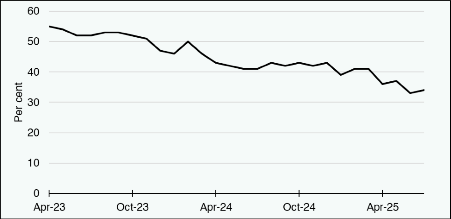
In 2022, Social Security Scotland introduced the Adult Disability Payment (ADP), replacing the Personal Independence Payment (PIP) for new claimants in Scotland. The PIP is a UK-wide benefit to support with the extra costs of living with a disability. The assessments and reassessments in the PIP system were described by beneficiaries as not fit for purpose, exclusionary, and demeaning, leaving many disabled people living with amplified anxieties, and many without basic financial support. While ADP maintains similar financial support levels, it has been designed with a more inclusive and less adversarial application process. However, the rate of authorised ADP claims has continued to decrease since the introduction of the benefit (as seen in Figure 1).
Figure 1 - ADP Authorisation Rate April 2023 to April 2025:
Source: Scottish Fiscal Commission 2026
One explanation for this is that ADP remains fiscally constrained by the UK block grant adjustment (BGA) system, which pegs Scotland's funding to PIP uptake in the rest of the UK. This creates a fiscal vulnerability: if the UK Government tightens PIP eligibility, Scotland's BGA is automatically reduced - even if the Scottish Government maintains more generous entitlement criteria. This policy divergence exacerbates a volatile fiscal environment that undermines the financial security of sustained social security investment and can compound anxiety among claimants. The caseload for disability payments is rising more rapidly in Scotland than the rest of the UK, and the Scottish Government is forecast to spend £440 million more on ADP by 2029-30 than it will receive in BGA for PIP. The complexity is not confined to policy design; it also extends to fiscal rules and the UK funding framework itself. Policy divergence between Scotland and Westminster in disability benefits creates complex fiscal interdependencies, generating uncertainty for both claimants and policymakers.
The financing of social security
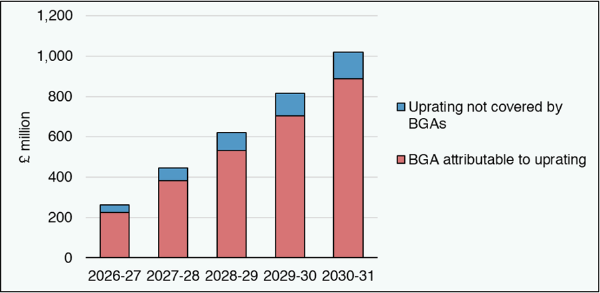
Any continued policy divergence between the Scottish and UK Governments on social security will generate ongoing financial pressures throughout the next parliamentary term. Social security investment in Scotland is projected to rise from £7.4 billion in 2026–27 to £9.2 billion by 2030–31. The vast majority of this expenditure - along with projected increases - will be covered by the BGA (as shown in Figure 2). However, devolved policy decisions resulted in almost an additional £1 billion per year in social security expenditure in Scotland in 2024-25. Furthermore, the next Scottish Government will likely need to redirect up to £131 million from other budget areas by 2030–31 solely to fund the uprating of current benefits in line with inflation (Scottish Fiscal Commission, 2026).
Figure 2 - Cumulative cost of uprating and effect of uprating on Block Grant Adjustments (BGAs):
Source: Scottish Fiscal Commission 2026
This leaves limited room for the Scottish Government to diverge further from UK social security policy, given the financial strain that new or alternative benefits would impose. The SCP remains the Scottish Government's flagship social security policy and has unquestionably prevented more children from growing up in relative income poverty. On its own, however, it is unlikely to deliver a sustainable long-term reduction in child poverty. The priority must therefore shift towards evaluating the holistic experiences of households receiving the SCP to understand what augmented or alternative forms of support would deliver the greatest impact. While additional resources could, in principle, be redirected from elsewhere in the Scottish budget, it is evident that the Scottish Government holds levers beyond cash transfers - in devolved policy areas such as housing and education - that could meaningfully improve the quality of life for low-income families.
The central question for the next parliament is whether low-income families will ultimately gain the agency and financial security to utilise the SCP to enhance their quality of life. Research indicates that additional income for low-income households frequently goes directly towards paying off public debt - for example, council tax debt or rent arrears. Ensuring that increased social security investment lifts more people out of poverty, rather than simply prevents more from falling deeper into it, will require a coherent strategy that links devolved policy levers, particularly across housing, education, childcare, and health. Although a welcome policy, the SCP represents more of a reactive, emergency payment. Sustainably tackling inequality in Scotland requires proactive, preventative system-level change.
Author
Dr Thomas Rochow is a Research Associate at the Centre for Public Policy. He is primarily a qualitative researcher, and his work intersects youth transitions, welfare systems and care policies.
Download and read this CPP 2026 Election Policy Insights - Social Security as a PDF
Election 2026 Policy Insights
The Centre for Public Policy’s Election Policy Insights series seeks to enhance and inform the key debates defining the future of the country, offering comprehensive insight on policy issues and ways forward.
Image by davidhills from Getty Images via Canva Pro
First published: 15 June 2026
Author
Dr Thomas Rochow is a Research Associate at the Centre for Public Policy. He is primarily a qualitative researcher, and his work intersects youth transitions, welfare systems and care policies.
Election 2026 Policy Insights
The Centre for Public Policy’s Election Policy Insights series seeks to enhance and inform the key debates defining the future of the country, offering comprehensive insight on policy issues and ways forward.
CPP on Elections 2026
Visit our dedicated elections webpage for more expert insights.
Download and read this CPP 2026 Election Policy Insights - Social Security as a PDF