

Unfinished business: Why closing the poverty–attainment gap must be an election priority
Published: 6 May 2026
6 May 2026: Professor Edward Sosu looks at the poverty-attainment gap in schools in Scotland, writing that while there is cross-party agreement on the need to close the gap, it remains 'unfinished business'. He says that sustained support from the next parliament is essential to deliver lasting progress.
6 May 2026: Professor Edward Sosu looks at the poverty-attainment gap in schools in Scotland, writing that while there is cross-party agreement on the need to close the gap, it remains 'unfinished business'. He says that sustained support from the next parliament is essential to deliver lasting progress.
Blog by Professor Edward Sosu
Closing the poverty–attainment gap has been a central education policy ambition of the Scottish Government for over a decade. In a 2014 report for the Joseph Rowntree Foundation, we set out the scale and nature of the gap, reviewed earlier policy responses, and proposed a range of actions. Unlike many other areas of public policy, there has since been broad cross-party agreement in successive Scottish parliaments on the need to close the poverty–attainment gap, with disagreement focused mainly on how this should be achieved and on claims about the rate of progress.
Over the past two parliaments, a combination of education and macroeconomic policies has been deployed in pursuit of this goal. In education, these have included the Attainment Scotland Fund, the expansion of free school meals to a wider group of children, and increased state-funded early years provision. At the macroeconomic level, measures such as the Scottish Child Payment were introduced to reduce child poverty more directly. Taken together, these policies reflect a recognition that educational inequality cannot be solved by schools alone.
As Scotland approaches another parliamentary election, there is a need to ask the following questions: what has happened to the poverty–attainment gap since this ambition was first articulated, and are we making sufficient progress? Answering this is less straightforward than it might appear. Trends vary depending on where in the educational journey the gap is examined (primary vs secondary); which benchmarks are used (CFE literacy and numeracy measures, or Scottish Credit and Qualifications Framework qualifications thresholds); the measure of poverty available (predominantly neighbourhood-level SIMD data rather than family income); and the role played by the COVID‑19 disruptions.
Here, I present a rather simplified assessment, drawing on selected publicly available data comparing learners from the most deprived (SIMD1) and least deprived (SIMD5) areas. At the primary stage (Figure 1), literacy provides a useful illustration. At Primary 1, the gap in the proportion of pupils achieving expected curriculum levels between 2016 and 2025 remains largely stable, aside from a temporary widening in 2021 before returning to earlier levels. Primary 4 shows a similar pattern, with very small reductions in recent years. At Primary 7, however, there is a noticeable narrowing of the gap. Overall, this suggests that while gaps in early and middle primary have remained persistent, there has been some narrowing by the end of primary school.
Figure 1:
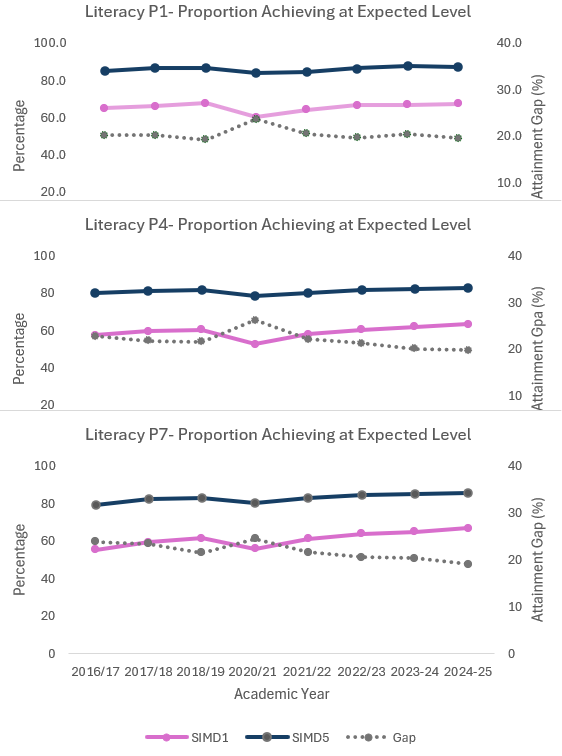
Figure 1: Literacy attainment gap in primary school over time
Figure 2:
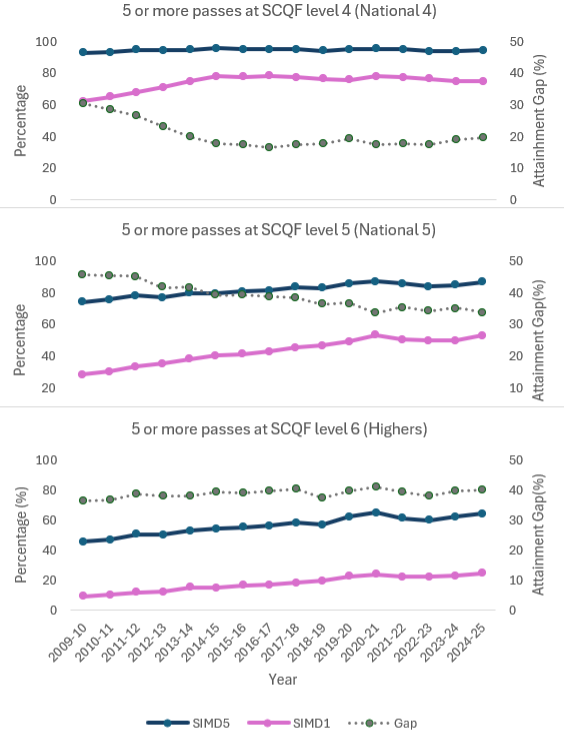
Figure 2: Attainment gap in secondary school over time
Note: Data was not available in 2019/2020 for primary attainment due to Covid-19 disruptions; Data from Scottish Government publications
At secondary level (Figure 2), trends from 2009 to 2025 in the proportion of learners achieving five or more passes using the Scottish Credit and Qualifications Framework (SCQF) levels present a more mixed picture. SCQF qualifications can be taken at the senior phase of secondary school (S4 – S6; ages 15-18). At SCQF level 4 (achievement at National 4 consisting of units and assessed using teacher continuous assessment), the attainment gap narrowed steadily until around 2016, followed by a modest increase afterwards. At SCQF level 5 (achievement at National 5 and assessed using exam, coursework or both), the gap shows a general narrowing over time, although it has stabilised more recently. In contrast, at SCQF level 6 (achievement at Highers and assessed using exam, coursework or both) there is evidence of a slight widening of the gap.
Overall, secondary trends suggest earlier progress at lower qualification levels, but continued and possibly growing inequalities at higher level. While several factors contribute to widening achievement gaps at higher qualification levels, the cumulative effect of poverty on early learning, attendance, health, home, peer and school contexts are possible key factors that amplify disadvantage as students move through the education system.
The overall picture is one of modest success alongside persistent inequality. As I have argued elsewhere, progress has been limited by several blind spots including a weak evidence base on the pathways linking poverty to educational outcomes; ambiguity over how the attainment gap is defined and interpreted; and limited independent evaluation of major policy interventions.
These issues matter during this Scottish election because closing the poverty–attainment gap remains unfinished business. The projected economic outlook suggests increased income volatility. Our research in Scotland shows that income volatility affects learning outcomes before children even enter formal schooling. Income gains are associated with positive cognitive outcomes, while income losses or fluctuations are associated with negative ones. Importantly, these effects are not confined to the poorest families. Future policy commitments must therefore be attuned to how changes in family income shape children’s educational trajectories.
As parties set out their election commitments, there needs to be greater clarity about what success in closing the poverty–attainment gap would actually look like and how this will be determined. Achieving progress will also require renewed effort by schools, education and local authorities. Schools undoubtedly have an important role in closing the poverty–attainment gap. However, sustained support from the next parliament is essential if schools are to deliver meaningful and lasting progress.
Author
Edward Sosu is Professor of Education and Research Director in the University of Glasgow School of Education. His research examines how socioeconomic circumstances and poverty dynamics influence schooling, school readiness, attendance, academic achievement, and psychological outcomes across the lifespan.
First published: 6 May 2026