

So, what’s ‘Embedding Collective Leadership’ even all about?
Published: 25 August 2026
The Embedding Collective Leadership project is helping to build a more inclusive and collaborative research culture by developing facilitation and participatory leadership skills across the Universities of Edinburgh, Glasgow, and St Andrews. Through training, communities of practice, and shared resources, the project aims to embed collective leadership approaches that enable meaningful collaboration, shared decision-making, and positive cultural change across higher education.
Written by Max Reiter, Community Engagement Executive, Edinburgh Innovations
So, what’s ‘Embedding Collective Leadership’ even all about?
Universities are extremely complex institutions, possessing deeply entrenched hierarchies that can feel insurmountable, particularly in the current climate around the sector. We may feel like these hierarchies can create a research culture which can become toxic, leading to an environment that is not as conducive to great research, impact, or well-being as it could or should be.
Challenging these dynamics is what the ‘Embedding Collective Leadership’ project set out to address. We hypothesise that by developing everyone's skills in facilitation tools and processes — and in particular participatory methods — we can empower people to better hold space for conversations that matter. We hope these skills will allow individuals to design these spaces with a toolkit which will enable truly participatory processes to be held confidently, allowing collective wisdom to be gathered and translated into real change.
Why facilitation supports a better research culture
Much of what we'd describe as research culture — the behaviours, values, expectations and norms that people experience day in, day out — plays out in everyday interactions with peers and those who hold power. Traditional meetings around all sorts of subjects tend to reinforce existing hierarchies. They lack diversity of opinion. They inhibit the kind of collective thinking that leads to wiser, more widely supported decisions.
Emergent, participatory processes offer a genuine alternative. Methods like Open Space, World Café, Liberating Structures, and Lewis Deep Democracy create conditions for different kinds of conversation — ones where leadership is genuinely shared, where quieter voices have room to be heard, and where the intelligence of the whole group can surface. Looking at the feedback we have been able to gather from our project, those who have experienced these participatory approaches first-hand recognise their value.
That is not to imply that these approaches are foolproof, or a total silver bullet. They can be challenging to pull off. Also, for those who are not familiar (initially myself included!) they can seem odd, uncomfortable, or counter-intuitive. However, the magic (if I can use so emotive a word!?) of these approaches is how sitting with discomfort — with challenge — is baked-in, encouraged, and even celebrated. The cathartic cycle that these methods employ can be a powerful team or community building structure in and of itself.
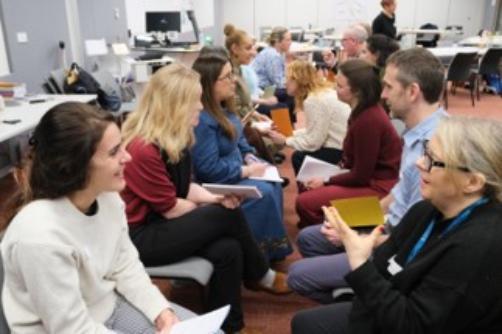
The realpolitik… how do we do it?
Those of us who have developed facilitation skills are regularly approached by colleagues from across our universities: people who want help designing and hosting workshops within change processes, strategic development sessions, and cross-team working.
However, there is very rarely a budget to commission external facilitators to support these opportunities, and the process of bringing in an external facilitator also means that these skills don’t dwell within and inform culture on a daily basis (which we believe is a key aspect to the research culture challenge).
Even when the will is there, leaders can't always identify or access the skills, confidence, or support they need to facilitate effective collaborative processes themselves. The result is that the potential of these methods remains locked up in a small number of people, rather than spread across the organisation — and particularly across hierarchies — where it could do the best.
What facilitation training does exist across the UK University sector tends to be expensive, drawing on stretched training budgets, and the knowledge it generates often walks out of the door when individuals move on. There is no shared infrastructure, no common language, and no easy way for those with skills to support those who are developing them.
With all the above in mind, taking the first steps towards closing this gap is a key part of our project. The structure of our project, beginning with the design and delivery of a series of training workshops developed with the higher education context in mind, is just the first step. From this point, we seek to cascade these skills out through a community of practice, to support others within our institutions in developing their own facilitation methods. In the same way that alumni of leadership programmes support subsequent cohorts through mentorship, peer community, and facilitation, we want to pool resource, retain institutional knowledge, and grow something that outlasts any individual.
The retaining of this knowledge is precisely why developing a community of practice is such a key part of our ambitions. As well as the more top-level benefits such as acting as a resource repository and directory for those looking to develop their skills, we hope that by developing a community we will also be able to create a genuinely open and participatory space, of the kind that we feel research culture could benefit from moving towards! In short, a space where Collective Leadership is already embedded, rather than in the process of embedding!
So, how’s it been? Here’s how some participants described the training:
“A really practical course that opens up new ways of getting fuller engagement and better outputs from of meetings and workshops.”
“The ‘learning by doing’, where we were encouraged to think about the activities we had been asked to do and why they were chosen, what made them successful and how they achieved the purpose - this really drove home all the learning for me.”
“Not only do you understand how to plan a good workshop, you understand how to get true value from a session and translate that into something tangible. No more meetings for the sake of having meetings!”

Where we’re at, where we’re going…
So far, as part of this project, we’ve held our specially adapted courses from our partners Centre for Participatory Leadership – Leading in Complexity, Groundwork in Facilitation and Art of Participatory Leadership. Through these workshops, we’ve trained over 100 staff across University of Edinburgh, University of Glasgow and University of St Andrews. We’ve also started to build our community of practice, meeting every six weeks since November 2025.
We are now developing our how to guide for others in the higher education sector, which we hope to distribute far and wide. We hope our outputs can help those who are exploring this space and hope to offer support to colleagues in other Universities to embed Collective Leadership Practices in their institutions.
If you’d like to receive a copy sent straight to you, please sign up via the QR code below, or via this link.

First published: 25 August 2026