Building Connection, Confidence and Culture: Reflections from the SRTP Academy
Published: 10 June 2026
Written by Mohammad Ali Salik, this insightful blog reflects on the Scottish Research Technical Professionals Academy, a cross institutional programme across Glasgow, Edinburgh and St Andrews. It highlights how fostering connection and community helped technical staff build confidence, recognise their value and leadership potential, and shows how small relational interventions can positively shape research culture, while underlining the need for sustained institutional support.
Written by Mohammed Ali Salik, SRTP Academy project lead, University of Glasgow
Building Connection, Confidence and Culture: Reflections from the SRTP Academy
When we set out to establish the Scottish Research Technical Professionals Academy, the ambition was clear: to create a space where technical professionals could connect, develop, and be recognised as integral contributors to research.
What was less clear was how that ambition would unfold in practice.
This blog post reflects on that journey: not just the outcomes, but the moments of learning, the unexpected shifts in direction, and the quieter changes that began to reshape how technical professionals see themselves, and how they are seen by others.
Starting with a gap
The Academy emerged in response to a familiar but persistent set of challenges. Across institutions, Research Technical Professionals (RTPs) often described These challenges are shaped by a combination of factors, including unclear or non-linear career structures, limited formal recognition of technical expertise within research leadership, and differences in how technical roles are defined and supported across institutions. In many cases, technical contributions are critical to research delivery but are not consistently visible within institutional systems.
There was no single solution to these challenges. But there was a clear opportunity to create something that didn’t exist : a space that was cross-institutional, collaborative, and centred on the needs of technicians themselves.
From the outset, the vision for the Scottish Research Technical Professionals (SRTP) Academy combined structure with flexibility: a programme that could offer leadership development, mentoring, and networking, while also responding to the lived experiences of participants.
What we built (and what emerged)
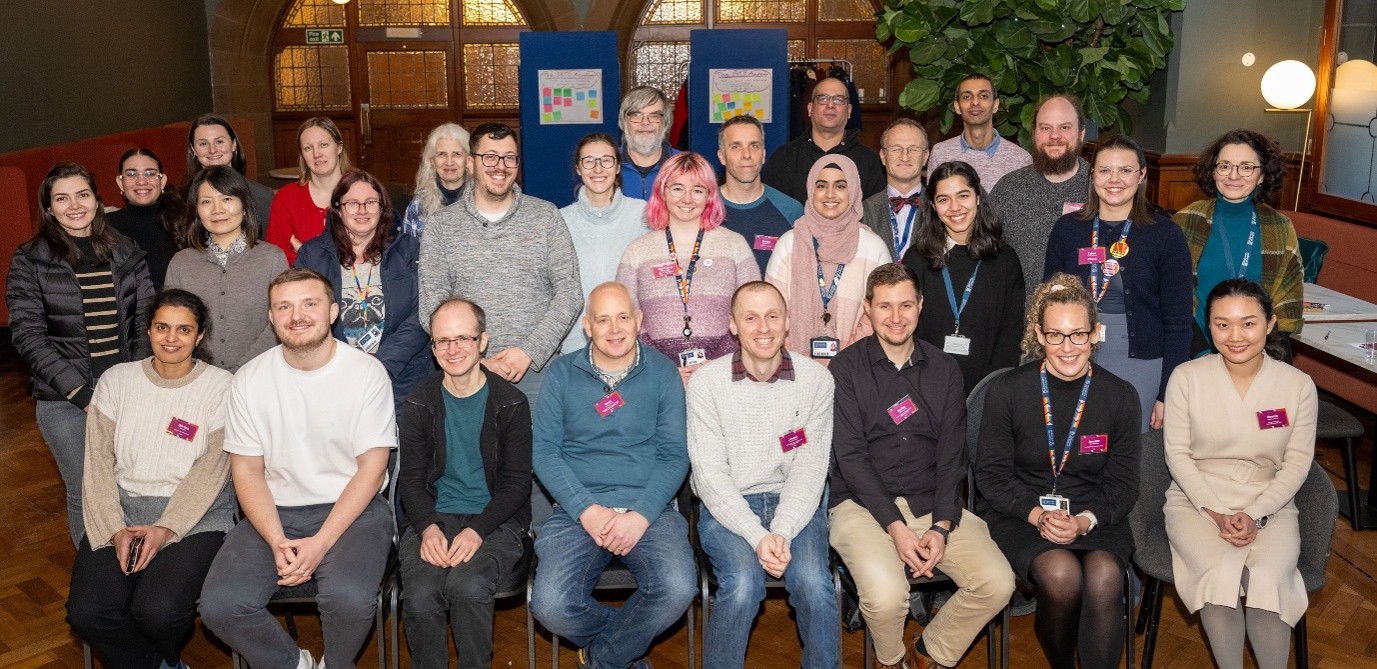
The SRTP Academy brought together technical professionals from the Universities of Glasgow, Edinburgh, and St Andrews through a co-designed programme of workshops, mentoring opportunities, networking events, and collaborative learning activities.
But as the project developed, something important became clear.
While the programme included training and structured development, its strongest impact was not in formal skills acquisition. Instead, it was in something less tangible, but arguably more powerful – connection.
Participants spoke about:
- feeling less isolated
- gaining confidence in their role and expertise
- building relationships across institutions and disciplines
- recognising their own leadership potential
In many cases, these were shifts that had not been enabled within their home institutions. Participants reflected that opportunities for this kind of development are often limited by workload pressures, localised ways of working, and a lack of structured space for cross-institutional connection. Technical roles can be highly specialised and, at times, isolating, meaning that opportunities to share practice, build networks, and reflect on professional identity are not always readily available within day-to-day work.
A shift in focus: from structure to community
Originally, the project placed significant emphasis on mapping technical roles and building structured development provision. While these elements remained important, the centre of gravity shifted. The Academy became, primarily, a relational intervention.
The most meaningful outcomes were those that strengthened peer networks, gave an increased sense of belonging, built confidence to engage and contribute and fostered a willingness to take on leadership and mentoring roles
This shift was not planned, but it was revealing. In practice, refocusing the SRTP Academy was both organic and intentional. Early sessions highlighted the value participants placed on discussion, peer exchange, and informal connection. In response, we adapted elements of the programme to create more space for this, while retaining core structured activities. This flexible approach allowed the Academy to respond to participant needs in real time and to place greater emphasis on relational learning.
It highlighted that culture change doesn’t end at systems or policies, it requires the insights that emerge from people, and the relationships between them.
The reality of doing this work
Not everything was straightforward.
In delivering a more responsive programme time pressures were a consistent challenge, both for participants and for those delivering the programme. Engagement varied across institutions, shaped by local context, workload, and existing infrastructure.
Working across three universities also required ongoing coordination, negotiation, and adaptation. What worked well in one context did not necessarily translate directly to another.
These challenges were not barriers in themselves, but they highlighted an important truth – creating space for development and connection requires institutional support.
Without protected time and recognition, even the most valued initiatives struggle to reach their full potential.
What we learned about ‘Changing what counts’
The SRTP Academy was rooted in the Culture Catalyst Fund theme of Changing what counts: challenging traditional ideas of what is valued in research.
Through the project, this theme became more concrete.
We saw that:
- leadership is not confined to formal roles
- contribution is not limited to publications or grants
- community-building, mentoring, and collaboration are central to building a better research culture
And yet, these are the areas least consistently recognised across institutions.
The Academy created space for these contributions to be visible, and for participants to recognise them in themselves.
Looking ahead
The end of the pilot is not an endpoint. If anything, it marks the beginning of a new phase.
The evidence generated through the project shows that relatively small, targeted interventions can have meaningful impact on confidence, collaboration, and engagement. It also demonstrates the value of cross-institutional approaches in addressing shared challenges.
The next step is to build on this foundation by embedding this work within institutional strategies. We also seek to strengthen cross-sector collaboration and to ensure that technical professionals are not only included, but recognised, supported, and empowered. This will be a process of many conversations to share our findings, and to try to secure the needed resources to sustain momentum.
A final reflection
One of the most powerful insights from the Academy is a simple one.
When technical professionals are given space to connect, reflect, and develop, the impact extends beyond individuals. It begins to shape how teams work, how institutions think, and how research is done. This reinforces that culture change is not only about designing programmes but about creating the conditions in which people can connect, contribute, and be recognised.
The challenge now is not whether this works, we know that it does.
The challenge is how we sustain it.
First published: 10 June 2026