

Research breakthrough could enable ultra-sensitive quantum chemical sensors
Published: 9 October 2026
University of Glasgow researchers are part of an international collaboration which could lead to a new generation of quantum sensors.
University of Glasgow researchers are part of an international collaboration which could lead to a new generation of quantum sensors.
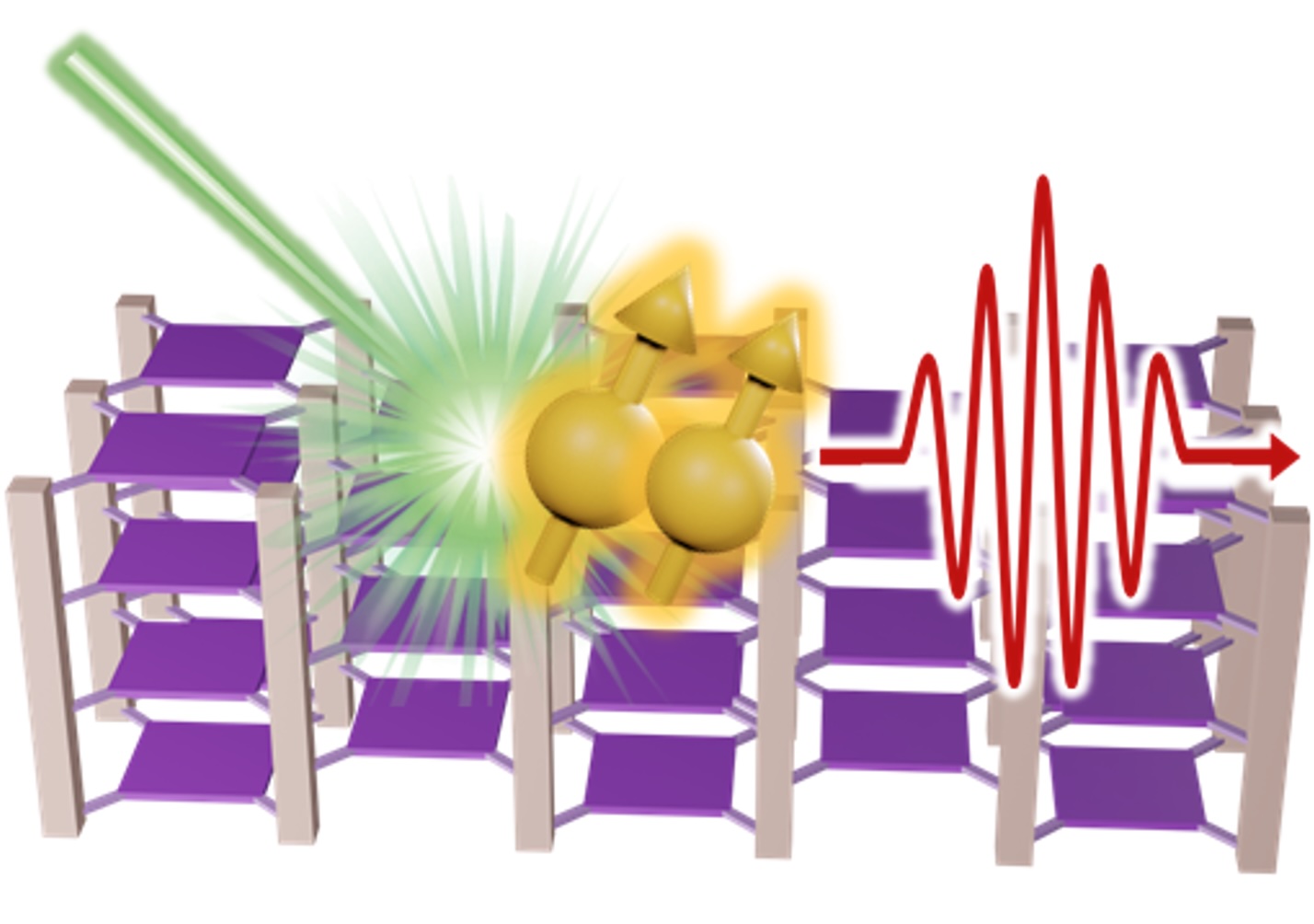
The team, which spanned researchers from the University of Tokyo, Glasgow, Sheffield, and Kobe have for the first time used light to read out the magnetic spin of electrons trapped inside a porous crystalline material known as a metal-organic framework (MOF).
The team’s work builds on previous research into a method of detecting electron spins using light called optically detected magnetic resonance, or ODMR. The technique has attracted attention as a useful method for reading out spin qubits in quantum sensing.
The development marks an important step towards using MOFs, which have been regarded as promising materials for quantum sensing applications, to detect chemical substances with extraordinary sensitivity in future sensing devices.
Dr Sam Bayliss and Dr Alistair Inglis of the James Watt School of Engineering led the University of Glasgow’s contribution to the research. Colleagues from the University of Tokyo, University of Sheffield, Saitama University, JEOL Ltd., the Institute for Molecular Science and Kobe University also collaborated on the development of the new results.
Dr Bayliss said: "MOFs are essentially molecular scaffolds. They are rigid and porous structures that our colleagues synthesised at the University of Tokyo, and have great potential for sensing applications. At the University of Glasgow's Advanced Research Centre, we read the magnetic state of spins held inside one of these frameworks using light, through optically detected magnetic resonance. It is the first time anyone has measured spin resonance this way in this type of material.”
Dr Inglis said: “The exciting thing is that spin resonance tells us not only about the molecules themselves, but also about the environment they exist in, which means these materials could be used as sensors. And because these MOFs are porous, we can, in principle, load target molecules into the scaffold and read them out using the same technique, offering sensing on a molecular scale. The next step is pushing this to work at more practical temperatures and tuning the chemistry to make the signal stronger."
Electronic spins detectable by light can be detected with higher sensitivity and spatial resolution compared to electron spin resonance, or ESR, which relies on microwave detection. That makes them well-suited for quantum sensing, and they have been the subject of intense research in recent years.
Diamond nitrogen-vacancy centres are one well-studied example of optically detectable electron spins. Because they use spins present in defects within the crystal, however, there are limitations to their controllability, and their interactions with external substances.
Spins derived from molecules, by contrast, are chemically controllable - their structures can be designed and their spin properties adjusted. Metal-organic frameworks go further still, controlling the position and orientation of electron spins all within a porous material.
Since they are porous, target chemical substances can be adsorbed within the pores and detected by inducing close-range interactions with the spins. Given these advantages, MOFs have been regarded as promising materials for quantum sensing; however, optical detection of spins within MOFs had not been demonstrated before this study.
Since MOFs are materials that can be designed in a wide variety of ways by changing ligands and crystal structures, the team say their demonstration could be extended to many related materials. A library of such MOFs, each responding differently to particular chemicals, could act as a 'quantum nose', identifying substances based on their response patterns.
The team’s paper, titled ‘Optically Addressable Spins in a Metal-Organic Framework’, is published in the Journal of the American Chemical Society.
First published: 9 October 2026
Related links