

New research gives 3D-printed materials the ability to detect and map damage
Published: 30 September 2026
An international team of engineers has adapted a medical imaging technique to give 3D-printed materials the ability to sense where they are being damaged and track how that damage develops in real time.
An international team of engineers has adapted a medical imaging technique to give 3D-printed materials the ability to sense where they are being damaged and track how that damage develops in real time.
The research, led by academics from the UK and Australia, could help pave the way for new generations of ‘self-sensing’ metamaterials made with intricate lattice structures which are custom-designed to prioritise characteristics like weight, strength, impact resistance, or flexibility.
These materials could find use in medical implants, aircraft parts or the bodies of cars in the years to come, allowing detailed feedback on the condition of the materials used in the parts as they degrade with age or suffer strains caused by impacts.
The team’s new approach is made possible by incorporating carbon nanotubes into plastic structures that are architected and 3D-printed with precise arrangements of struts and spaces, giving them a lattice-like structure.
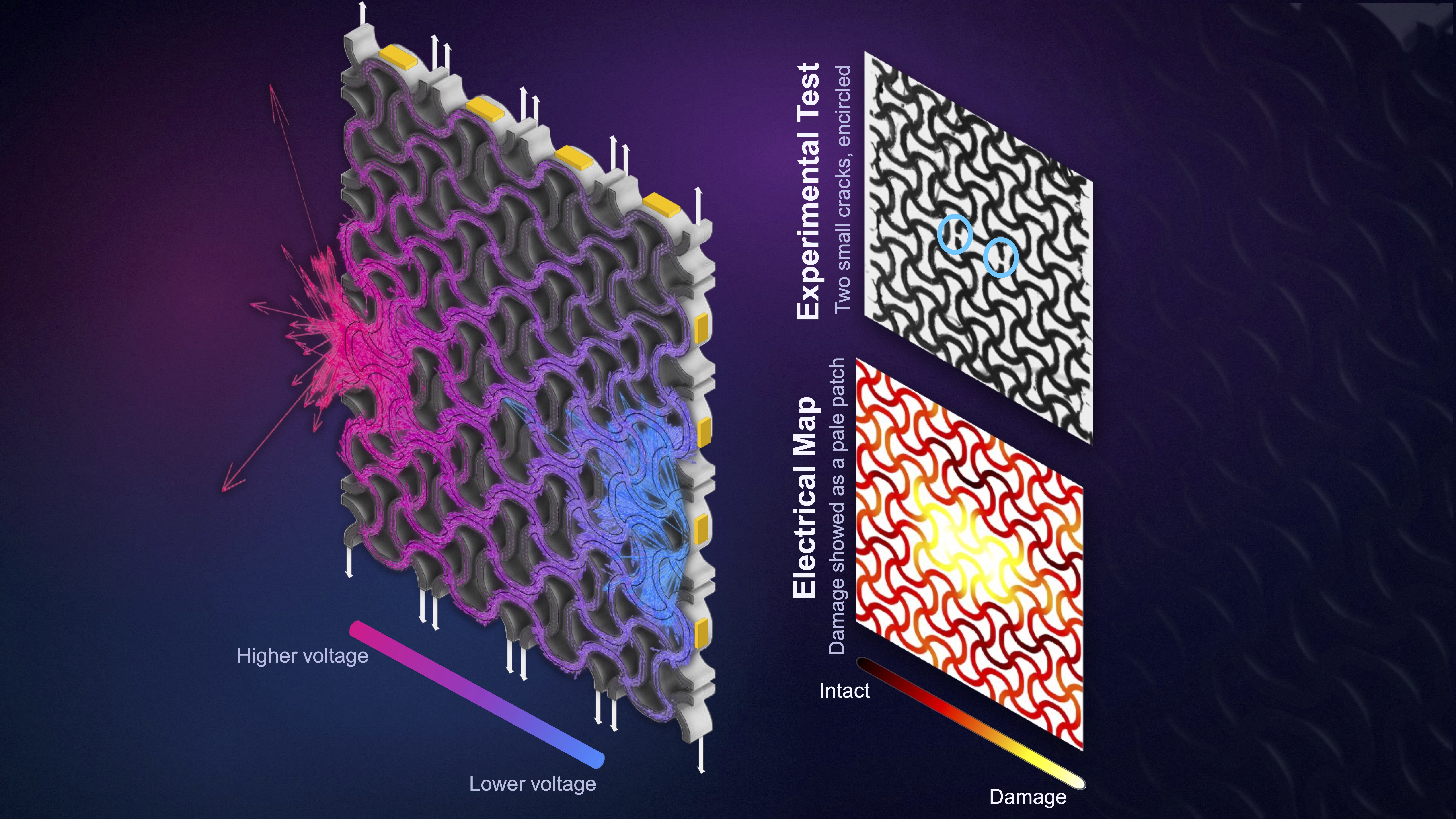
By passing current through the carbon nanotubes via electrodes attached to the materials, the team can harness an imaging technique called electrical impedance tomography (EIT) to monitor the structural health of the material as it experiences external loads. The team believes their new research, published as an Early View paper in the journal Advanced Functional Materials, is the first reported use of in situ EIT to monitor damage in 3D-printed architected metamaterials.
EIT is often used in medical settings to monitor patients’ lung function during stays in hospital. It works by using electrodes to take continuous measurements of how electricity flows through materials such as human tissues. Analysis of these measurements enables images of the interior of the material to be reconstructed without invasive procedures, allowing changes to be tracked in real time.
In the team’s research, they used EIT to map changes in electrical conductivity across the structure by passing current and measuring voltage differences through external electrodes attached to structures that they designed and printed in the lab as they were stretched until breaking point. The lattice specimens were rectangular structures measuring 48 millimetres across.
The research builds on years of previous work from the University of Glasgow’s Sustainable Multifunctional Materials and Additive Manufacturing (SM2AM) Lab, led by Professor Shanmugam Kumar.
Traditional sensing methods measure changes in electrical resistance/conductivity at specific points, which can work well for simple structures but cannot show what is happening throughout complex metamaterials.
In 2024, the SM2AM lab developed a sophisticated modelling framework that could predict how the electrical conductivity of lattice materials changes when they are stretched or compressed. However, the approach is relatively complex. To address this, the team used EIT to monitor changes in conductivity across the whole structure, rather than only at individual points.
As the materials stretched, the conductive pathways within the lattice changed, altering the way electricity flowed through the structure and the voltages measured at its surface. These changes in electrical behaviour provided information about how the structure was deforming and where damage was developing.
A computer algorithm translated these changes in voltage into real-time maps showing how the electrical properties of the structure were changing as damage developed. The system showed where damage was developing and how it was progressing, including damage occurring away from the electrodes used to make the measurements.
The system also highlighted where damage was building up before the lattice broke, providing what could be the basis of an early-warning system in future practical applications. The team’s findings were validated by comparing the system’s results with direct observations of the structures, confirming that it accurately identified where damage developed and where the structures eventually failed.
The maps produced by the algorithm could localise damage to within approximately one strut of its actual location. The researchers also pushed the limits of the system’s ability to detect damage by deliberately building in tiny cracks in some of the struts. They found that they were able to track the cracks as they spread outwards under increasing strain.
Professor Kumar, of the James Watt School of Engineering, said: “In this research, we’ve developed a new way to map electrical changes across an entire 3D-printed lattice structure in real time. The output is somewhat like an MRI scan: just as an MRI can show what is happening throughout the body, our approach allows us to see how different parts of the lattice are responding while it is under strain. The engineered lattice architectures enable control over sensing fidelity.
“Conventional measurements can tell us what is happening at a particular location in a material, or provide an overall, averaged indication of the structural health of the whole structure. However, they cannot show us in detail where damage is developing and how it is spreading throughout the structure. Our research shows that, by combining carefully designed lattice structures with EIT, we can obtain this much richer picture of structural behaviour, including detecting damage before the structure ultimately fails.
“This technique could open up potential applications in areas such as structural health monitoring and other advanced engineering systems, although further work is needed to develop and scale the technology for practical applications.”
Akash Deep and Professor Andrew McBride from the University of Glasgow contributed to the research and co-authored the paper, alongside Dr Andrea Samore and Professor Alistair McEwan from the University of Sydney.
The team’s paper, titled ‘Full-Field Damage Monitoring in Architected Lattices Using In situ Electrical Impedance Tomography’, is published in Advanced Functional Materials. The research was supported by the University of Sydney–University of Glasgow Ignition Grants, and by a Vaibhav Fellowship awarded to Professor Kumar by the Indian National Academy of Engineering and India's Department of Science & Technology.
First published: 30 September 2026
Related links