

Monumental paintings set to be installed at Kelvin Building
Published: 20 May 2026
Two vast paintings inspired by one of the most ambitious scientific theories proposed by physicist Lord Kelvin will be unveiled at the University of Glasgow this June.
Two vast paintings inspired by one of the most ambitious scientific theories proposed by physicist Lord Kelvin will be unveiled at the University of Glasgow this June.
Created by Scottish artist Gregor Harvie, The Light Universe and The Dark Universe will be permanently installed in the newly refurbished Kelvin Building from 4 June 2026, coinciding with the start of the Glasgow International Festival of Contemporary Art and the Glasgow Science Festival.

The monumental works use artificial intelligence, advanced 3D computer modelling and layered painting techniques to reconstruct Kelvin’s all-pervading ‘ether’, a theory for the structure for the universe.
Throughout history, there has been a recurring intuition that 'empty space' isn’t empty at all but filled with something continuous. In ancient Greece, the primordial god 'Aether' was a divine substance filling the heavens. In Victorian times, the idea of an ether was used to explain how light could travel through a vacuum, and in 1887, Glasgow’s Lord Kelvin proposed the Kelvin Cell as the most efficient possible solution.
Working with researchers from Glasgow University’s Quantum Theory Group, artist Gregor Harvie has digitally recreated thousands of interconnected Kelvin Cells to form a complex lattice that is the basis of his two paintings. The Light Universe is a luminous field of flowing colour and energy representing the visible, measurable cosmos. The Dark Universe is more unsettling, a fragmented monochrome patchwork inspired by dark matter and dark energy, which together are believed to make up 95 per cent of the universe, but are largely unexplained.
The Light Universe and The Dark Universe were commissioned to celebrate the bicentenary of the birth of Lord Kelvin. Artist Gregor Harvie developed the paintings during a year-long affiliation with the Quantum Theory Group at the University of Glasgow. The works are based on Kelvin’s 1887 proposal for the geometric structure of space, known today as the 'Kelvin Cell' - a doubly curved truncated octahedron which Kelvin believed could divide all of space with maximum efficiency and minimum surface area.
Professor Stephen Barnett, Head of the Quantum Theory Group at the University of Glasgow, said: “It’s fantastic to see Kelvin’s idea brought to life in these extraordinarily beautiful paintings. Kelvin imagined an astonishingly sophisticated geometry for the structure of space nearly 140 years ago using only pencil and paper. The ether is a concept that scientist have come back to again and again, and is one we still see aspects of in ideas like quantum field theory.”
Professor David Ireland, Head of the School of Physics and Astronomy, said: “These paintings are a fitting tribute to one of Kelvin’s most profound ideas and to the refurbished Kelvin Building, home of the School of Physics and Astronomy. Kelvin himself tried to build a model of his ether using wire and soap bubbles, but it is only now, with the help of computer modelling that we can see it in its full glory.”
Using 3d computer modelling, Gregor reconstructed thousands of interconnected Kelvin Cells to create a large-scale 3d lattice that was then painstakingly translated into two painted compositions.
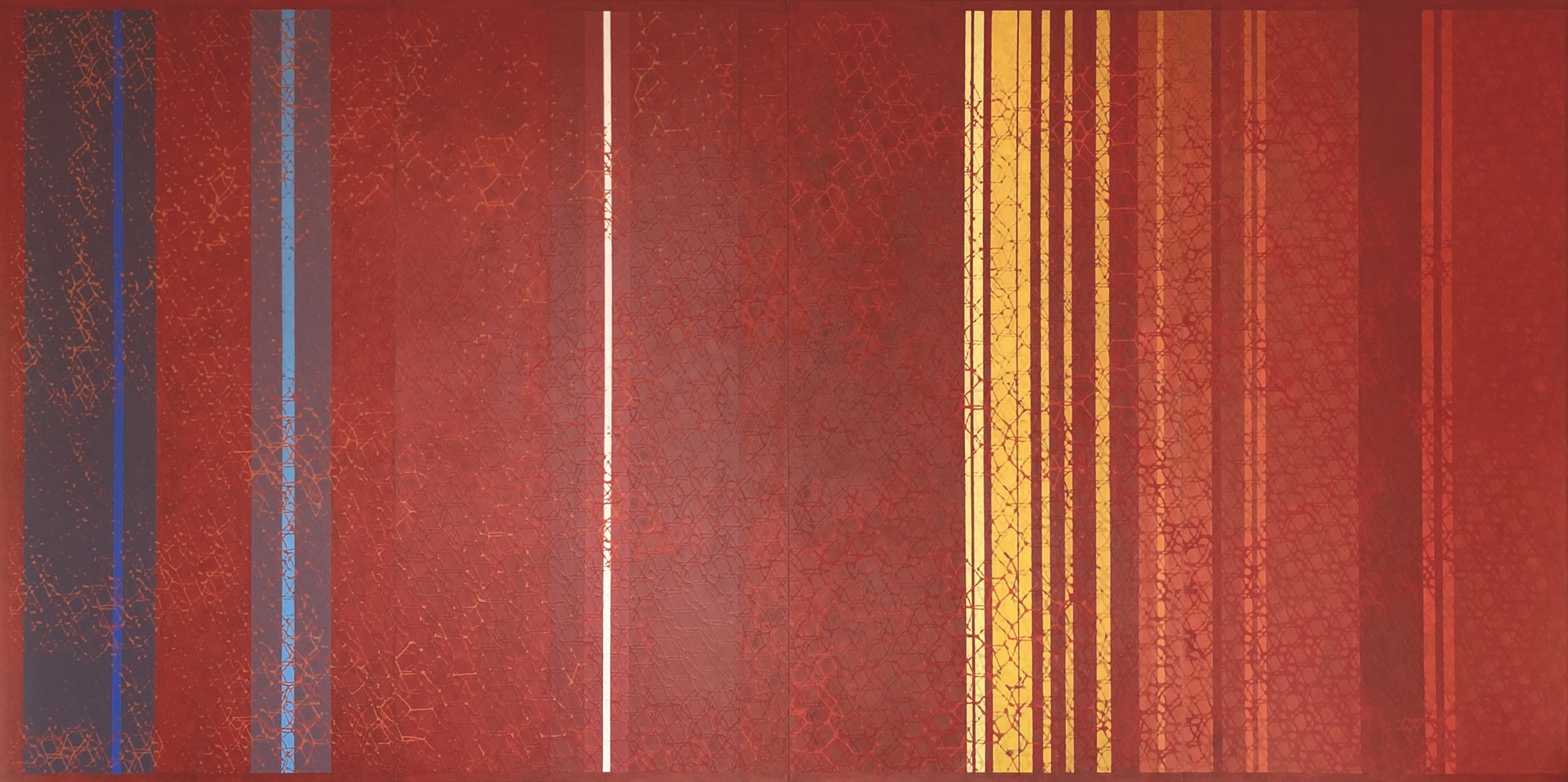 The Light Universe represents the observable universe - the matter, energy and physical processes that science has successfully measured and classified. The flowing, coloured lines moving through the ether combine Kelvin’s colour temperature scale and the emission spectrum of carbon, an element fundamental to life on Earth.
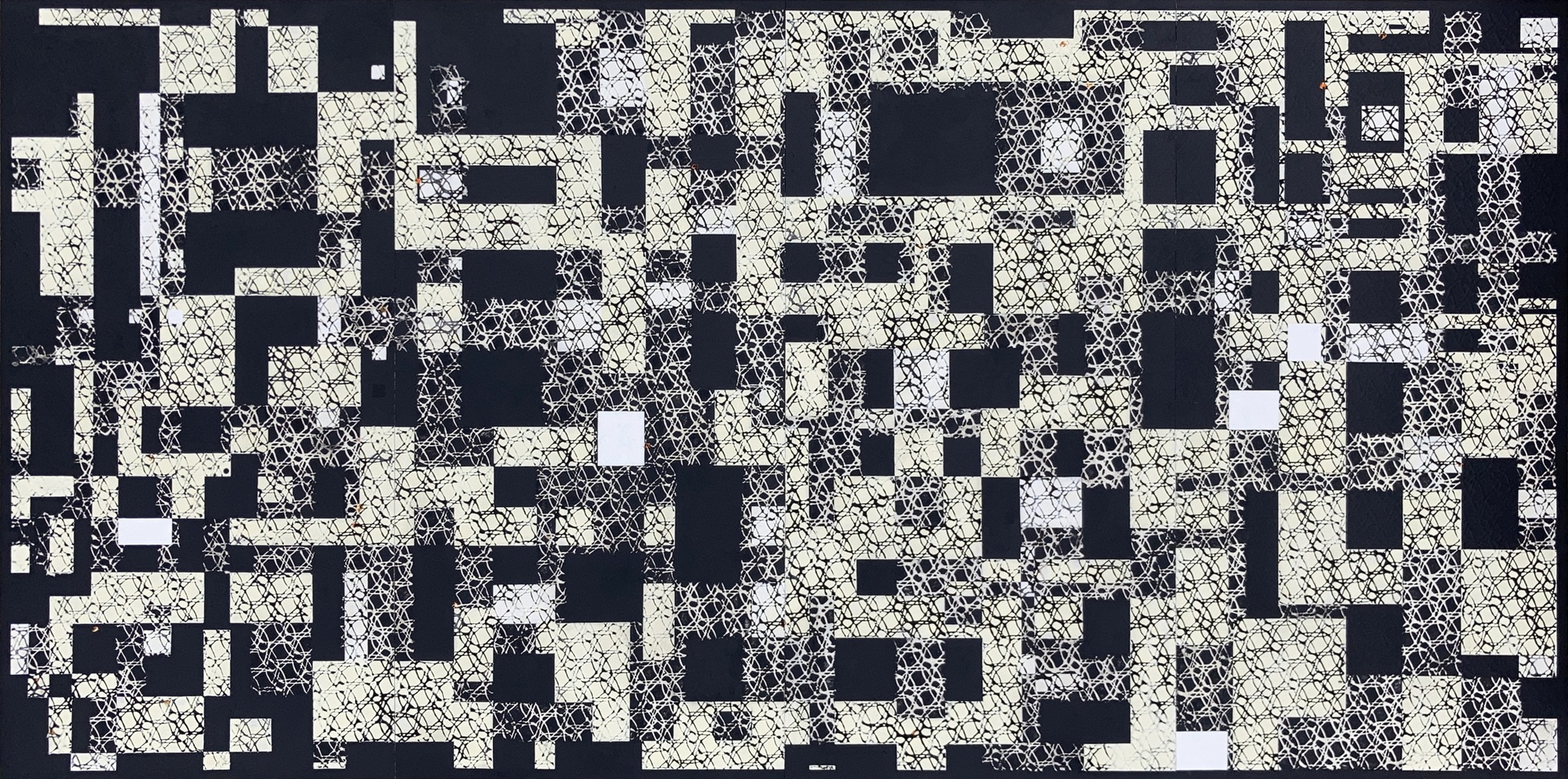 The Dark Universe explores the unknown - particularly dark matter and dark energy, which together are thought to account for 95 per cent of the universe. Unlike the ordered structure of The Light Universe, this work is deliberately disorientating. While the underlying geometry remains Kelvin’s ether, it is obscured by shifting black-and-white structures, conflicting patterns and fragmented forms. Elements of the composition were developed using AI-generated interpretations of dark matter and dark energy, creating an intentionally uncertain and unstable visual language.
Artist Gregor Harvie said: “Kelvin’s ether is both mind-bendingly complex and breathtakingly simple. As an artist, the idea that there might be an invisible structure underpinning everything is deeply compelling - something we cannot see and cannot do without. These paintings explore the tension between what we can measure and describe and what still lies beyond our understanding.”
Professor Declan Diver, academic lead for the refurbishment of the Kelvin Building, said: “The Kelvin Building brings together two landmark listed structures by celebrated architects James Miller and Basil Spence. Our major refurbishment programme is now nearing completion, creating a modern, accessible environment with new entrances, a pedestrian bridge, lifts and upgraded facilities. We are delighted that Gregor’s remarkable paintings will form a focal point within the original entrance foyer, transforming the space with ambitious, thought-provoking works that connect art, science and the history of the building itself.”
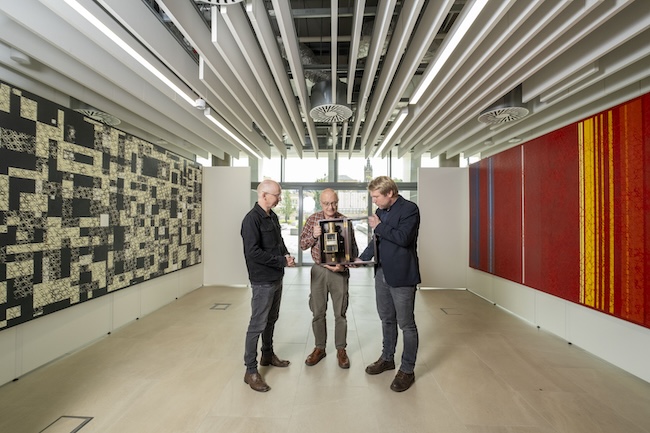
Artist Gregor Harvie (left) examines a voltmeter designed by Lord Kelvin with Professor Stephen Barnett (centre) and Professor Jörg Götte (right) of the University of Glasgow’s School of Physics & Astronomy. Professor Götte was instrumental in arranging the Lord Kelvin: Beyond Absolute Zero exhibition at the ARC in 2024.
The two paintings were originally exhibited for two weeks as part of the Kelvin Bicentenary Symposium in 2024 in the Advanced Research Centre at the University of Glasgow.
The paintings will be on permanent display in the first-floor foyer of the Kelvin Building at the University of Glasgow from 4 June 2026.
First published: 20 May 2026