

Resolving Minor Instances of Misconduct
Informal resolution is preferred for minor workplace conduct issues, focusing on swift, non-punitive resolutions where appropriate. A thoughtful conversation at the right time can correct behaviour without formal action. Formal action has its place, where appropriate (e.g. more serious or repeat behaviours), but it can place strain on wellbeing and/or relationships and should only be considered where necessary.
Addressing minor misconduct early prevents escalation, fosters a positive work environment and prioritises support over disciplinary steps however it may not be appropriate or successful in all circumstances. Line managers should consider the circumstances on a case-by-case basis and decide on the appropriate course of action.
Some typical but non-exhaustive considerations are noted below:
When Informal Resolution is Appropriate:
- When the issue is relatively minor or a less serious first-time occurrence (e.g. poor timekeeping, carelessness or negligence causing no serious difficulty or inconvenience, slight uncooperativeness, minor discourtesy towards others).
- When the colleague acknowledges the relatively minor problem or issue and is committed to making changes.
- Where the behaviour doesn’t contravene University policies in a serious way.
When Informal Resolution may not be suitable:
- For repeated or more serious misconduct (including gross misconduct – see Gross Misconduct Appendix 1).
- Where formal investigation or procedures are required due to a lack of information (that can’t easily be obtained) or to ensure fairness or legal compliance.
Managers can seek guidance from their local People & OD (P&OD) Business Partner if required, particularly where there is a lack of clarity.
Resolving Informally - Process:
The following steps should be taken by the relevant manager, typically the line manager, when addressing minor instances of misconduct:
- Managers should prepare in advance by thinking about what they are ultimately trying to achieve through the discussion and planning out the issues they intend to cover, as well as the questions they plan to ask. This can help to ensure the meeting is productive as possible for both the manager and the colleague. Managers should also collect and prepare any evidence or documentation to which they plan to refer to during the conversation.
- The University promotes open and constructive dialogue between managers and employees to enable the prompt and informal resolution of minor misconduct issues, consistent with other processes.
- This conversation is informal and is not a formal disciplinary meeting. Colleagues should be made aware of the informal context of any discussion to avoid any confusion or undue concern around formality. Emphasising the informal nature of these discussions can avoid undue stress, aligning with the spirit of supportive resolution or correction of behaviour without hastening formal escalation.
- Due to the informal nature of these discussions, colleagues would not normally be accompanied by a Trade Union Representative. Managers may, by exception and at their own discretion, determine if the circumstances of the case would benefit from an individual being supported by a Trade Union (TU) representative. In such cases the discussion should not be unnecessarily delayed and care should be taken (as per points above) to emphasise the informal nature of the discussion.
- The success of the conversation can be influenced by a wide range of factors, including the skill and awareness of those involved. The aim is to clearly communicate the expected standards and the areas that require improvement.
- Help the colleague understand the issue, giving them an opportunity to correct the behaviour. The focus should be on identifying ways to improve behaviours and ensuring that the improvement is sustained.
- Encourage the colleague to share any underlying factors that may be contributing to the issue, such as personal challenges or workplace difficulties.
- Identify any support options, such as additional training, mentoring, or other resources, which may be offered to help the colleague meet the required standards.
- Set a clear timeframe for the colleague to demonstrate improvement. While the discussion remains informal, the manager should make it clear that if the issue persists, it may proceed to the formal stages of the Disciplinary Policy.
- Informal discussions are typically not recorded in formal disciplinary records. However, it is important that managers confirm in writing what is agreed / to document the conversation for future reference, should the case progress any further. Managers should provide clear feedback and guidance on what is expected of the colleague and outline any potential consequences if the issues are not addressed properly. To support this, the University has developed an online form designed to assist with the informal recording of such discussions. Managers are encouraged to use this resource where appropriate or beneficial. Managers can access the Resolving Minor Instances of Misconduct Form through the People & OD Helpdesk.
- Failure to keep any record of informal discussions (including expectations of improvement) can result in ambiguity, including at a later date when referring back to earlier conversations.
- There is no specific legal requirement on how long an employer must retain records of informal discussions regarding minor misconduct, but it is generally considered good practice to keep such records for a reasonable period, typically 6 to12 months, depending on the nature of the issue, and the University aligns with this good practice. This ensures that records can be referred to if similar issues arise within the outlined timeframe and that the record is removed after the agreed retention period.
- If, during the discussion, it becomes evident that the matter is more serious than initially thought, the meeting should be adjourned. Guidance and support must be sought from the relevant People and OD Partner. The colleague should be informed that, due to the matter appearing more serious than initially anticipated, it is necessary to adjourn the meeting to obtain further advice and determine the appropriate next steps. The matter may then proceed under the formal disciplinary procedure.
- If it becomes clear during the discussion that there is no issue, this should be clearly communicated to the colleague.
- A follow-up meeting may be held to assess whether the improvements have been made and whether further action is necessary. If the issue is resolved, no further action is needed. If not, the manager may consider moving forward with a formal disciplinary process.
Managers who want to build on their knowledge or refresh their skills can register for the Effective Conversations Bitesize session offered by Organisational Development, or alternatively explore the full range of courses available.
A simple but helpful model is highlighted below which shows an effective conversation cycle across 4 distinct stages:
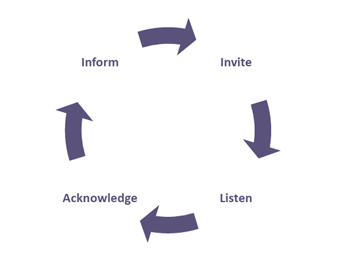
Inform: Provide information or explanation, so that the colleague knows what the discussion is focussing on.
Example: I’d like to discuss the number of times you have been late for work this month.
Invite: Ask a question relevant to the information given at the inform stage in order to seek input from the colleague and to bring them into the conversation.
Example: I’ve noticed you have been arriving late for our 9.30am meetings over the last month. When you are late it impacts the team’s ability to stay on track. I wanted to understand if there is something going on that’s making it difficult for you to get here on time.
Listen: Actively listen to the colleague’s response. Utilising non-verbal communication while the speaker is talking, such as maintaining eye contact and nodding may help the colleague feel more at ease and confident that what they are saying is being heard and understood. A degree of interruption can be appropriate here in order to ensure a point is understood, although interruptions should not be to an extent that they detract from the colleague being given the chance to respond.
Acknowledge: Having listened to what they colleague had to say on a given point of discussion, managers should demonstrate that they have listened and understood by acknowledging what was said. Language such as ‘Ok, I understand’ or ‘I Appreciate that’ alongside a degree of paraphrasing/feeding back can help to acknowledge what was said.
Example:
Manager: From what you have said, I understand that you have been having some trouble with your morning commute as there has been a lot of construction and it’s thrown off your routine. I understand unexpected things like construction can be disruptive, I appreciate you being honest about what’s going on. Would adjusting your routine slightly or leaving earlier be possible to allow you to arrive for work on time? Alternatively, if there is a more systemic issue, we can consider flexible solutions, which ensure you to arrive for work on time.
Colleague: I think leaving earlier is doable-I just need to adjust my alarm and prep for the day the night before. If that doesn’t work, I will let you know.
Manager: That sounds like a plan. Let’s check in after two weeks to see how things are going. Does that work for you?
Colleague: Yes, thanks for understanding.