


Experiential Learning Case Study: Simulated Practice
|
Title of case study |
Simulated Practice: Multi-agency major incident simulation |
|
School / subject |
Health and Care |
|
Lecturer |
Liz Simpson |
|
Course |
BN (Hons) Nursing |
|
Student Level |
Undergraduate and Postgraduate |
|
Class size |
15 nursing students, 4 medical students, 4 paramedicine students and 10 multimedia journalism students. |
|
Location |
Albert Bridge Glasgow, River Clyde |
Brief summary
The BN (Hons) Nursing programme participated in an immersive major-incident simulation in Glasgow city centre, organised by the Scottish Fire and Rescue Service (SFRS). The live, large-scale scenario stretched 1km along the River Clyde and featured a minibus crash into the river, triggering a multi-vehicle collision. Members of the public were also in the water, having jumped to avoid the impact. This created a rare opportunity for students to experience a realistic and dynamic major incident in a safe environment.
Over 100 participants took part, including University of Glasgow students from nursing, medicine and paramedicine; multimedia journalism students from Glasgow Caledonian University; educators from NHS Lanarkshire and colleagues in emergency response and trauma care from NHS Greater Glasgow and Clyde (GGC) and NHS Lanarkshire. Additional professional partners included:
- Scottish Fire and Rescue Service (SFRS)
- Glasgow Humane Society
- Police Scotland
- Royal National Lifeboat Institution (RNLI)
- Coastguard
- Glasgow City Council
- Scottish Environment Protection Agency (SEPA)
- Clinical Skills Managed Education Network (CSMEN)
This collaboration reflected the teamwork required in real incidents. Students were deployed in rescue teams, casualty roles and live news crews, gaining hands-on experience in clinical care, triage and media reporting. The exercise was supported by detailed casualty storyboards, scenario planning and oversight from multiple emergency services, ensuring both psychological and physical safety.
After the simulation, students engaged in debrief sessions, with some submitting abstracts to a national simulation conference and several presenting their work.
Overall, the exercise allowed students to develop essential future skills, including communication, decision-making, teamwork, adaptability, interprofessional collaboration and reflective practice.
Unlike traditional ‘tabletop’ exercises, this live, city-scale event provided an unparalleled opportunity to experience the realities of a major incident in a safe but highly dynamic environment offering the closest possible preparation before encountering such events in practice.
Objectives
- To design and deliver an immersive, realistic major incident simulation.
- To engage multiple disciplines in collaborative, interprofessional learning.
- To provide a high-pressure environment that fosters teamwork, decision-making and coordinated professional response.
What is done?
The scenario unfolded in the city centre during rush hour on a wet Wednesday morning. On scene were the SFRS, including both land and water rescue and Police Scotland and was supported by the RNLI, coastguard, Glasgow Humane Society, Glasgow City Council and the Scottish Environment Protection Agency (SEPA). Safety oversight for the simulation was provided by representatives from SFRS and Police Scotland.
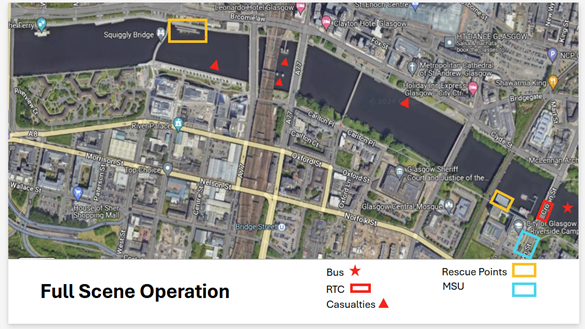
We were deployed to the Albert Bridge and a pontoon by the River Clyde to work as part of the response teams to assess, triage and provide emergency care to casualties. We arranged for Scottish Clinical Skills Managed Educational Network’s Mobile Skills Unit to be there and used this as our receiving emergency department. Here, students worked alongside qualified colleagues, taking the lead in the assessment and management of trauma patients.
Each rescue area contained multiple casualties, with individual scenario storyboards created for every individual. These storyboards outlined key details such as the casualty’s gender, age, initial presentation and anticipated clinical trajectory. It also included associated learning outcomes and points for discussion and reflection. They were developed collaboratively with stakeholders to ensure the learning outcomes addressed the needs of all participating disciplines.
Immediately following the event, students joined the multi-agency ‘hot debrief’ led by the SFRS. This was followed by our own structured debrief, designed to consolidate learning and safeguard students’ psychological wellbeing. Feedback was overwhelmingly positive: some students highlighted how experiencing the scenario from the perspective of a casualty or relative deepened their understanding, while others reflected on the lessons learned around teamwork and making clinical decisions both in the field and within the trauma centre.
Multimedia and journalism students participated as television and radio news crews, gaining hands-on experience in reporting major incidents, conducting press conferences and interviewing professionals, emotional relatives, victims and witnesses. This was then reported at the university newsrooms via their news outlets. Footage from this group of students has been subsequently used to develop a classroom based major incident workshop for the undergraduate nursing programme.
Students from medicine, nursing and paramedicine were supported in writing and submitting an abstract of their experience to a national simulation conference. This was successful and three students were funded and supported to attend the conference where they presented their poster.
What works well?
Meticulous planning and collaborative storyboard development were crucial to the simulation’s success and achieving each discipline’s learning goals.
Benefits (students & staff)
Benefits for students:
- Working alongside emergency service colleagues, developing insight into their different roles and priorities.
- Reflection on clinical decisions and patient outcomes during structured debrief sessions.
- Improved understanding of in-hospital processes and the patient journey.
- Recognising the importance of clear, shared communication for delivering high-quality care.
- Experiencing interprofessional collaboration in a realistic, high-pressure setting.
- Developing future skills, including interprofessional collaboration, effective communication, clinical decision-making, adaptability, leadership and reflective practice, all of which will support professional growth.
Benefits for staff:
- Preparation of students in a hands-on, high-stakes simulation while ensuring psychological safety.
- Collaboration across disciplines and institutions, fostering professional networks.
- Building partnerships that lead to further collaborations and enhanced national profile.
- Gaining insights from observing student learning to inform future teaching and curriculum development.
Challenges (students & staff)
Balancing psychological and physical safety
- Challenge: Simulated practice requires learners to feel psychologically safe so they can make mistakes without fear of consequence. In this event, an added layer of complexity arose because some learners took on the role of simulated casualties. This raised concerns about their physical safety in a dynamic training environment.
- Response: Health and safety officers from the emergency services tightly controlled physical safety, ensuring risks were mitigated while learners could still engage fully in the exercise.
- Learning: Maintaining both psychological and physical safety requires clear planning and designated roles. Involving health and safety professionals alongside simulation faculty helps protect learners without undermining the educational purpose of the exercise.
Communication breakdowns
- Challenge: Information flow between and within teams was disrupted. For example, messages often had to be directed through the highest-ranking officer present, but this individual could change as the situation developed. Staff were unfamiliar with the ranking system and could not always identify officers by their uniforms or headgear, causing delays in relaying key information. In addition, the staff were initially excluded from the radio communication system, which disrupted authenticity and left them temporarily out of the loop.
- Response: Faculty adapted by clarifying communication channels as the simulation progressed and by integrating into the radio system as soon as access was provided.
- Learning: Communication structures in interprofessional simulations should be clarified in advance. Staff need at least a working knowledge of command structures and identification markers used by emergency services to avoid unnecessary disruption.
Maintaining educational control
- Challenge: As educators, simulation staff need to retain a degree of control over the scenario to ensure learners achieve intended outcomes. Communication breakdowns risked compromising this control and threatened both the flow and learning value of the event.
- Response: The embedded professional, an experienced staff member immersed in the simulation played a vital role in guiding learners from within, reducing the risk of derailment and protecting their psychological safety.
- Learning: Embedding a staff member in the simulation is a powerful strategy. It provides in-scenario guidance, supports learning outcomes and safeguards the psychological safety of participants when unexpected challenges arise.
What did you learn?
Communication is key, before, during and after the event. It is important to be involved in the central communication system (radios) and to know how to identify the senior ranking officers.
In healthcare, we talk a lot about flattening the hierarchy, basically, making sure anyone can speak up if they spot a mistake or have something important to add, no matter their role. After years in an environment of open, transparent communication, it felt almost draconian at the scene of the simulated major incident. In the emergency services, communication mostly happens through senior officers. However, once we understood the roles and responsibilities of the senior officers, in terms of public and personnel safety, the need for them to have control made sense. The senior officers are responsible for scene management and this includes managing risk, coordinating many of moving parts, and making sure the public and everyone on the ground stay safe. So, while the hierarchy can feel restrictive at first, it’s there for a reason.
Planning the event was a logistical challenge. The whole event was highly complex, and trying to coordinate the planning meetings, across multiple disciplines and services was very difficult. The changing availability of those involved in planning meant that tasks involved in the organisation of the event often took longer than anticipated. Added to this the many shift patterns involved across the emergency services, healthcare colleagues, and teaching staff meant we had to be adaptable around shift patterns.
What advice would you give to others?
Set clear learning objectives: Focus on quality over quantity, more isn’t always better.
Plan collaboratively: Future simulations should involve joint planning, precise in-situ communication strategies, awareness of different disciplinary simulation styles, teaching of skills such as readiness to adapt to the unpredictable, fostering teamwork, adaptability and strategic thinking.
Anticipate emotional responses: Simulations can be highly emotive; have strategies in place to support participants, such as a safe word to pause or remove someone without disrupting the experience for others, building resilience and emotional intelligence.
Think ahead: Use insights and resources from each simulation to inform and enhance future teaching materials, encouraging reflective practice and continuous professional development.