

The Shared Universe Simulation: Cross-subject simulation design and delivery
The Shared Universe Simulation: Cross-subject simulation design and delivery
|
Title of case study |
The Shared Universe Simulation: Cross-subject simulation design and delivery |
|
School/Subject: |
School of Social and Political Science- Politics and International Relations |
|
Lecturer(s): |
Michael Toomey and Jonathan Parker |
|
Course: |
POLITIC4132 (Defending Democracy); POLITIC4015 (Parties and Institutions) |
|
Student Level: |
Honours |
|
Class size:
|
40 students from POLITIC4132 and 30 from POLITIC4015 |
|
X On campus/in person |
|
The “Shared Universe” simulation is an innovative variation on a role play/crisis game. Two simulations are designed for a pair of classes in separate (but related) disciplines; in this case, Comparative Politics and International Relations. Each simulation occurs within the same “universe”, with teams from one scenario ‘existing’ in the other, but faced with different scenarios and distinct objectives, and operating at different ‘levels’ of politics.
Objectives
Each simulation has its own explicit set of Intended Learning Objectives. The Defending Democracy simulation had three specific goals:
1. to help students learn more about the dynamics of the historical case being simulated (in this instance, accession negotiations between the EU and the government of Turkey from 2011 to 2018);
2. to give students a direct insight into the decision‑making processes and dilemmas of various EU actors in terms of managing the relationship with a key strategic partner; and
3. to encourage students to examine the range of policy options available to governments and political institutions within the EU in their pursuit of peace, security, and democracy on the European continent.
Meanwhile, the Parties and Institutions simulation aimed to solidify understandings of the dynamics of party politics, especially in a semi‑authoritarian setting, and to highlight the importance of political parties as gatekeepers of democracy. These points were facilitated and drawn out both through the process of participating in the game, and through a guided debrief session whereby students were invited by the lecturers to reflect upon the events and outcomes of the simulation.
While these objectives are rooted in Politics and International Relations, they also reflect broader pedagogical principles common across disciplines that make use of simulations. In any field, simulations can be designed to:
- develop substantive knowledge of a particular case, process, or system;
- provide experiential insight into how actors make decisions under constraints;
- allow participants to explore competing strategies or courses of action; or
- support the application of theoretical concepts to practical and/or ambiguous real‑world situations.
These principles guide simulation‑based teaching in areas as varied as business negotiation, legal advocacy, public health planning, and environmental policy analysis.
The Shared Universe simulation also had two implicit (and otherwise unstated) objectives. Firstly, to help students gain an experiential understanding of the ways in which domestic and international politics interact with and shape one another. Secondly (and most importantly), to encourage students to apply their learning from one course to a different subject field, and to draw direct connections between courses in International Relations and Comparative Politics. More generally, integrative learning of this kind - encouraging students to transfer insights across courses, disciplines, or methodological approaches - is a core benefit of simulation‑based pedagogy across the social sciences and beyond. It reinforces students’ ability to recognise patterns, draw comparisons, and synthesise knowledge in a manner that mirrors how actors operate in real-world multi-dimensional environments. This is a principle that is directly applicable to other academic fields, as many of these are also studied at different but interconnected “levels” (e.g. international law and domestic law, macro- and micro-economics, global health policy and public health policy, etc.). As such, the Shared Universe simulation concept is one with direct relevance to a broad array of subjects.
What was done?
Structure:
Originally, the simulation was planned to be held over two days, with each day featuring two 1/1.5-hour sessions and a ten minute debrief at the end of each block (30 minutes for the final debrief). However, due to timetabling problems, we were forced to hold all four sessions in one day.
In terms of staff, four lecturers were present for each session, with two judging and approving/rejecting moves and two others helping and advising students. However, the session could be run with just two faculty members as well.
Location:
The simulation took place in two large, accessible active learning spaces (McIntyre 201 and JMS 639). Each room had a capacity of 90 students, which was necessary given the large number of students participating (up to 70 in each session). However, the simulation can be run in a smaller space if there are fewer participants. The only necessity is that the students have space to move about freely, and the lecturers have a lectern where they can respond to student moves. While we always run the simulation in person, it can easily be amended to run in an online format as well, if preferred/necessary.
Regarding layout, the room was laid out with each team having its own table (five seats at each for the Defending Democracy teams, and eight seats for the Parties and Institutions teams). Students would sit with their teams for joint sessions such as opening plenaries or debriefing sessions but would otherwise be free to move about the classroom.
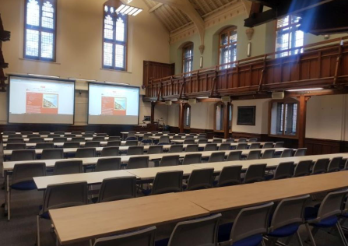
-McIntyre 201
Equipment:
No specialist equipment is needed outside of a computer with internet access, a screen projector, and a shared document where moves can be uploaded.


Interested in finding out more about the classroom set up?
In each course, a separate simulation scenario was designed, but with the same branching-off point: the re-election victory of the Justice and Development (AKP) party in the 2011 Turkish general elections. This was a real-life critical juncture in Turkish and European politics, following which Turkey underwent significant democratic backsliding and saw the effective end of its bid for EU membership.
For the Defending Democracy students, their simulation revolved around the post-2011 negotiations between the Turkish government, the European Commission, the European Parliament, and the various EU member states regarding Turkey’s bid for membership of the EU. Students were divided up into teams representing these actors. Each team was made up of five students (except for the Turkish government team, made up of students who were enrolled in both courses and numbering ten students). For the Political Parties and Institutions side of the simulation (entitled “Authoritarian Party Politics in Turkey”), students were assigned groups representing the governing AKP party, and the three main Turkish opposition parties. Each group was made up of 6-8 students. In addition, the AKP group from Political Parties and Institutions sat with the Turkish government team from the Defending Democracy simulation and was comprised of students who were taking both modules. For preparation, each group was provided with their own unique briefing documents, sets of instructions, and (most importantly) a list of “win” and “lose” conditions. As in real life, while different teams might have had some similar interests or goals to others, each team’s objectives were unique- and occasionally contradictory with those of other teams.
At the start of the game, all teams nominated one of their members to give an opening statement which would set out that team’s beginning position; after this, students were allowed to move freely throughout the room. Teams made moves by submitting them to the lecturers, who reviewed and approved (or rejected) them, and entered them onto a publicly available shared document. As a result, other teams could see and react to these moves. The conveners would also periodically announce new events, which the teams had to respond to, and would ‘resolve’ in-game events (such as elections, coup attempts, European Court of Justice rulings etc.) by using their academic judgement to provide an appropriate outcome, based on the moves of the students. Students were able to negotiate with members of other groups, ally with them or act against them. Based on the extent to which each team met their win or lose conditions, we were able to judge how successful each group had been in the end of session discussion.
What worked well?
There was a good integration of two sides of the simulation, and they interacted in interesting and realistic ways. For instance, some players representing EU member states approached Turkish parties directly, and many kept an eye on changes in government in Turkey and reacted accordingly. Moreover, students clearly demonstrated knowledge and understanding of the subject and put it into practice and were highly enthusiastic about the experience.
Benefits
|
Students |
Staff |
|
|
Challenges
|
Students |
Staff |
|
|
What did you learn?
In future, we would ensure to hold the simulation over two days, in order to reduce student fatigue and to retain their attention throughout the simulation. This was the primary challenge we faced, as towards the end of the day the students were clearly tired, as were the faculty members overseeing the simulation.
Additionally, we would seed the simulation throughout our respective courses, to prepare students better in future. We were quite late in the course in deciding to run a joint simulation, only confirming the shape and format after the beginning of the term, and finalising the scenario, team roles, and game mechanics in the first week of November- two weeks before the simulation was due to run. The result of this was that the students were provided with a little less preparatory detail than was ideal. Having now a blueprint for the simulation, this should not be a problem in future, as we would make sure to finalise the details and mechanics of the simulation before the beginning of the term.
Finally, rather than intervene when students made unrealistic moves, we would permit them to make the mistake and would use the game mechanics to punish these decisions- thus ensuring a more realistic overall experience.
What advice would you give to others?
The most important pieces of advice we would give people looking to use the shared universe simulation concept would be to plan out and prepare the simulation before the beginning of the term, and to make sure that you are timetabled for two days (rather than just one). The simulation needs time and space to play itself out but running it all in a single day will make for a lot of tired students and staff!
In addition, while students are becoming more familiar with simulations and role-plays, it is important to make sure they are given the time and space to prepare, and that they are made clear on the dynamics and on how to make moves, etc. Generally though, once explained to them, they usually pick it up quickly.
For some students with anxiety disorders or some forms of neurodivergence, the simulation can be a bit overwhelming. Such students should be given time and space to decompress, should they need it; alternatively, they might be excused from participating if they so wish.
Think carefully about the objectives you set for students. Too much similarity or alignment between them can make things too “easy”, but if there are no shared or similar interests then the whole game can break down. Try to create a balance where cooperation and/or competition may be encouraged, depending on the circumstances.
Finally, make sure to allocate enough time for the debrief. This is where students can most clearly connect the various threads of the simulation and can reflect upon the broader learning opportunity provided by the game. This can also potentially be buttressed by a reflective writing assignment (or similar exercise).
The following is a sample schedule we would suggest. This might be further shortened or amended, depending on the numbers of participants. However, assuming 60-80 participants (as in our version), we recommend the following:
Day 1:
- 10:00-10:30 - Opening plenary
- 10:30-11:30 - Session 1
- 11.30-11:40 - End-of-session debrief
- 11:40-12:00 - Coffee break
- 12:00-12:50 - Session 2
- 12:50-13:00 - End-of-session debrief
Day 2:
- 10:00-10:10 - Day 2 plenary (this does not necessarily need as much time as on the first day, as students will already be in the ‘flow’ of the game; indeed, it can just be a catch-up led by the lecturers themselves)
- 10:10-11:00 - Session 3
- 11:00-11:10 - End-of-session debrief
- 11:10-11:30 - Coffee Break
- 11:30-12:30 - Session 4
- 12:30-13:00 - Closing statements and final debriefing