

A University for the World
Transnational digital education partnership
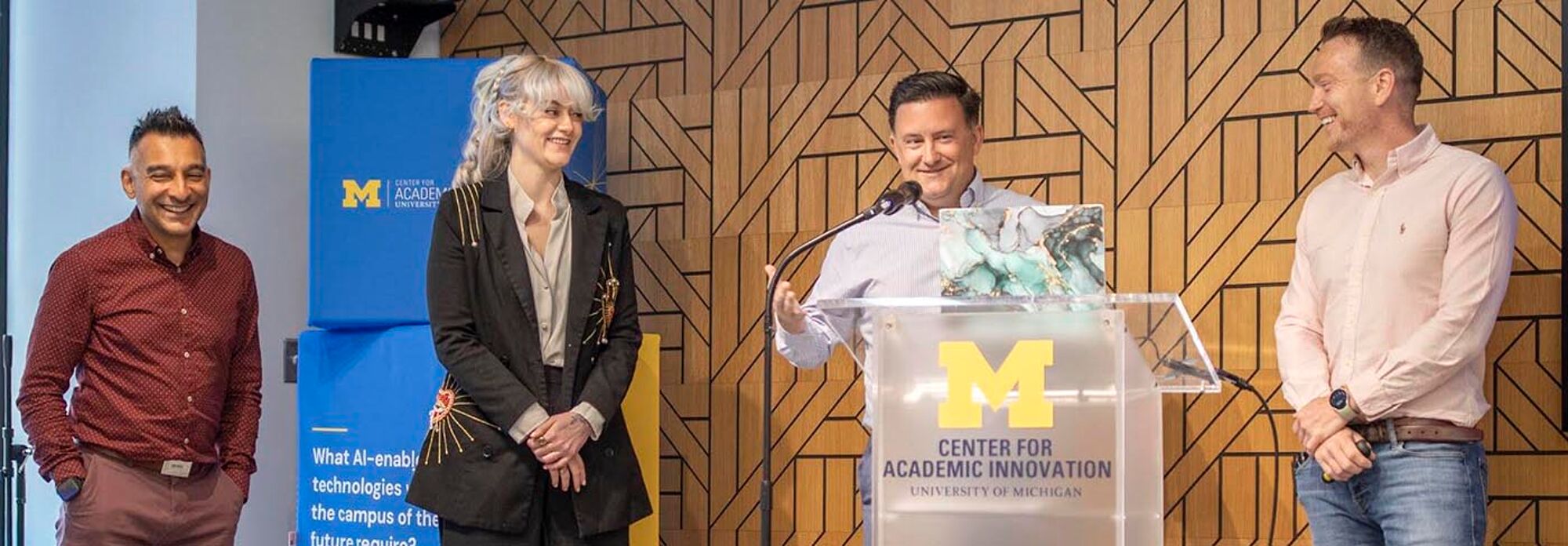
In May 2026, three colleagues from the University of Glasgow's Learning Innovation Support Unit (LISU) visited the University of Michigan's Centre for Academic Innovation (CAI) to explore approaches to online learning, digital education and emerging technologies. As a global leader in academic innovation, Michigan provided a valuable opportunity to compare approaches, exchange ideas and identify opportunities to strengthen Glasgow's own digital education provision.
Exploring innovation in digital education
 The visit explored how large scale, data-informed approaches to online learning, learning design, and educational technology could inform and strengthen Glasgow’s own digital education approaches. This includes our online short course provision (MOOCs), Microcredentials, and fully online degree programmes (UofG online).
The Centre for Academic Innovation (CAI) at Michigan provides end to end support for online learning, including instructional design, media production, learning analytics, course and programme selection strategy and platform management strategy. CAI further supports GenAI integration, immersive learning facilities (including an XR stage), lifelong learning partnerships, and a dedicated innovation and piloting function.
By engaging directly with multiple CAI teams (who have over 120 staff in comparison to LISUs 14), the team gained valuable insights into how the CAI support staff via their process which culminates into the same outputs as LISU delivers at Glasgow.
The visit included a programme of meetings with CAI leadership and teams sharing similar responsibilities to LISUs core areas (Digital Skills, Digital Education Delivery, Microcredentials and Learning Innovation Officers). The meetings explored these key themes: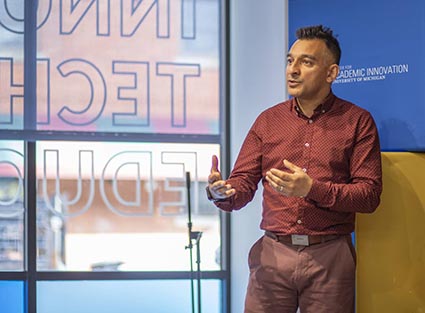
- Online learning design and delivery: how CAI develops, delivers and maintains online learning, including CAI's cascading design process, with components that allow content to be repurposed across different delivery modes.
- Learning analytics and data use: how Michigan's course data dashboards support new course development, changes and content edits, and marketing and e-comms announcements.
- Media production and content development: reviewing workflows of Michigan's world-class, large scale studio facilities and drawing connections to Glasgow’s approaches to improve self-capture and supported audio recordings. This extended to reviewing multi-departmental collaboration trackers that help different teams to work fluidly across course development.
- Generative AI in education: examining CAI tools to support learners. The visit also explored CAI's AI governance and experimentation culture: including pilot projects to test new approaches, decision-making authority held by operational teams rather than separate committees, and incentivised experimentation where staff are encouraged to trial tools and provide feedback without mandated adoption.
- Platform strategy: process of using Michigan Online to support continuing professional development (CPD) activity, including how employers can use Michigan’s platform as a skills provider. At Glasgow, we are progressing with a similar approach for UofG Online Open Moodle platform.
- Structured innovation - CAI's EdTech Accelerator: a dedicated team whose remit is to identify, pilot, and evaluate new software and processes before go/no-go decisions are made. This formalised piloting function produces tangible outputs from prototype work, whether or not projects move forward to full implementation.
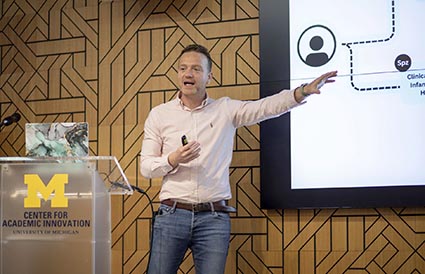
The visit also included opportunities for the team to present Glasgow’s own work, creating a two-way exchange of ideas and practices. This reciprocal approach ensured that both institutions benefited from the visit, with the presentation well attended with over 70 people in the room.
Reflections and learning
 The three-person delegation structure proved essential to the visit's value. The team composition, which spanned Assistant Director, team manager and team leader role - enabled simultaneous engagement across multiple CAI teams and depth of knowledge exchange within each specialisation. This allowed LISU colleagues to build direct relationships with their CAI counterparts, identify specific synergies within their own areas of work, and return with contextualised insights they could share and build upon across the team. A single representative would have been unable to engage simultaneously across learning design, data infrastructure, media production, and AI governance, nor could they have effectively translated insights across such diverse functional areas on return to Glasgow.
The team visit also made LISU's own organisational model visible in ways that resonated with CAI leadership. Observing how three people from LISU could engage meaningfully across comparable remits and seeing the multi-disciplinary perspectives they brought to each conversation demonstrated the structural strength of LISU's vertical-based approach. This visibility strengthened the foundation for reciprocal collaboration. One of the most striking aspects of the collaboration was the alignment in core goals despite differences in scale. Both institutions are focused on improving student experience, enhancing teaching quality, and expanding access to education through digital means. This visit reinforced that shared purpose transcends organisational size: the strategic questions that drive CAI drive LISU, and the solutions often look remarkably similar when constraints and resources are accounted for.
Impact and outcomes
"The International Experience Fund has created real momentum for LISU and for our wider digital education work at Glasgow. The visit to the University of Michigan provided us the opportunity to benchmark our approaches against a mature, online and digital-focused university, while also recognising the value of our own agile and internally developed way of working. Being present and embedded within another team for a short period is an incredibly impactful experience. The ability to use and harness that insight to shape what we do or refine how we offer our service has been deeply valuable."
The visit has had several important outcomes for LISU at Glasgow:
- Benchmarking and quality enhancement: We were able to compare Glasgow’s Digital Education Delivery (DED) standards with a mature and highly resourced model. This has and will continue to directly inform improvements to our processes to course design, consistency, and accessibility considerations.
- Stronger use of data and evaluation: Michigan’s use of data to evaluate educational impact highlighted opportunities for Glasgow to make better use of our existing datasets. From this, after reviewing our data, we have a project ongoing to compile our data into a single, powerful PowerBI dashboard for Colleges to integrate and support course design choices, whilst also surfacing important data points.
- Enhanced collaboration and future partnerships: The visit established the foundations for ongoing collaboration between each institution, specifically focusing on Open Content in AI and healthcare.
- Strategic insight for online platform development: Insights from Michigan Online have provided valuable perspectives on how our ongoing Glasgow Online developments might be further enhanced to support CPD delivery.
- Media production and microlearning scalability: CAI's approach to scalable media production (dedicated production leads, short-form video formats, style guides, and collaborative production tracking tools) provided a benchmark for strengthening LISU's media production partnerships. Insights from their workflow, including video styles reference decks and cross-departmental tracking, are directly transferable to LISU's evolving microlearning series and broader course development practices.
Why the partnership matters
"We would strongly encourage colleagues to make use of the International Experience Fund, either individually or as part of a small team visit. Being present in a different work setting, engaging directly with international peers, and learning from similar challenges can generate new ideas and plans that can often be difficult to visualise from a distance.
Finally, through this experience you will create lasting partnerships and connections that will be you grow and develop in your role. "
Visiting an international partner of this scale offered insights that could not have been achieved via Teams or email communication alone. The University of Michigan operates with extensive resources and specialist teams. It was inspiring to see this operating model in person.
It also allowed a positive reflection point to happen. It highlighted that Glasgow’s agile approach, and inhouse designed and developed mapping approaches are more powerful and offer time savings that we did not fully comprehend. Equally, the visit revealed structural differences in how each organisation operates: while CAI's scale and specialist teams enable deep expertise and state-of-the-art facilities, their distributed structure creates visibility challenges within their own institution. By contrast, LISU has built a strong institutional profile through sustained collaborative effort. That recognition and trust, developed over time, is itself a form of capital that larger organisations struggle to replicate.
An exchange like this, supported by dedicated funding, creates a rare opportunity to pause, observe, and articulate organisational strengths that might otherwise remain invisible in the daily press of delivery. This reflective capacity, and the relationships built through in-person engagement, create foundations for genuine collaborative partnerships that would not emerge from remote communication alone.
The International Experience Fund (IEF) typically supports individual applicants, this visit is one of the first team-based awards that the IEF has funded.
Supporting three staff members to visit enabled simultaneous engagement across multiple Michigan teams and depth of knowledge exchange within each specialisation. This allowed Glasgow colleagues to build direct relationships with their counterparts at Michigan, identify specific synergies within their own areas of work.
The group visit also allowed the University of Michigan to provide a more efficient and coordinated programme of activities.
Funded UofG staff: John Kerr, Hannah John, Neeraj Bhardwaj
Professional service: Learning Innovation Support Unit (LISU)
Partner: Centre for Academic Innovation (CAI), University of Michigan, USA
Fund: International Experience Fund
Year of activity: 2026