

A University for the World
Building emotionally intelligent global leaders
Emotional intelligence (EI) is one of the most important skills a leader can have, and, unlike many traits, it can be taught. A new partnership between the University of Glasgow and The University of the West Indies (UWI) is putting that idea into practice, building on an interactive game, SuperbMarket, to help students develop these skills for real-world leadership.
A shared challenge
"Our time at The University of the West Indies has left a lasting impression as a place where important conversations unfold — about leadership, trust, and the future of organisations — and where students are encouraged to think deeply about their roles and develop their skills to shape exciting futures." — Professor Rosalind Searle
Leaders make emotional decisions every day, whether they realise it or not — how to respond to a difficult employee, whether to reward good work, how to handle conflict. Research from Glasgow has shown that emotional intelligence can be developed through training and practice, not just something people are born with. At the same time, colleagues at UWI had reached a similar conclusion from a different direction, testing classroom exercises that helped students build these same skills through hands-on, reflective learning.
Professor Rosalind Searle and Dr Paul Quigley (both from Adam Smith Business School) first met Dr Paul Balwant, Deputy Dean (Planning and Programming) and Senior Lecturer in UWI's Department of Management Studies, at the Academy of Management conference, where he presented his work on developing emotional intelligence in leaders. The team applied for a Glasgow Global Mobility Grant to explore a specific question: could emotional intelligence be built into SuperbMarket as a new dimension of the game?
Adding Emotional Intelligence to SuperbMarket
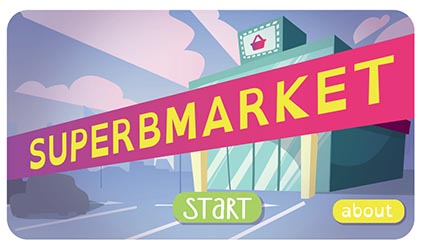 At the centre of the project is SuperbMarket*, an interactive educational game developed at Glasgow that explores workplace decision-making and its impact on people. Players take on the role of a manager caught between a demanding, aggressive business owner and two employees whose wellbeing depends on the choices the player makes — for example, whether to pay a living wage. Every decision has consequences, both for the characters in the game and for the emotions of the player: guilt, pride, frustration, relief.
The Glasgow–UWI team is building on this game with new, structured activities designed to turn those in game emotional reactions into real learning. Students will:
- Learn why emotional intelligence matters for effective leadership, backed by research evidence.
- Build a richer emotional vocabulary — learning to tell the difference between, say, frustration, disappointment and anger.
- Reflect on the intensity of their own emotional responses to strengthen self-regulation.
- Practise empathy by stepping into the shoes of both managers and employees in the game.
- Link game decisions to real situations in their own lives.
Meeting on the ground in Trinidad
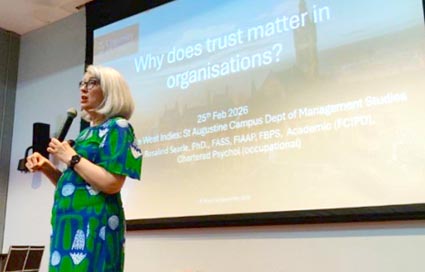 Professor Searle and Dr Quigley travelled to UWI's St Augustine campus, arriving just after the island's Carnival celebrations — a vivid reminder they had landed somewhere with its own distinct rhythm and culture, still settling after what had clearly been a huge national party.
The visit included a public lecture, "Warning! Pay Attention to Trust: Exploring Trust Building and Its Preservation in Organisations," in which Professor Searle examined why trust in institutions is declining, and why preserving trust before it breaks down is far more effective, and far cheaper, than repairing it afterwards. She also gave a lecture to more than 100 of UWI's undergraduate management students on "felt trust": the idea that trust isn't only something leaders extend, but something employees perceive and respond to, shaping their motivation and performance.
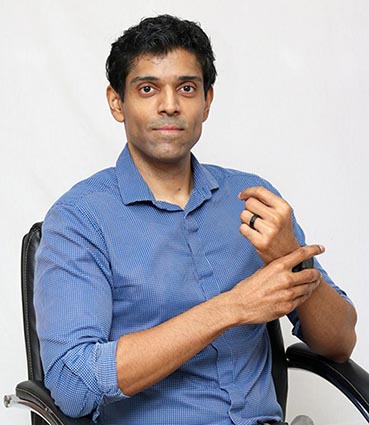
Dr Balwant (pictured below) arranged meetings with UWI faculty and their Dean, opening up further ways the two universities could work together. Dr Quigley is now building links for Glasgow's Masters in Management students to collaborate directly with students at UWI. Through these conversations, the emotional intelligence project moved from an idea into a genuine collaborative plan.
Why an international partnership mattered
 Neither Glasgow nor UWI could have delivered this project alone. Glasgow in collaboration with ESRC IAA and EAWOP Impact incubator funding brought the technology — a tested, research-backed game — while UWI brought an empirically supported approach to experiential classroom learning on emotional intelligence. Testing the combined resource with two culturally distinct student groups, rather than one, means the findings are far more likely to hold up in other settings, and the resulting teaching tools are more broadly useful for leadership education anywhere.
The collaboration has also sharpened the research itself. Conversations in Trinidad moved our focus from emotional intelligence in general towards perspective-taking as a specific mechanism at work, and prompted a rigorous test of it. SuperbMarket is already an experiential learning environment, so any improvement we saw might come from the game rather than from the perspective-taking exercises built on top of it. The joint study therefore runs three groups: game plus perspective-taking, game only, and standard teaching — across both universities, so we can tell the difference.
What stood out most from the visit wasn't a single meeting or lecture, but the enthusiasm of UWI's faculty for working together. Conversations that started as introductions kept turning into genuine collaborative plans — a sign, the team felt, of UWI's strength as a hub for critical thinking and engaged scholarship.
What's next
Beyond this pilot, the team plans to evaluate the impact on students' emotional intelligence, refine the materials based on what they learn, and use the project as a springboard for further joint work, including new research funding applications, a conference symposium, and co-authored publications exploring cross-cultural differences in emotional intelligence development.
Soon, data collection for a joint study running across both universities will commence and be completed during the 2026–27 academic year. We will be:
- Comparing gains in emotional intelligence and emotional self-efficacy across the three groups at both sites.
- Tracking how students’ reflective journals change over a twelve-week semester, as a window on how perspective-taking develops.
- Refining the resources into a teaching toolkit that other educators can use We will also be participating in a symposium at a conference in May about the game and its application.
Building on the connections made through this visit, Glasgow and UWI are also developing a collaborative online learning course for postgraduate students at both institutions — extending the partnership from staff-led research into a shared learning experience students at both universities can take part in together.
* SuperbMarket was developed at Glasgow using the ESRC Impact Acceleration Accounts (IAAs) and EAWOP Impact incubator funding.
Funded UofG staff: Professor Rosalind Searle and Dr Paul Quigley
School: Adam Smith Business School
College: Social Sciences
Partner: University of the West Indies, St Augustine, Trinidad and Tobago
Partner co-Lead: Dr Paul Balwant, Deputy Dean (Planning and Programming) / Senior Lecturer, Department of Management Studies, UWI
Fund: Glasgow's Global Partnership Fund
Year of activity: 2025-2026
University of Glasgow's priority partnership with the University of the West Indies:
The Glasgow-Caribbean Centre for Development Research (GCCDR) is a joint initiative between the University of Glasgow and The University of the West Indies.
The University of Glasgow and The University of the West Indies jointly offer a Masters Programme in Reparatory Justice.