

A University for the World
Advancing software sustainability
As software becomes increasingly ubiquitous in all areas of life, issues surrounding its environmental and societal impact are being raised. As a result, researchers are asking a new question: how can sustainability become part of everyday software development?
This collaboration between the University of Glasgow and Uppsala University brought together research expertise in software engineering practices and sustainable software engineering to explore that challenge.
Complementary expertise
 The collaboration with Uppsala provided an opportunity to explore shared interests at the intersection of software engineering and sustainability while laying the foundations for a long-term international research partnership. It brought together researchers complementary expertise in empirical software engineering, agile practices and software sustainability.
At the University of Glasgow, Dr Peggy Gregory is an empirical software engineering researcher whose work focuses on the human and social aspects of software development, with expertise in agility, sustainability and improving software engineering practice through close collaboration with industry. Dr Mahum Adil is a software engineering researcher whose work examines socio-technical challenges in software development, with a focus on sustainable software engineering, collaborative software design and empirical studies with software practitioners.
At Uppsala University, Dr Sofia Ouhbi is a software engineering researcher whose work focuses on human-machine interaction and sustainability, with research exploring how digital technologies can support sustainable and user-centred software systems. Jennifer Gross is a software sustainability researcher whose work focuses on the relationship between software sustainability and software quality, with particular interest in quality-in-use and incorporating user perspectives into sustainable software development.
Advancing research together
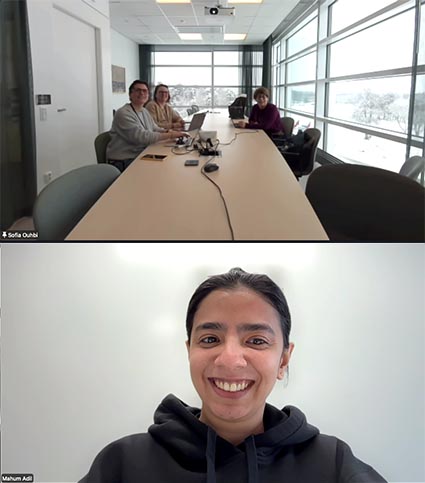 By combining online knowledge exchange with two research visits, the collaboration enabled researchers to build relationships, develop new research ideas, conduct joint research activities, and work together on research outputs.
The project began with online meetings in November 2025, during which the researchers agreed on a shared research focus and planned their collaborative work. In February 2026, Dr Peggy Gregory visited Uppsala University to work with the team on refining the study design and finalising a two-round survey for software practitioners. This was followed Dr Mahum Adil’s research visit in March 2026, where both teams collaborated on data analysis, interpretation of findings and findings and the preparation of joint publications.
A central outcome of the partnership was the validation of a sustainability framework for software development. The framework, originally developed within the Uppsala research group, was further examined through the collaborative research. The results formed the basis of a journal paper submitted to ACM Transactions on Software Engineering and Methodology (TOSEM).
The collaboration also extended a research study conducted by the Uppsala team on how generative AI can help gather software requirements in a more sustainable way. By replicating an earlier student-based study in Sweden with a follow-on study with software practitioners in Scotland, the researchers were able to compare findings across academic and industrial contexts and write a more substantial output. This broader perspective strengthened the research and resulted in a second collaborative paper submitted to the Automated Software Engineering (ASE) Journal.
Creating impact through collaboration
"The greatest achievement of this collaboration was not only the research outputs, but the long-term partnership we have built to advance software sustainability research."
Beyond the shared agenda and research outputs, the project strengthened institutional links and demonstrated how complementary expertise can generate meaningful international collaboration.
The benefits of the partnership extended beyond the project's original goals. Dr Peggy Gregory collaborated with Dr Sofia Ouhbi and researchers from across the software engineering community on an international funding proposal, helping to expand the collaboration into a wider international research network. The partnership brought together complementary expertise in software engineering, sustainability and evidence-based research, enabling the exchange of ideas, methods and industry connections and creating new opportunities for future joint research.
The value of international collaboration
 Working with an international partner enabled the team to benefit from different perspectives, complementary expertise and diverse research environments. The collaboration created opportunities to jointly design studies, analyse findings and exchange knowledge throughout the research process, strengthening both the quality of the research and the partnership itself.
The team is now developing a new research direction in software sustainability while exploring further national and international funding opportunities to support long-term collaborative research.
The project has strengthened the research relationship between the University of Glasgow and Uppsala University, creating a lasting foundation for future joint research, publications and international funding applications.
The research partnership was supported by the Glasgow’s Global Partnership Fund (GGPF), and combined knowledge exchange, collaborative research and international networking to establish the foundations for a long-term research collaboration and to advance knowledge in the research field of software sustainability.
Funded UofG staff: Dr Mahum Adil and Dr Peggy Gregory
School: Computing Science
College: Science & Engineering
Partner: Uppsala University, Sweden
Partner co-Lead: Dr Sofia Ouhbi
Fund: Glasgow's Global Partnership Fund
Year of activity: 2025-2026
Uppsala University and the University of Glasgow are both members of the Guild of European Research-Intensive Universities. They are also a partner in the Erasmus Mundus Joint Master Degree: Global Markets, Local Creativities