

Academic visit to the School of Education, University of West Indies, Kingston Jamaica
Published: 25 February 2026
Commentary
Dr Paul Lynch and Dr Janice Kim from the University of Glasgow visited the University of the West Indies to strengthen a new institutional partnership in early childhood education, resulting in a joint PhD scholarship and plans for collaborative teaching and research across the Caribbean.
Dr Paul Lynch and Dr Janice Kim, specialists in early childhood education at the School of Education, University of Glasgow was hosted by Zoyah Kinkead-Clark, Professor of Early Childhood Care and Education at the School of Education of the Faculty of Humanities and Education, University of West Indies (UWI), Mona. This visit was part of a recently new UofG-UWI partnership to build relations between the two institutions. Previously, Prof Kinkead-Clark was invited to the University of Glasgow in June 2024 where she met members of staff at the School of Education working in early childhood practices as well as early learning in Glasgow.
The University of the West Indies, a regional university with over 50,000 students, is ranked as the number one university in the Caribbean. The University has sites in Jamaica, Trinidad and Tobago, Barbados and Antigua and Barbuda. The UWI also has a Global Campus across 16 islands in the region which allows students to access tertiary studies via distance.
The aim of the visit was to establish stronger teaching and research ties between the two Schools of Education and to explore opportunities to apply for joint funding applications in early childhood education across the Caribbean region.
New PhD Scholarship!
More recently Drs Lynch, Kim and Kinkead-Clark have been successful in securing the first fully funded UofG-UWI PhD scholarship for the College of Social Sciences. As a result of the scholarship Neisha Williams from Belize commenced her doctorate programme in September 2025 under the joint supervision arrangement between UofG and UWI.
The week’s visits gave the Glasgow visitors an opportunity to meet academic staff and senior Ministry of Education officials, present their own research on early childhood education in the Global South, and learn about Caribbean partners’ research areas in order to identify potential avenues for collaboration.
On Monday 19 January – We met the Dean of the Faculty of Humanities and Education, Deon Edwards-Kerr and the Director of the School of Education, Carmel Roofe for welcome and introduction to the School of Education. This meeting allowed the partners to recap on earlier UofG-UWI collaboration through an MOU. Dr Lynch and Kim were able to gain an overview of the breadth of degree courses offered by the faculty (add hyperlink to courses) and of current early years research being led by faculty members.
As part of the introduction, we were given a tour of the MONA campus, including the university museum and the library services. The museum focuses on the history and development of the university, which was set up after World War II, in the waning years of the British Empire, to serve the development needs of the then British West Indies and encourage regional understanding and cooperation. The main aim of the museum is to recall, collect, conserve and interpret artifacts, texts and stories in all forms that illuminate the history, heritage and development of the UWI and reflect its continuing relevance to the region it serves.
On Tuesday -20 January – We visited the Early Childhood Commission (ECC), an agency of the Ministry of Education established to facilitate cross-sectoral collaboration within the early childhood sector. During the visit, we learn about the ECC’s work on curriculum design, teacher training and assessment of children with special education needs and disabilities. The ECC was established under the Early Childhood Commission Act (2003) to improve the quality of early childhood care, education and development within the early childhood sector. The ECC coordinates development plans and programmes within the early childhood sector. It has responsibility for the registration of early childhood institutions (ECIs), and monitors their operations, to ensure compliance with the regulations and standards governing the sector. The Sector Support Services department provides developmental support to ECIs and early childhood practitioners (ECPs). The visit provided an opportunity to explore potential areas for collaboration, particularly in relation to research, professional development, and system-level support for quality improvement in early childhood education.
The team met: Karlene Deslandes, Executive Director of the ECC; Nicole Morgan, Manager of Training and Development; Tracy-Ann Morgan- Smith, Director of Regulations and Monitoring and Andrea Edwards Brown, Senior Director of Cross Sectoral Coordination.
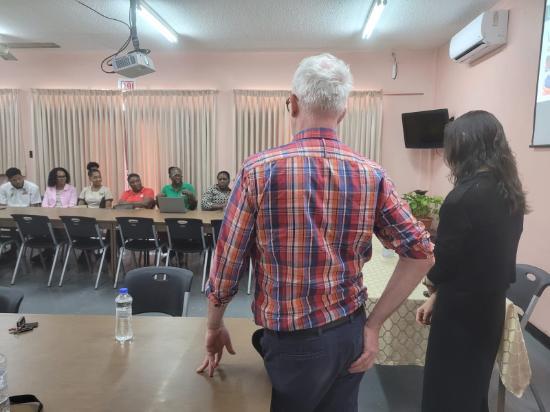
On Wednesday – 21 January – Dr Kim and Dr Lynch were invited to a ‘Discover, Connect: Meet and Greet and Research Exchange’ session organised by Mrs Nadine Brown (Manager of Events, Marketing and Communication) with faculty staff at the Faculty of Education. Drs Kim and Lynch heard about a range of diverse research interests including the effects of climate change on education, STEM, teacher education and development, early childhood teacher education. It was a great opportunity to learn about the rich breadth of research topics that faculty staff were carrying out in Jamaica and the Caribbean area.
Dr Lynch and Kim were then invited to give presentations on research conducted in the Global South. Lynch presented on prevalence of disability in young children as well as a three year multi-country study in Bangladesh, Nepal, Tanzania. Kim presented on Early Learning Partnership research in Ethiopia and the VVOB’s IT’S PLAY project in Zambia. Both presentations prompted substantial discussion around the methods employed, findings, and potential implication for the Carribean region.
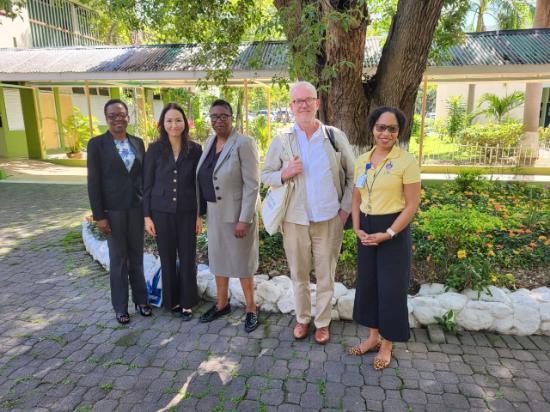
On Thursday 22 January – The team visited McCam Child Development Centre and was greeted by Dr. Pauline Watson Campbell , who founded the centre in 1986 as a model for inclusive early childhood education for children with neuro-developmental disabilities (autism, ADHD,) in Jamaica. Dr Watson Campbell and principal of the school, Kristy Fernandez, gave a tour of the centre. The 60+ children attending the centre follow individualised education programs and use a range of communication systems including Picture Exchange Communication System (PECS). It was a great privilege for the visitors to be able to visit a well established early intervention programme in Kingston. The visitors were able to visit the classrooms and the recreation area.
On Friday 23 January we visited the Early Childhood Stimulation Programme (ESP) which is located just outside downtown Kingston. The ESP is an early intervention programme for young children (0-6 years) with different developmental disabilities. The Programme commenced operation in 1975 as a project, but has subsequently became integrated into one of the Ministry’s social programmes. Since its inception in 1975, the Programme has benefited well over twenty thousand children with various types of disabilities across the island.
In the afternoon, we made a visit to St Joseph’s Techers’ Training College – where we met the Principal, Mrs Winsome P. Francis and Vice Principal, Dr Jacqueline Chen. We were invited to give similar presentations of research in ECCE to a group of lecturers and students during the lunch break. We had a rich question and answer session after the presentations around the importance of play for young children and discussed ways to support both teacher and parent education on the importance of early years stimulation and play.
A cultural visit to understand Jamaica’s historical past
As part of learning about the history of Jamaica, it was important to visit to learn about Dr Kinkead-Clark took Drs Lynch and Kim to Fort Charles which is located at Port Royal. The fort maintains much of its old appearance after surviving multiple earthquakes and hurricanes. The fort was completed in 1655 and was the first of six forts to be built and manned by a garrison in Jamaica. It was initially referred to as Passage Fort and after it was finished it was given the name "Fort Cromwell" in honour of the patron of the expedition and leader of the Commonwealth at the time. However, it received its present name after the restoration of the monarchy under Charles II. They had the opportunity of visiting Giddy House, which was originally a Royal Artillery House meant to store weapons and gunpowder for the adjacent Victoria and Albert Battery. After Port Royal was struck by an earthquake in 1907, Giddy House partially sank into the ground as a result of soil liquefaction. Its nickname, Giddy House, comes from the feeling visitors have when trying to stand straight while inside. It was a very strange feeling standing in the house because of the deep slant of the floor. It was difficult to stand straight, but they managed to!
Exploring opportunities for joint research
Drs Lynch, Kim and Kinkead-Clark held a wrap-up meeting on Friday to reflect on the week’s visits and to discuss ways forward to conduct joint research. The discussion focused on shared research interests, including early childhood inventions in high-poverty, rural areas of Jamaica - e.g. St. Elizabeth and St. Mary Parishes - which have been significantly affected by recent hurricanes. The farming parishes have experienced substantial disruption following Hurricane Beryl in 2024 and Hurricane Melissa in 2025, resulting in the loss of homes and damage to schools. Teachers in these communities are required to provide both educational and psychosocial support to young children affected by displacement and trauma. However, they are experiencing limited access to the resources needed to support children with different educational needs, especially in post-disaster settings.
The meeting highlighted several avenues for joint research, with further discussions expected to continue over the coming months as these ideas are developed.
The visit concluded with an appreciation for the rich professional and personal experiences gained throughout the week. We are especially grateful to our host, Zoyah Kinkead Clark, for her exceptional hospitality and for supporting our visit to UWI.
First published: 25 February 2026