Healthy & Equitable Futures Catalyst (Phase 3)
The first two phases of the Healthy & Equitable Futures Catalyst demonstrated both the ambition and the diversity of perspectives required to address complex health and equity challenges. Phases 1 and 2 workshops helped map the capabilities and interests for both the internal and external audiences and understand the priorities of each. Phase 3 created space for participants to deepen conversations, develop new partnerships and begin translating shared ideas into practical next steps.
Phase 3 workshops
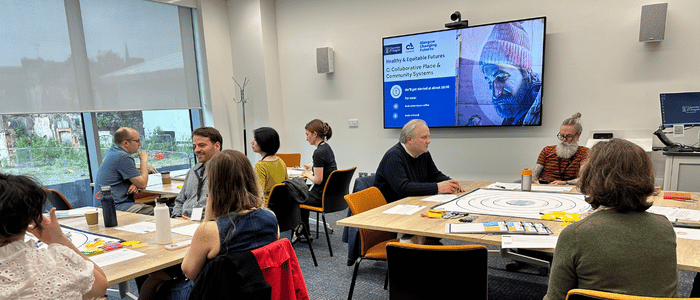
Following the generation of 68 propositions across the first two phases of the Healthy & Equitable Futures Catalyst, Phase 3 shifted the focus from imagining healthier and more equitable futures to exploring how they might be realised. Through a series of themed workshops, participants from across the University of Glasgow and partner organisations came together to develop ideas, form new collaborations and identify practical opportunities for collective action.
Phase 3 focused on bringing people together around shared interests, expertise and challenges to explore how those ideas could be developed, tested and taken forward.
The first two phases paved the way for phase 3: the propositions developed in phases 1 and 2, were synthesised into six overarching clusters, which provided a framework for discussion, while more specific briefs (3-4 per each cluster) were used as conversation starters at each workshop. The briefs were meant as springboards and not fixed agendas, allowing the discussions to meander in new and unexpected directions.
Each cluster became a set of workshops dedicated to that theme. Participants from Phases 1 and 2 and some new participants selected the clusters that interested them most and then selected the brief that they wished to work on.
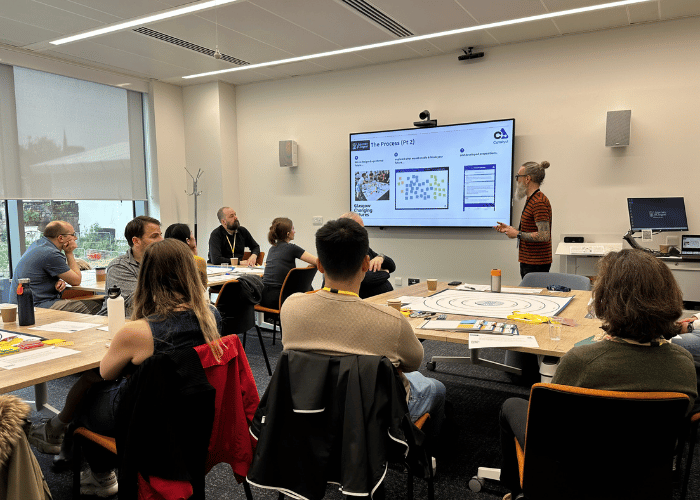
They started with re-orientating the brief to make it their own. They determined who they needed onboard to make the activity work, what resources were required, what it was they were going to create and who it was for. They then used a collaboration framework to develop a project plan which teams could use to apply to the HEF micro-seed fund to pump-prime their ideas.
Micro-seed funding
To help sustain the momentum generated through the workshops, Glasgow Changing Futures made a micro-seed fund available to teams that formed in the Phase 3 workshops. The funding was designed to enable early-stage collaboration, helping teams test ideas, build partnerships, engage communities and develop future funding opportunities. Projects that emerged reflect the diversity of interests, expertise and perspectives brought together through the Catalyst.
The funded projects cover a range of themes, from community empowerment and democratic participation to place-based health, artificial intelligence, culture, learning and environmental stewardship. Several projects share common concerns around participation, equity, wellbeing and the importance of bringing together different forms of expertise, including academic knowledge, professional experience and lived experience. Others focused on convening conversations, co-producing with communities, mapping existing knowledge and building the partnerships needed for larger-scale activity in the future.
Micro-seed funded project summaries
- Patterns of Power
Explores how language and communication shape participation in imagining futures, particularly for groups who may be excluded by traditional, language-based approaches to engagement. - Future Ancestors Network: Community-Led Intergenerational Stewardship for Healthy Futures
Investigates how community-managed green spaces, outdoor play and intergenerational activities can strengthen wellbeing, belonging and social connection while supporting healthier futures. - Glasgow: A Map for the Future
Seeks to understand how infrastructure, housing, transport, public spaces and the built environment shape health and wellbeing in Glasgow, laying the groundwork for a future city-wide mapping and planning resource. - Reframing Leadership through a Community-Led Approach
Explores how leadership can be reshaped through community voices, bringing together community and faith leaders, charities, academics and policymakers to co-design more inclusive models of leadership, participation and decision-making. - Powerlines
Brings together academics and external partners to investigate how different forms of power influence social and health inequalities, with the aim of developing a larger collaborative research programme on power and equity. - VoiceEquity Scotland
Explores whether AI tools used to detect depression perform equitably across communities experiencing different levels of deprivation, helping to ensure future healthcare technologies do not reinforce inequalities. - Stories of Work and Care
Works with women from minoritised ethnic communities to explore how paid work, unpaid care and wellbeing intersect, using participatory and creative methods to centre lived experience. - Learning by Stealth: Promoting Wellbeing through Sharing Food and Culture
Examines how informal cultural experiences centred around food, music, literature and museum collections can support wellbeing, social connection and lifelong learning. - People Place & Glasgow: Glasgow's Shared Understanding of Place
Explores how people experience and define "place" in Glasgow, combining community perspectives, health research and spatial analysis to understand the links between neighbourhoods and wellbeing. - To Be Communitied
Investigates how communities might collect, interpret and use local data differently if residents had greater control, focusing on community knowledge, participation and decision-making.
Full list of HEF Catalyst funded projects, including team members
Reflections on the HEF catalyst and micro-seed funding
Participants spoke positively about the confidence the schemes have given them to explore ideas and develop projects, particularly those who may not traditionally see themselves as part of research and innovation conversations.
Awarded project teams were invited to attend a support session, where they shared some useful reflections.
Most participants felt that the process is helping to broaden participation and create a more inclusive route into project development and future funding opportunities. However, some community participants told us that the traditional academic seed funding application process did not manage to maintain the positive energy from the workshops and wasn't as well suited to genuine co-design with community partners. Something to consider in future iterations.
Phase 3 created space for participants from different disciplines, sectors and backgrounds to develop ideas together, while also highlighting some of the challenges involved in moving from broad propositions to themed action-focused discussions.
Next steps
Looking ahead, the micro-seed projects represent one possible pathway rather than an end point. Some collaborations may conclude once their seed-funded activities are complete, while others may continue to develop into larger projects. To support this next stage, micro-seed-funded teams are being offered ongoing development support to help strengthen ideas and explore future funding opportunities.
A further funding call will be open to all participants from earlier phases, regardless of whether they took part in Phase 3.
The application window for the further funding closes on 22 October with the aim to have funding available for teams by December 2026 and projects delivered by July 2027.