

Creating inclusive thought spaces - the Healthy and Equitable Futures Fishbowl (Case Study)
The Healthy and Equitable Futures (HEF) Fishbowl is a designed process that supports inclusive dialogue at scale. It offers an alternative to traditional panels or breakout groups by creating a shared space where participants move between listening and speaking and where no single group is positioned as the sole authority.
Background
Progress in healthy life expectancy - the years we live in good health - has stalled in many high-income countries, with declines seen in the UK and USA. This is happening against a backdrop of major global trends shaping future health and wellbeing, including climate change, pollution and biodiversity loss, geopolitical instability, urbanisation, pandemics, commercial influences, shifting social structures, and technological advances such as AI.
It is important for societies to find ways to have discourse about these issues to form a vision of what desirable futures could look like and discuss how to ensure a healthier and more equitable future remains a viable goal.
The fishbowl approach offers a shared space where such discourses can take place. Rather than aiming for consensus or predefined outputs, sessions are designed to create open conversations that could surface a range of perspectives and challenge established ways of thinking.
Method
The fishbowl structure combines the principles of a roundtable discussion with interactive engagement. The room is set up to include both an inner and an outer circle; this open aspect introduces additional layer of structure. Panellists occupy seat in the inner circle and start he conversation. The wider group of participants is then seated in the outer circle.
The inner circle deliberately has empty chairs available, and participants can join the ‘inner circle’ conversation anytime there is a free seat. The initial ‘panellists’ can move to ‘listening’ roles and merge with the audience, allowing new ‘panellists’ to join the inner circle – creating a fluid movement of voices throughout the dialogue. Wider points and reflections are also invited and welcomed from the outer ring as the dialogue progresses (via facilitation – a roving mic or Mentimeter). The concept, also known as a ‘fishbowl dialogue', enables equality and inclusiveness in communication.
The fishbowl process allows audience members to participate in the way they want:
- Observe, listen and reflect
- Join the conversation if they wish to contribute
- Capture and share individual thoughts and reactions
Fishbowl in action
In its pursuit of health equity for all, HEF has used the fishbowl process in two events where participants explored preferred futures and their role in shaping them.
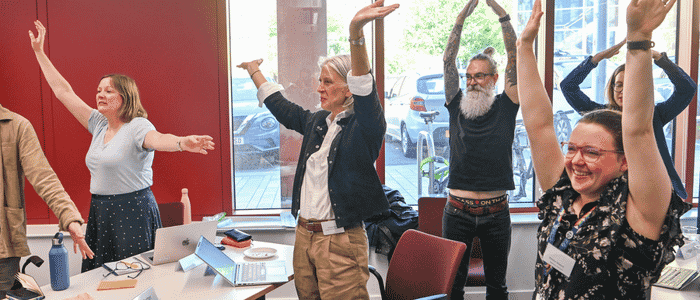
The Healthy & Equitable Futures workshop at the University of Glasgow (20 May 2025) and the Prevention Research 2026 roundtable in Birmingham (4 March 2026) both aimed to explore and shape visions for healthier, more equitable futures. The Glasgow workshop, involving over 50 colleagues, supported the formulation of a pan-institutional vision and initial directions of the Healthy and Equitable Futures (HEF) challenge area within the Glasgow Changing Futures programme by examining potential futures, key trends, barriers, and paradoxes, as well as the University’s role in driving positive change through its expertise and diversity of thought, including consideration of scenarios where health and equity decline. Building on this, the Prevention Research 2026 plenary session engaged around 300 researchers, practitioners, and policymakers to surface diverse perspectives on what desirable and undesirable futures might look like, identify factors influencing these outcomes, and strengthen collective capacity to plan and act for future generations.
Across both sessions, strong points of convergence emerged:
- Equity is structural: participants emphasised power, starting points, institutions and political systems as decisive.
- Narratives and communication matter: how futures are framed can mobilise or paralyse action.
- Short-termism is a barrier: political cycles, funding models and evidence demands disrupt pursuing a preferred future.
- Institutions must change: universities and research systems were seen as constrained by inertia, silos and risk aversion.
- Community knowledge is essential: lived experience, trust and embedded relationships are critical in futures thinking.
- The future requires humility: assumptions about expertise, evidence and who speaks must be questioned.
The two fishbowls tell a coherent story:
- Glasgow created the conceptual and institutional foundations for healthy and equitable futures, focusing on meaning, values, systems and the role of a civic university.
- Prevention Research 2026 pushed the conversation outward and forward, confronting the political, evidentiary and cultural barriers that prevent those concepts from becoming reality.
Lessons learned and impact
The primary aim of the Healthy & Equitable Futures (HEF) fishbowls was to create the conditions for equality, inclusiveness, and shared learning by creating a different kind of reflective space. In this format, diverse perspectives are given equal time and value, enabling participants to step outside conventional hierarchies and boundaries.
The fishbowl approach is particularly effective for challenge programmes which seek to foster interdisciplinary and intersectoral dialogue. It encourages participants to move beyond established silos, reframe complex challenges, and explore more innovative, holistic, systems-based solutions.
The Glasgow fishbowl brought together a broad cross-section of University staff, representing varied backgrounds, experiences, and levels of expertise. This diversity drove the conversation, allowing both depth and breadth of insight. As the topic of living a healthy and equitable life is universally relevant, creating space for shared reflection and exchange was both timely and necessary. It reinforced the principle that everyone has a stake in shaping the future and a right to contribute to the conversation.
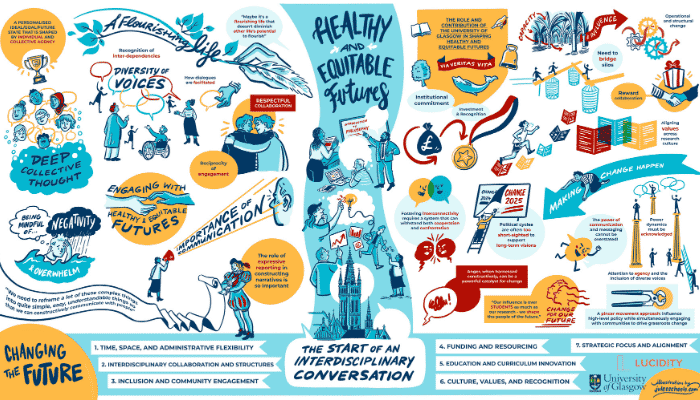
Illustration by Jules Scheele
The event succeeded in engaging the University community in thinking collectively about what a healthy and equitable future means and how it can be achieved. Participant feedback indicated that the session not only surfaced strong interest in the topic but also helped individuals connect with one another and recognise the breadth of talent across the University. One attendee described it as the most interdisciplinary event they had participated in, highlighting its value in revealing potential levers for change within the institution.
The inclusive nature of the fishbowl format empowered participants to take a position, think differently, and carry insights forward into their own work and networks. A key takeaway was the shared recognition that shaping the future is a collective responsibility and everyone has a role to play.
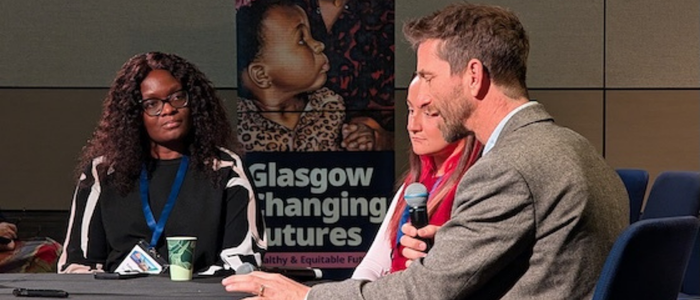
Overall, the Glasgow fishbowl acted as both an introduction to Glasgow Changing Futures (GCF) and a practical demonstration of its inclusive, participatory approach. It helped build engagement and buy-in while offering a fresh perspective on interdisciplinarity. Taking it beyond Glasgow, the Prevention Research 2026 fishbowl provided valuable insight from external academics and representatives from public health practice, broadening perspectives and informing future research directions.
Further information
A blog about the Prevention Research roundtable
Resources
If you plan to run your own Fishbowl, you are welcome to use the briefing below. Please acknowledge GCF, and let us know if it's been helpful.