

Physics-Informed Neural Networks for Modelling Extreme Temperature Dynamics
Supervisor: Dr Vinny Davies
School: Mathematics and Statistics
Description:
Weather and climate systems exhibit complex temporal behaviour driven by external forcing, daily cycles, seasonal patterns, and physical feedback mechanisms. While modelling typical temperature variation is already challenging, modelling unusually high temperatures is substantially harder because extreme events are rare, poorly represented in historical data, and often arise from nonlinear interactions between physical processes operating across multiple timescales. As climate change alters the frequency and intensity of heat events, understanding temperature extremes is becoming increasingly important. Developing models that capture both the statistical behaviour and physical drivers of extremes is therefore a major open challenge.
Standard deep learning approaches can capture complex patterns in environmental data, but typically provide limited physical interpretation. Physics Informed Neural Networks (PINNs) address this by embedding governing equations directly into the learning process. However, most existing PINN approaches focus on predicting mean (average) behaviour rather than rare events. In contrast, statistical methods from extreme value theory are designed specifically to model extremes but are rarely combined with deep learning or physics-informed approaches. Bringing these ideas together represents a largely unexplored research direction that is increasingly important as climate-driven extremes intensify.
This project will develop a PINN for modelling hourly near-surface temperature using a simple but physically meaningful energy balance model:
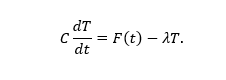
Here T(t) represents temperature, C is an effective heat capacity, λ controls relaxation towards equilibrium, and F(t) represents time-varying external forcing such as diurnal and seasonal heating. The neural network will be trained to match both observed data and this governing equation, allowing physical parameters and forcing terms to be estimated directly from observations.
A central aim of the project is to extend this framework to model unusually high temperatures using ideas from extreme value statistics. Instead of assuming a standard Gaussian observation model, the approach will incorporate an extreme value likelihood designed to capture rare heat events. Combining physics-informed neural networks with statistical models for extremes in this way is a new research direction that may improve the prediction and interpretation of temperature extremes.
The student will work with real meteorological observations and compare the approach with statistical alternatives such as smoothing splines or generalised additive models, assessing whether incorporating physical structure improves prediction accuracy, robustness, and performance in modelling extremes.