Deep Learning for Wildlife Monitoring
Supervisor: Dr Tiffany Vlaar
School: Mathematics and Statistics
Description:
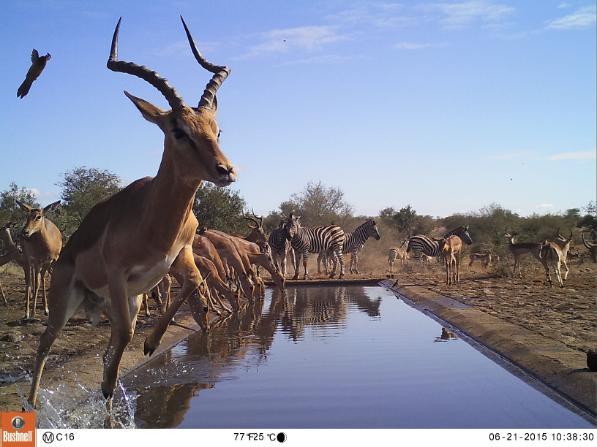
This research project focuses on enhancing artificial intelligence (AI) approaches for automated wildlife monitoring. Specifically, deep learning models will be used for analysis of camera-trap image data collected across multiple sites in the Kruger National Park, South Africa. We will focus on images captured at waterholes, where animal activity is high and multiple species often appear simultaneously, leading to various interesting research challenges. A subset of these images—restricted to specific locations and timeframes—has been manually annotated by experts, providing ground truth labels on the numbers of individuals of each species per image, and their relative distance from the water hole (drinking, at waterhole edge, in background).
In the first phase of the project, we will focus on single-species classification and counting of individuals, and investigate the role of initialisation of the deep learning models under data scarcity and domain shift. The second phase of the project focuses on crowded, multi-species scenes, where overlapping animals and occlusion make species detection and counting significantly harder, causing uncertainty in estimates.
Co-supervisor: Maxwell Farrell (School of Biodiversity, One Health & Veterinary Medicine)