Deep Learning for Climate Downscaling
Supervisor: Dr Linus Ericsson
School: Computing Science
Description:
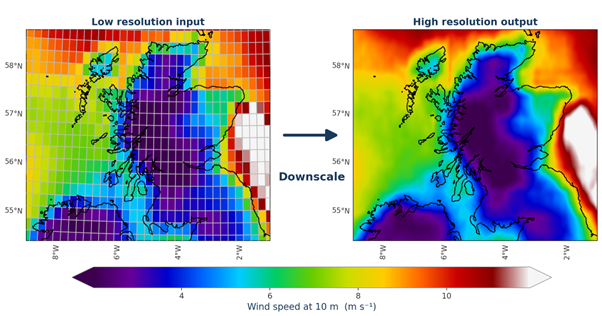
Climate change is one of the defining challenges of our generation, and machine learning is emerging as a powerful tool to tackle it. Climate downscaling is the task of taking coarse, low-resolution climate data and generating fine-grained predictions at 3 km or finer. It's a bit like super-resolution in computer vision, except instead of sharpening a blurry photo, you are sharpening our picture of the planet's future. Better downscaling would let urban planners prepare for localised flooding, help farmers anticipate regional drought, and give policymakers the resolution they need for sound infrastructure decisions.
State-of-the-art deep learning models have made impressive progress here, but a fundamental problem remains: they do not know the rules that weather and climate follow. A model that predicts moisture appearing out of nowhere violates conservation of mass, producing scientifically meaningless results however good the error metrics look. These models are also data-hungry and struggle to generalise, often failing completely when applied outside the region they were trained on. This project investigates ways to address these problems. You will explore architectures and training strategies that build physical constraints directly into the model, and work with self-supervised and transfer learning to make models that learn from less data and generalise across regions. Experiments will be conducted on ERA5, the gold-standard global climate dataset covering over 80 years of atmospheric observations, alongside real regional datasets.
You will be part of a small, enthusiastic international team who will meet with you weekly throughout the project. Your primary supervisor, Dr Linus Ericsson, is a Lecturer in Computing Science at Glasgow specialising in AI. Dr Tiffany Vlaar, also a Lecturer at Glasgow bridging Computing Science and Mathematics, brings complementary research expertise and will be closely involved in supervision. Rounding out the team is Dr Sigrid Passano Hellan, a Senior Researcher at NORCE Research Institute and the Bjerknes Centre for Climate Research in Norway, one of Europe's leading climate research centres, who works at the intersection of machine learning and climate science. You will have the opportunity to present your work to her team and receive feedback from world-class applied researchers.
The project runs for ten weeks: weeks 1 and 2 cover the literature and ERA5; weeks 3 and 4 focus on a baseline model and first experiments; weeks 5 and 6 on physics-informed objectives or architectural constraints; weeks 7 and 8 on transfer learning and generalisation; and weeks 9 and 10 on consolidating results and preparing a write-up. The project suits a student who has taken a machine learning course, is comfortable in Python, and wants to spend a summer doing research that matters. No background in climate science is needed.