Can De-greasing Proteins Cure Heart Diseases? The Synthesis of small molecule catalytic de-palmitoylators for cardiac treatment.
Supervisor: Dr Jerry Tam
School: Chemistry
Description:
Attaching lipids to proteins is one of the many ways that cells control how proteins behave. When lipids such as palmitic acids are attached to a protein, the protein anchor itself to a cell membrane; when the palmitic acids are removed (de-palmitoylation), the protein gets dislodged from the cell membrane and loses its function. Being able to influence the lipidation states of membrane-bound proteins using small, drug-like molecules offers an opportunity to fine tune protein behaviour in a cell, thus represent a therapeutic strategy to treat a wide range of diseases from heart failure to cancer.
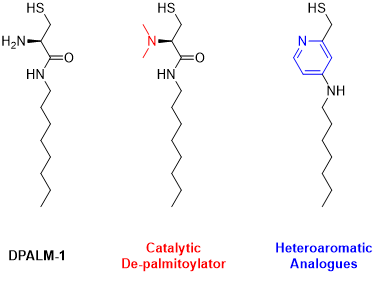
DPALM-1 is an example of a small molecule that can carry out de-palmitoylation in a living system. The main limitation of DPALM-1 is that it works in a one-to-one manner, meaning each small molecule can only carry out de-palmitoylation once. This limits its utility for therapeutic applications.
Previous work from our group has shown that modified versions of DPALM-1 containing tertiary amines can function as catalytic de-palmitoylators, enabling multiple rounds of lipid removal without consuming the small molecule. These catalytic de-palmitoylators are promising candidate drugs for regulating protein-membrane interactions.
This project aims to synthesise a broader set of related compounds featuring aromatic amines in the hopes to identify molecules with improved activity and lower toxicity.