

Digital Humanities Support
Increasingly, our life is shaped by technology and technological gadgets, and we interact daily with websites and phone applications. We all have certain expectations of what a web resource should offer. Digital resources are expected to work as expected, be intuitive, and provide quality information quickly. It is vital that colleagues don't underestimate the importance of how the data produced by their research is presented, organised, and accessed. We strive to be world-class with our research. Let’s apply that same standard to our digital outputs.
If you’re planning a research project or developing an online resource for your data, the College of Arts & Humanities has four software developers who collaborate as research partners helping shape digital humanities questions, methods, and workflows while also providing technical advice and designing and implementing web‑based solutions.
Services offered include:
• Offering advice on how your research data can be presented and accessed online;
• Contributing technical details to research proposal applications.
• Planning the development of online resources, including writing technical specification and requirements documents that can be understood by non-technical people.
• Designing and developing suitable storage methods for your data, including both relational and NoSQL databases, XML, RDF, and search platforms (e.g., Solr or Meilisearch).
• Creating content management systems through which your data can be straightforwardly managed.
• Developing digital editions of texts using XML (e.g., TEI, EpiDoc, or other XML dialects);
• Providing IIIF image servers and associated image delivery workflows.
• Designing intuitive and easy to use user interfaces.
• Developing interactive maps and data visualisations.
• Providing training in the use of any software that has been developed.
• Contributing to academic papers about research projects and presenting at conferences if applicable.
• Taking responsibility for the long-term maintenance of your online resource to ensure it continues to be accessible for many years to come.
Our developers have been responsible for creating more than 100 online resources for research projects based in the College, many of which can be viewed on the Digital Humanities at Glasgow website (https://digital-humanities.glasgow.ac.uk/projects/title/). Our team consists of Dr Luca Guariento and Faidon Koutsogiannopoulos, who work on projects across the College, Brian Aitken, who works on projects in the School of Critical Studies, and Stephen Barrett, who works on projects in Celtic and Gaelic. To discuss any digital aspect of your research project please email one of our team.
Dr Luca Guariento
Luca is Senior Research Systems Developer for the College of Arts. He advises on and supports Arts research projects with a Digital Humanities component at every stage, from shaping the technical aspects of funding proposals to project launch and long-term sustainability.
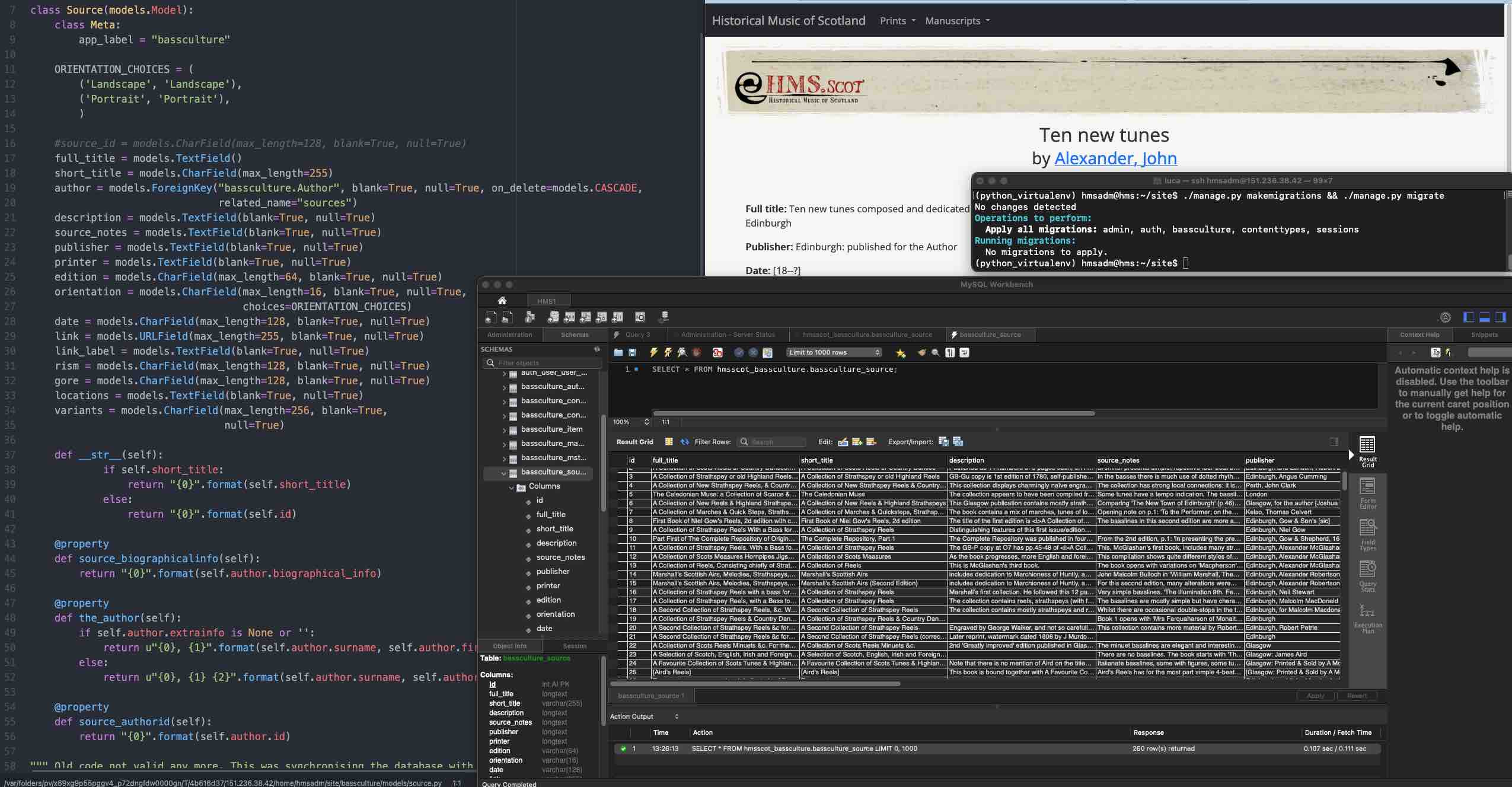
He provides strategic and practical guidance on Digital Humanities methodologies, tools, and infrastructure, and delivers training sessions and workshops for researchers and project teams. His work spans development and infrastructure: he designs and maintains digital platforms and web applications, manages server-side configuration and deployment, and supports the ongoing sustainability of systems. He also maintains legacy web resources from completed projects. Examples of his work include Ogham, Curious Travellers, and Historical Music of Scotland.
Luca holds a BA and MA in Musicology and a PhD in Music. Before joining the university sector, he worked as a systems administrator in a large software company, bringing together his academic background in the Arts and Humanities with his long-standing interest in technology.
Contact Luca at Luca.Guariento@glasgow.ac.uk.
Brian Aitken
Brian is the Digital Humanities Research Officer for the School of Critical Studies and is responsible for developing, implementing, and supporting the school’s extensive collection of digital resources and offering technical advice to any staff across the School who are planning research projects. He has designed and developed more than 50 online resources for research projects over the past 25 years, including the Historical Thesaurus of English, Books and Borrowing: An Analysis of Scottish Borrowers’ Registers, 1750-1830, the Dictionaries of the Scots Language, the Anglo-Norman Dictionary, Mapping Metaphor, the Scots Syntax Atlas, Speak For Yersel, and several place-name projects such as the Berwickshire Place-Name Resource.
Brian has an MA in English Language and an MSc in Information Technology and has been working in his current role since 2012. He has written a weekly blog since 2012 that discusses the work he has undertaken each week.
Contact Brian at Brian.Aitken@glasgow.ac.uk.
Stephen Barrett
Stevie is a Research Systems Developer for Celtic and Gaelic in the School of Humanities. In addition to creating the various online applications for the Digital Archive of Scottish Gaelic, he works closely with Faclair na Gàidhlig, creating bespoke software to support the creation of the first historical dictionary of Scottish Gaelic.
Stevie holds an MA in English Literature and Philosophy, an MPhil in European Romanticism, and Postgraduate Diplomas in Information Technology and Mindfulness Studies.
Contact Stephen at Stephen.Barrett@glasgow.ac.uk.
Faidon Koutsogiannopoulos
Faidon is a Research Systems Developer in the College of Arts & Humanities, where he supports and enhances digital research by designing, developing, and maintaining technical systems and infrastructure. He collaborates with academic staff to build and support web applications, databases, and APIs, contributing to projects from initial proposals through to implementation. His work focuses on ensuring that research outputs are robust, accessible, and sustainable, while modernising legacy systems, improving data workflows, resolving technical issues, and promoting best practices in data management, user experience, and digital infrastructure to enable innovative research.
Faidon holds a BSc in Geology, an MSc in Geoinformatics, a postgraduate diploma in full-stack development (Java-based applications), and a certificate in full-stack web development.
Contact Faidon at Faidon.Koutsogiannopoulos@glasgow.ac.uk.