Projects
Understanding Sembrando Vida
Mexico’s Sembrando Vida, or “Sowing Life” program was launched by president Andrés Manuel López Obrador in 2019 as his signature program under the Secretary of Welfare. While often referred to as a “reforestation” program, Sembrando Vida actually seeks to address two problems: rural poverty and environmental degradation. Mexico, the 11th most-forested country in the world, is losing an average of nearly 213 thousand hectares of forest a year, according to the National Forestry Commission. The administration, on the Sembrando Vida website, diagnoses the causes of deforestation in this way: “Due to conditions of poverty, the rural regions of the country have undergone, in recent decades, a significant process of deforestation, and over-exploitation of its resources…”
The goals of Sembrando Vida include planting a million hectares of fruit and timber trees in agroforestry systems, supported by trained technicians, state-supervised nurseries, and “peasant learning communities.” The program currently claims to have 400,000 beneficiaries in 20 states throughout Mexico, who upon enrolling and adhering to the program, receive a salary of 5,000 MXN, 500 of which are placed into a savings account for them.
Sembrando Vida’s website reads, “Our objective is to contribute to the social welfare of the agrarian subjects in their rural locations and to promote their effective participation in the holistic development of their communities.” Touting the program as “agroecology” López Obrador presents it as a panacea for carbon sequestration, reforestation, poverty mitigation and amelioration of the migration crisis. In recent negotiations with the U.S. the Mexican president has proposed his vision be extended across Central America.
COP 26
On October 31st to November 12th 2021, the United Nations Climate Change Conference of Parties 26 (COP 26) was held in Glasgow. Despite the emphatic urgency of British Prime Minister Boris Johnson, and similar overtures by other political leaders, COP26 is roundly regarded as a failed deal, reached through “watered-down” language pushed by corporate lobbying. Recent calculations, assuming the most recent agreement will be in place, estimate planetary levels of warming will be 2.4 degrees, a considerable backslide from the 1.5 degrees target Declared in the Paris Agreement of 2015. The resolution has been called a “betrayal of global South countries.”
López Obrador (or “AMLO”) who was not present at the COP, critiqued the gathering of political and business leaders for their “hypocrisy” and failure to address “monstrous inequality” as a root cause of the climate crisis. Mexico was one of the last countries to sign on to a COP 26 pact of 105 countries to end deforestation by 2030, and AMLO’s administration has drawn fire from climate action groups for failure to commit to a clean energy transition.
In response to criticisms of Mexico’s half-hearted participation, López Obrador claimed that Sembrando Vida was, in fact, the inspiration for the pact on deforestation, pointing out that no other nation was spending 1.3 billion dollars annually to halt forest loss.
Our Project
Given the magnitude and scope, both actual and proposed, of Sembrando Vida in the Americas, and its positioning at COP as an example to the rest of the world, this project includes the collaboration of peasant leaders, defenders of territory, activists, and researchers to examine the impacts of Sembrando Vida on the ground and the implications of such state-led “agroecology from above.”
The project is a collaboration between the National Autonomous University of Mexico Merida and the University of Glasgow, and was funded by the Global Challenges Research Fund.
Cómo entender Sembrando Vida
El programa Sembrando Vida de México se arrancó por el presidente Andrés Manuel López Obrador en 2019 como su programa insignia bajo la Secretaría del Bienestar. Aunque a menudo se refiere como un programa de "reforestación", Sembrando Vida en realidad busca atender dos problemas: la pobreza rural y la degradación ambiental. México, el undécimo país más boscoso del mundo, está perdiendo un promedio de casi 213 mil hectáreas de bosque al año, según la Comisión Nacional Forestal. La administración, en el sitio web Sembrando Vida, diagnostica las causas de la deforestación de esta manera: "Debido a las condiciones de pobreza, las regiones rurales del país han sufrido, en las últimas décadas, un importante proceso de deforestación y sobreexplotación de sus recursos..."
Los objetivos de Sembrando Vida incluyen la plantación de un millón de hectáreas de árboles frutales y maderables en sistemas agroforestales, con el apoyo de técnicos capacitados, viveros supervisados por el Estado y "comunidades campesinas de aprendizaje''. El programa afirma tener actualmente 400.000 beneficiarios en 20 estados de México, que al inscribirse y adherirse al programa reciben un salario de 5.000 MXN, 500 de los cuales se depositan en una cuenta de ahorro para ellos.
El sitio web de Sembrando Vida dice: "Nuestro objetivo es contribuir al bienestar social de los sujetos agrarios en sus localidades rurales y promover su participación efectiva en el desarrollo integral de sus comunidades." Promoviendo el programa como "agroecología", López Obrador lo presenta como una panacea para la captura de carbono, la reforestación, la mitigación de la pobreza y la mejora de la crisis migratoria. En recientes negociaciones con Estados Unidos, el presidente mexicano ha propuesto que su visión se extienda a toda Centroamérica.
COP 26
Del 31 de octubre al 12 de noviembre de 2021 se celebró en Glasgow la Conferencia de las Partes de las Naciones Unidas sobre el Cambio Climático 26 (COP 26). A pesar de la enfática urgencia del primer ministro británico, Boris Johnson, y de las propuestas similares de otros líderes políticos, la COP26 se considera en general un acuerdo fallido, alcanzado mediante un lenguaje "diluido" impulsado por los grupos de presión empresariales. Cálculos recientes, asumiendo que el acuerdo más reciente estará en vigor, estiman que los niveles de calentamiento planetario serán de 2,4 grados, un retroceso considerable respecto al objetivo de 1,5 grados declarado en el Acuerdo de París de 2015. La resolución ha sido calificada como una "traición a los países del Sur global".
López Obrador (o "AMLO"), que no estuvo presente en la COP, criticó la reunión de líderes políticos y empresariales por su "hipocresía" y por no haber abordado la "monstruosa desigualdad" como causa fundamental de la crisis climática. México fue uno de los últimos países en firmar el pacto de la COP 26 de 105 países para poner fin a la deforestación para 2030, y la administración de AMLO ha sido criticada por los grupos de acción climática por no comprometerse con una transición energética limpia.
En respuesta a las críticas sobre la participación poco entusiasta de México, López Obrador afirmó que Sembrando Vida fue, de hecho, la inspiración para el pacto sobre la deforestación, señalando que ninguna otra nación estaba gastando 1.300 millones de dólares anuales para detener la pérdida de bosques.
Nuestro proyecto
Dada la magnitud y el alcance, tanto real como propuesto, de Sembrando Vida en las Américas, y su posicionamiento en la COP como ejemplo para el resto del mundo, este proyecto incluye la colaboración de líderes campesinos, defensores del territorio, activistas e investigadores para examinar los impactos de Sembrando Vida sobre el terreno y las implicaciones de esta "agroecología desde arriba" dirigida por el Estado.
El proyecto es una colaboración entre la Universidad Nacional Autónoma de México Mérida y la Universidad de Glasgow, y fue financiado por el Global Challenges Research Fund.
Further resources to understand sembrando vida
In this online webinar, academics, civil society and NGO actors, and community representatives discussed ‘Sembrando Vida’ – the new flagship programme for reforestation that is currently being operationalised in Chiapas, Mexico, and that has recently been promoted by the Mexican and US governments at COP26 in Glasgow as part of the solution to climate change. Speakers in the first panel located this programme against a broader background of state-led development initiatives . The second panel featured representatives from constituencies in Chiapas who will share their experiences with Sembrando Vida on the ground. See the recordings here:
Accompanying the Plan de Vida
The Selva Lacandona (Lacandon Jungle) is a region of important ecological and cultural diversity in Central America. The Selva Lacandona incorporates areas of the southern Mexican state of Chiapas and northern Guatemala, the two sides separated by the Usumacinta river. In Chiapas, the Indigenous people of the Lacandona live in three Bienes Comunales de la Zona Lacandona (BCZL), which are Lacanja, Nueva Palestina and Frontera Corozal. These Bienes Comunales have been recognised by the Mexican state since 1971, and in 1978 the presidential resolution was updated to recognise the Indigenous Chol, Tseltal, Tsotsil and Tojolabal speaking people, as well as the Maya Lacandon who were originally recognised in 1971. In 1978 the government also issued a resolution establishing the Montes Azules Biosphere Reserve (covering 331,200 hectares). Some of the territories of the three Bienes Comunales lie within the Calakmul region of the Montes Azules Biosphere. The legislation regulating the conservation area restrict the way the Indigenous people of the (BCZL) can use their land.
In 2021 the people of Bienes Comunales de la Zona Lacandona (BCZL) initiated a process (comisión), with the approval of the Asamblea (local governments of the bienes comunales), to investigate, understand, and reinforce, the traditional ecological practices and local democratic practices of the people of the Lacandon. The people of the (BCZL) engaged in a grassroots democratic process, consulting with people of all genders and generations, and have designed a Plan de Vida, Life plan, for the communities. These meetings were known as the circles of the word, and were accompanied by local researchers (Rosa López, Alberto Vallejo Reyna, Rita Valencia), supported by the University of Glasgow in collaboration with ECOSUR (Chiapas).
The Plan de Vida activists of the Lacandon have used the community knowledge to develop a first draft of the Plan de Vida. This was published, with help from the University of Glasgow, in 2022. It is intended that this Plan de Vida be accepted by the Asamblea and used to update the existing agricultural statutes and enforce the agroecological practices from the grassroots up. In 2022 researchers from the Food Sovereignty Network (Emma Cardwell, Anna Chadwick, Julia McClure) visited the Bienes Comunales of the Lacandona and learned about the importance of grassroots agroecological processes for supporting food sovereignty, culture and democracy locally, and for fighting climate change and the expansion of colonial capitalism globally.
In 2023 the Glasgow based Food Sovereignty Network continued to support the Plan de Vida activists of the BCZL. They supported and accompanied a meeting between the people of the BCZL and the Autonomous University of Oaxaca (AUCO) in the Isthmo region of Oaxaca, and the asamblea of the Bienes Comunales of the Chimalapas. Food Sovereignty Network co-cordinator Julia McClure travelled from Chiapas to Oaxaca with the representatives of the Lacandona to present the Plan de Vida in the Isthmo and the Chimalapas. The Chimalapas is another area of ecological diversity currently at risk from megaprojects such as the transisthmus corridor. The meeting between the Indigenous people of the Lacandon and the Chimalapas was a historic and monumental meeting that can support Indigenous people in their efforts to reinforce their agroecological practices locally and fight climate change and the risks of neoliberal projects globally.
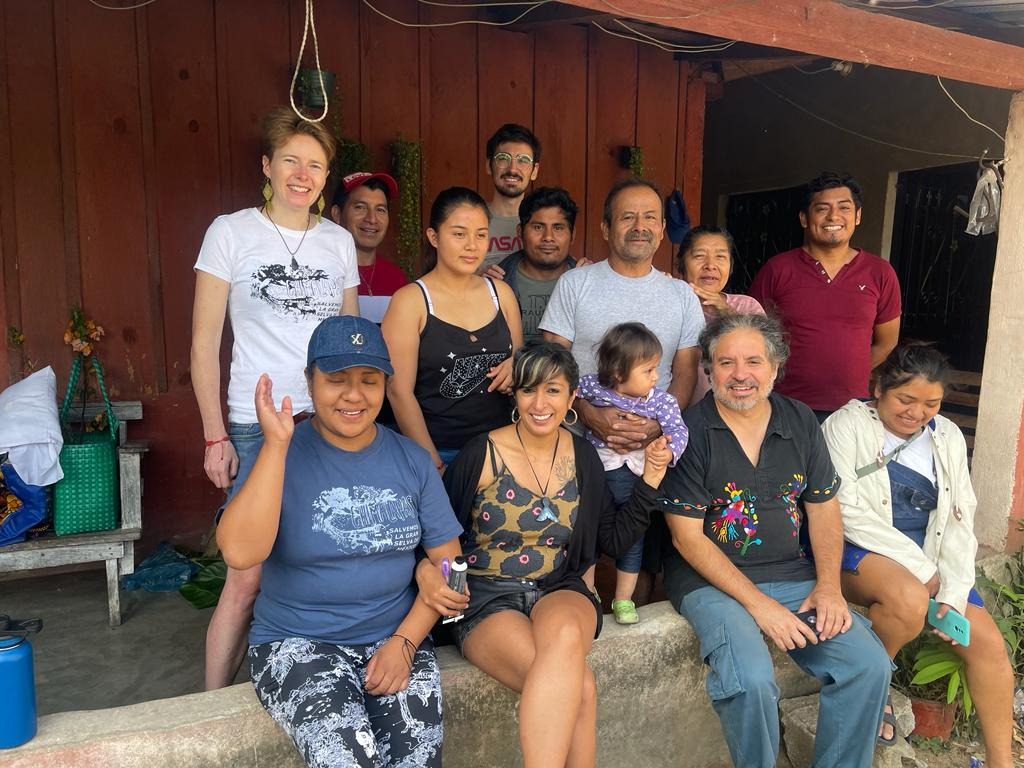
Illustration of the Plan de Vida by Angélica Ramírez
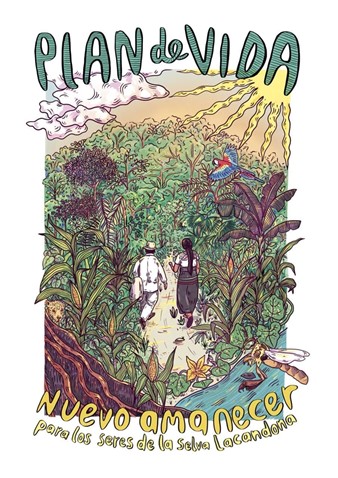
Presentation of the plan de vida book in a ceremony during a visit to the Isthmus of Tehuantepec
Sustainable Cities and Food Systems
For centuries, cities have been expanding around the world in unsustainable ways that have contributed to climate change. At the same time rural communities have faced increased pressures from the expansion of these cities, and increased pressures, including from climate change, have increased migration from rural to urban areas, exacerbating trends in unsustainable urbanisation. Colonialism and its legacies have created a world in which urban and rural societies, and people and nature are disconnected.
In recent decades, the drive to make cities more sustainable in order to address the threat posed by climate change and to improve the welfare of residents is well underway in many countries around the world. Indeed, cities like Copenhagen, are leading the way in mitigating and adapting to climate change. A number of models for sustainable city redesign have emerged in recent years and are at varying stages of implementation. The City of Amsterdam has advanced with the implementation of a model influenced by ‘Doughnut Economics’ (Raworth 2017) - a new approach to economic governance that requires that policies are elaborated within an outer ring of ‘planetary boundaries’ and an inner ring, the ‘social floor’. Other policy models advanced include ‘circular economies’, public-citizen owned renewable energy companies, ‘20-minute neighbourhoods’.
While advances are being made in some localities, the concept of sustainability upon which many of these initiatives rely remains vague and contested. Concerns have been voiced that the models that are getting the most traction are models that rely heavily on technocratic solutions to issues such as waste, energy use, and transport reform – models that leave the fundamental structures of a damaging growth-centric economic model intact. Significantly, few of the existing models for sustainable city redesign explicitly consider the relationship between urban planning and food systems, and the city and its surrounds.
As is well known, current models of food production that are highly industrialised, carbon intensive, and dependent on chemical inputs and last-minute distribution through global value chains are one of the leading causes of climate change. The need to transform our food systems in order to address a plethora of ecological issues, such as soil depletion, water contamination, and loss of biodiversity, as well as to tackle social and economic inequalities that result in multiple adverse health outcomes, is widely acknowledged. Yet, often, the necessary centrality of food systems to the project of designing sustainable cities is not reflected in policy making initiatives or academic models. Equally, the question of how to bring about food systems reform is sometimes focused on the reform of agriculture and activities in the countryside, and the question of how the ‘urban’ and the ‘rural’ interrelate is not specifically addressed. Finally, a great many of the efforts to make cities more sustainable in the global North neglect to consider important questions as to how the redesign of cities in the global ‘centre’, in the ‘core’ of the global political economy, will impact on populations in the ‘periphery’ - the global South. Patterns of industrialisation in both the global North and the global South are intimately interlinked owing to the colonial pasts and presents of international relations. Likewise, contemporary food systems are the legacy of colonial policies and law-making. Hence it is essential that models for creating sustainable cities take into account the impact that proposals and policies will have on constituencies in the global South.
Prior to colonialism, around the world there have been alternate examples of human cities where urban and rural zones, and people and nature, were less divided. In the Maya region of Mesoamerica prior to colonialism, Maya societies developed garden cities, with densely populated urban areas sustained both through urban growing and a close relationship with agroecological practices in the surrounding forests (Nigh and Ford, 2019). Increased understanding of examples of the world’s historic sustainable cities, histories that have been obscured by the colonial process, can help us to decolonise the future of sustainable cities, transcending the artificial boundaries that have been created between urban and rural zones and between people and nature.
In 2023 we held a one-day workshop to bring together activists, academics, NGOs and other civil society actors to critically evaluate leading models for city redesign from the perspective of food system reform. By means of a series of presentations and interactive brainstorming sessions, the workshop evaluated 3-4 different models for sustainable cities bringing in the neglected foci outlined in this concept note.
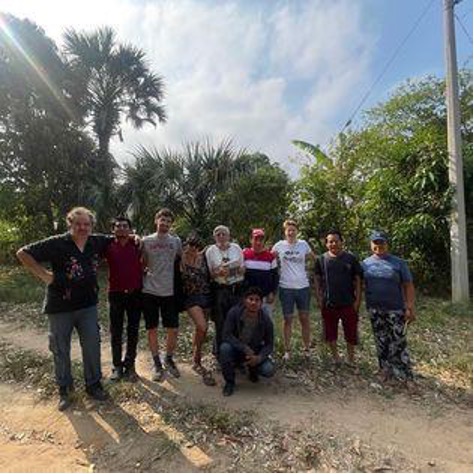
In 2023, following previous engagement with agroecological communities from the Maya region of Mesoamerica (accompanying Plan de Vida), the Food Sovereignty Network also facilitated a historic meeting between people of the Bienes Comunales de la Zona Lacandona (BCZL) and people of the Chimalapas. We came together to exchange knowledge and discuss agroecological land management, communal governance, and resistance to large-scale development projects. As part of the journey, participants also visited the Autonomous University of Oaxaca in the Isthmus of Tehuantepec, fostering further dialogue and collaboration.Each meeting was enriched by the presence of artists, including Mari Mariel, whose work added depth and resonance to these vital conversations. Mari Mariel produced an artwork that reflected these knowledge exchange dialogues between the people of the BCZL and the Chimalapas about the importance of historical knowledge and contemporary challenges to agroecology (see exhibitions).
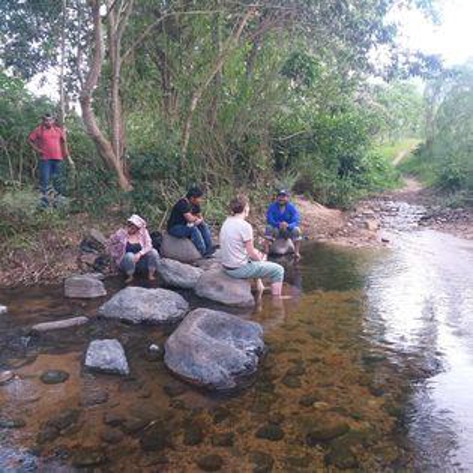
Examples of some of the Food Sovereignty Network’s funded projects:
• Strengthening Indigenous agro-ecological practices and reconnecting historically culturally and ecologically connected pathways in the South of Mexico, Impact Acceleration Funding, £6630 (2024)
• Sustainable Cities: Indigenous Histories of Mayan Garden Cities and the Future of Urban Growing, PI, co-Is Anna Chadwick, Mark Banks, Ross Beveridge, Global Challenges Research Fund (2022), £17K.
• Food Sovereignty Network, Dear Green Bothy creative arts funding (2021), £1,500.
• Re-costing the earth: indigenous governance of silviculture in Southern Mexico and the redesign of `sustainable development¿ consultation and impact assessment. PI with Anna Chadwick and Emma Cardwell, Global Challenges Research Fund (2020) £55,604.
Strengthening Indigenous agro-ecological practices
Strengthening Indigenous agro-ecological practices and reconnecting historically culturally and ecologically connected pathways in the South of Mexico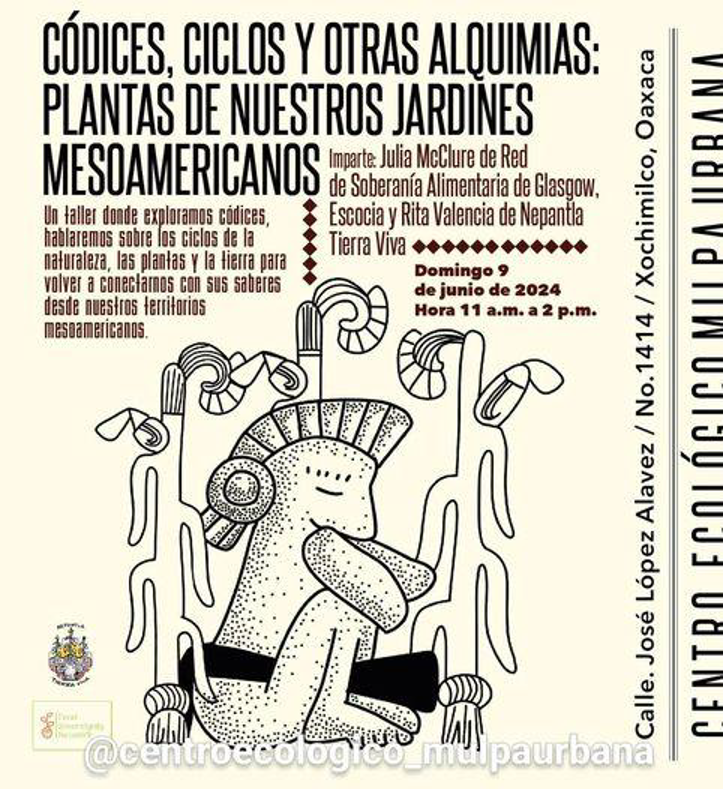
Since the onset of colonial capitalism’s global expansion in the long sixteenth century, communities around the world have faced challenges to their ancestral agroecological knowledges and practices. The Food Sovereignty Network is committed to supporting a peasant- and Indigenous-led movement to strengthen these historical practices in southern Mexico, fostering the regeneration of food systems, cultural traditions, and ecological diversity. Through art, the network strengthens agroecological knowledge and trans-regional solidarities, supporting people to reconnect with their histories and each other.
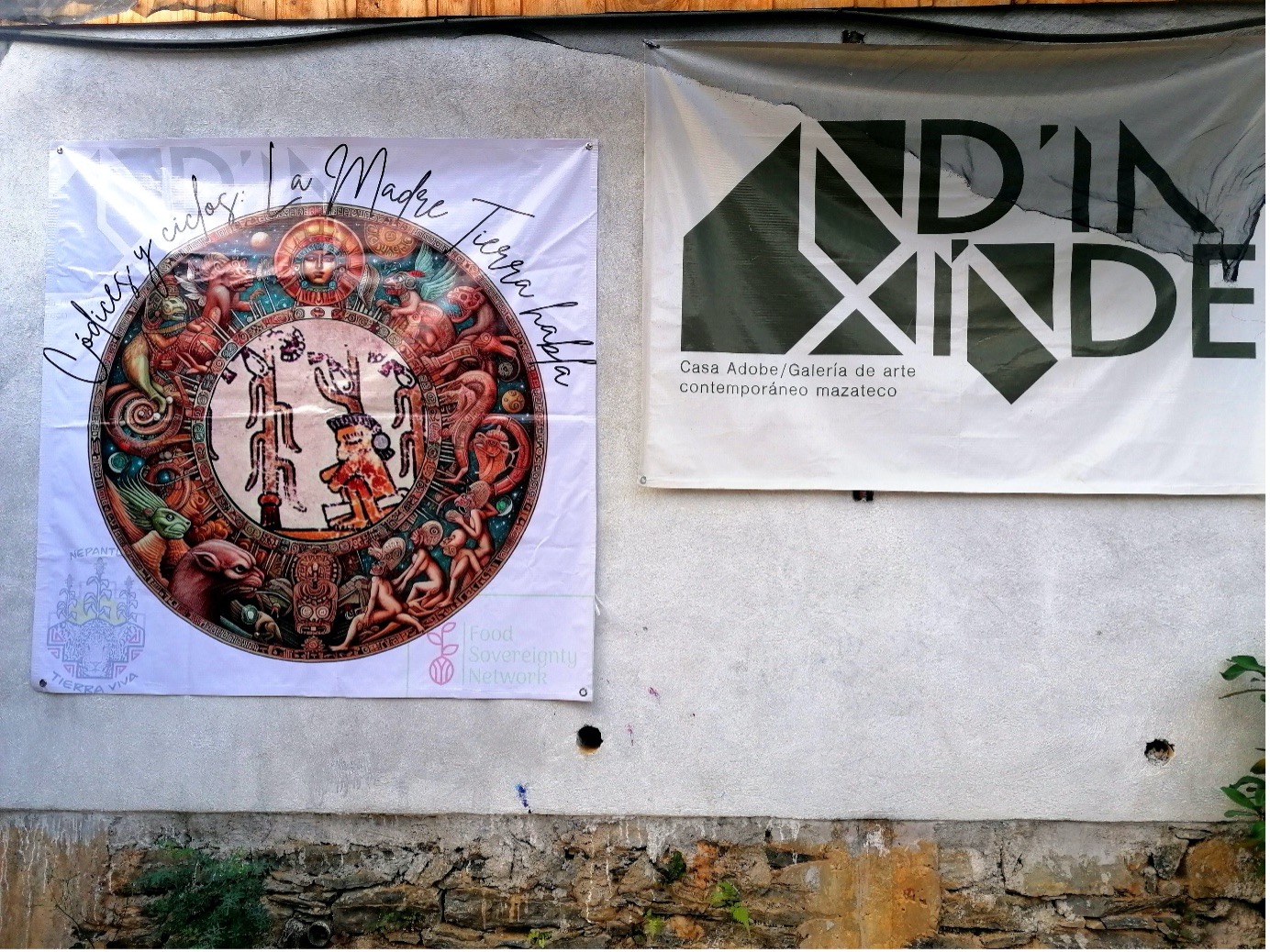
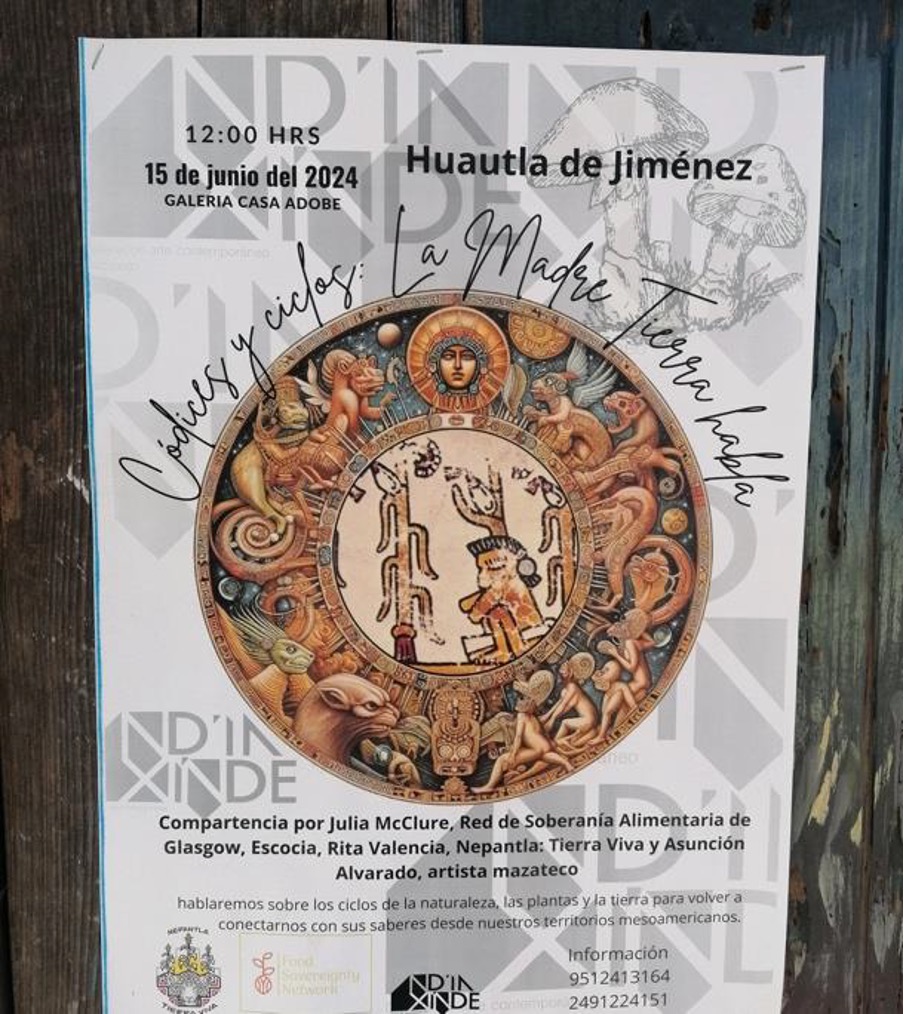
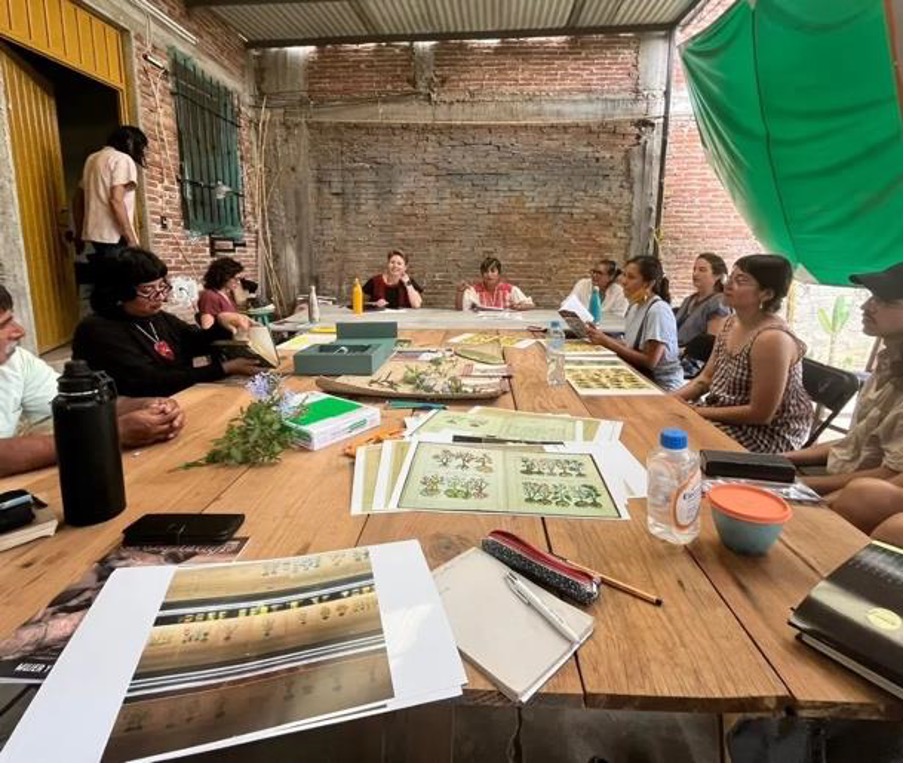
This project focused on agro-ecological practices within Indigenous communities in southern Mexico and involved the organization of two workshops: Codices, Cycles, and Other Alchemies: Plants of Our Mesoamerican Gardens at Milpa Urbana (Oaxaca), and Codices and Cycles: The Mother Earth Speaks at Casa Adobe (Mazateca).
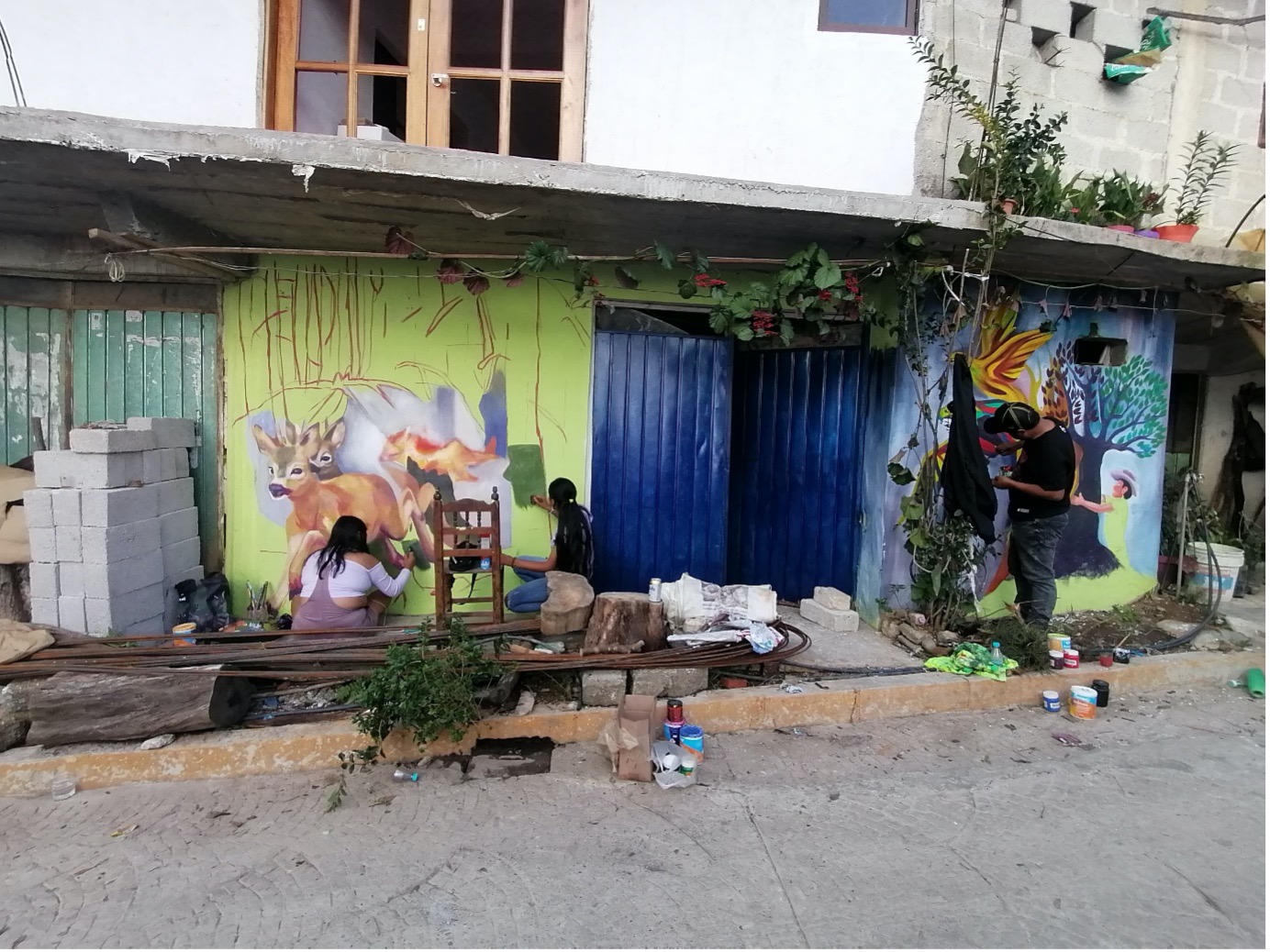
A key emphasis of this initiative was the role of art as a tool for connection and engagement. Two local artists were commissioned to create works that embody these themes: Mari Mariel produced an ink engraving titled Tierra Vida, while Asunción Alvarado painted Mapa Cosmogónico Mazateco on canvas. To further extend the impact of these artistic interventions, copies of the artworks were distributed among local communities, ensuring that the visual narratives of food sovereignty, ecological wisdom, and cultural resilience continue to inspire and take root. They also work together to paint a mural in the Mazateca region raising awareness of the importance of historic relations with the natural world and the contemporary challenges.
Mexican art projects
The FSN has worked with growers, artists, and activists in Mexico to promote peasant-Indigenous-led processes to restore historical knowledges agroecological practices and trans-regional solidarities. In 2021 the FSN accompanied the people of Bienes Comunales de la Zona Lacandona (BCZL) (Chiapas) as they developed a new land management plan, the Plan de Vida (Life Plan). In 2023 accompanied a historic meeting between representatives of the BCZL and Chimalapas (Oaxaca) to discuss their historic connections and shared challenges to their agroecological practices and their protection of the wider environment. The FSN also supported intragenerational conversations about agroecological practices in the Mazateca (Oaxaca) and met with these communities in 2024.
The FSN commissioned two Mexican artists, Mariela López and Asunción Alvarado to accompany these transregional and intergenerational conversations in Mexico. Asunción Alvarado participated in the meetings in the Mazateca and produced his Mazatec Cosmovision, which illustrates the ongoing connections between people, the earth, and the cosmos, that are renewed through dialogues and care for the earth. Mariela López travelled with the FSN to the Chimalapas in 2023 and produced her artwork, which responds to the dialogues about shared experiences of agroecology, resistance, and the importance of the natural world. In 2024 Mariela López travelled with the FSN to the Mazateca and met the artist Asunción Alvarado. Both artists distributed reproductions of their artworks to different communities in the Mazateca who had taken part in earlier conversations about history and agroecology. Both artists worked together to produce a mural, in Huautla de Jiménez, to represent what they had learned about the historic and contemporary challenges to the natural world and the importance of agroecology. This was a poignant time for reflection as wildfires were raging in the Mazateca, as they had previously in the Chimalapas.
Both artists reflected upon their experiences in a recorded interview at the end of the meeting in the Mazateca. During this interview the artists discussed how engagement with the FSN projects has shaped their practice and experiences:
Asunción Alvarez:
And in that sense, I repeat, it has been a great learning experience, and now in formalizing what we have been doing up to now, it has made me more aware that we have to continue working more, we have to continue insisting more and resist, even more, this system implanted from the outside. Because as Indigenous cultures, sometimes we don’t fit in those standards that are imposed on us and we have to follow the system. So, I try to resist a little bit through language, through Mazatec, and by, for example, making a pictorial composition where I am talking about corn, where I am talking about the language, where I am talking about the use of mushrooms, the use of plants, or the connection that exists with the mountain and the respect for the land.
Mari Mariel:
what I found interesting, or what I think we all learned, is how the community in the Chimalapas has been resisting for many years. How do they take care of the jungle as a community without other hands interfering? And throughout this, there have always been people who have wanted to take away that privilege. Like this, well, how to explain it? What has always belonged to them, well, not in the sense of saying this is mine, but a mutual coexistence, right? And then I think that for them, living there, knowing, knowing the land, everyone knows how to take care of it and how to protect it. So, I think that is what really caught my attention, everything Don Domingo was talking about. More than anything else, how many years they have been resisting and there they speak clearly about a love for Mother Earth, for nature.
Mariela López, untitled
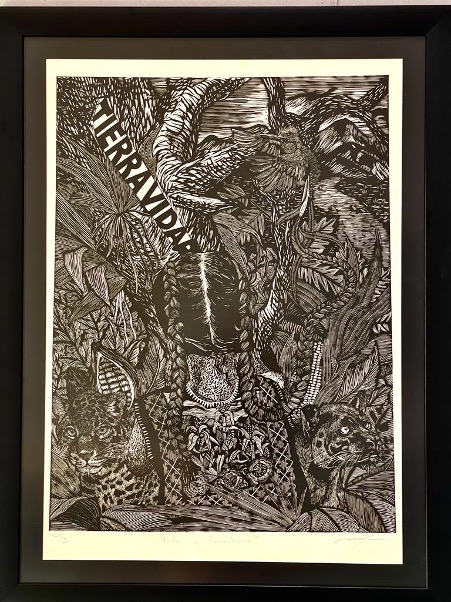
From Oaxaca but currently based in the city of Querétero. Mariela López is a visual artist principally immersed in graphic arts, especially in stencils and engravings. The work of Mariela can be described as figurative, searching for an introspective analysis that focuses upon the return to childhood in a relentless search for the resignification of adult life through memory. Her work is characterized by being very organic, using different elements from nature, always accompanying a person, always accompanying a person, merging in an exact way in each of its pieces.
Mariela López studied at the Autonomous University of Querétaro, a state in which her work has acquired relevance and interest in cultural venues and independent galleries, constantly contributing to her professional development. In 2014 she was part of a collective initiative ´The Graphic Burrow´, that successfully installed the first workshop-gallery of graphic art in the centre of the city of Guerétaro, a space that has contributed to the diffusion and development of graphic art in the state. In turn, the collective has established a dialogic bridge between workshops and spaces between the centre and south of the country, specifically between Oaxaca and Querétaro. Recently it has become a place of above all a place of learning and experience, in which one can enrich oneself as an artis through the generation of spaces dedicated to creation and expression. It should be noted that Mariela has consolidated the major part of her work in Querétaro and Oaxaca, but it was her birth city of Oaxaca that provided structure, as well as the definition of her artistic personality.
Throughout her career she has participated in several collective exhibitions, as well as has made graphic interventions in different places in the city of Querétaro, most of them starting from techniques like the stencil.
The main richness of her work comes from the way she works, which comes from introspection, but that also offers a constant development and change towards transformation, it is this characteristic that generate and define the compositions.
Asunción Alvarado, Mazatec Cosmovision
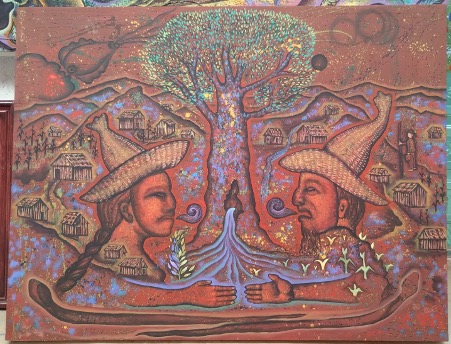
Work by the Mazatec artist from San Andrés Nanj ngaa, Huautla de Jiménez, Oaxaca. For its elaboration, Mazatec grandfathers and grandmothers were interviewed in order to learn about their origins as a people and the ways of inhabiting the territory. The oral tradition has been one of the most important elements for the continuity of all the elements of identity as a people that springs from the land.
It is the Sierra Mazateca where a grandfather and grandmother talk about the founding of the community, with a shamanic language that connects with the sacred tree, the tree of life, from whose entrails water flows. The tree connects with the cosmos and with the earth, in that connection the leaves suck the energy from the air to turn it into sage, into water.
The chikon tocoxo is the guardian who takes care of the mountain, a spiritual being who gave us the sacred food of corn, reformed the community to respect the rivers, caves, hills and the mountain. The Mazatec healers talk to him for any situation or problem of the community. An offering is made to him on May 1st with copal, candles and cocoa. In the community there are wise healers who, through the holy children, sacred mushrooms that have been used since pre-Hispanic times, perform ceremonies honoring mother earth, and at the same time cure the illnesses suffered by the people of the community.
While sowing corn, the Mazatecos make offerings where the corn is going to be planted, they pray for a good harvest and talk to the entities that own the place. The snake is the representation of the territory, symbol of fertility and abundance.
Obra del artista mazateco originario de San Andrés Nanj ngaa, Huautla de Jiménez, Oaxaca. Para su elaboración se entrevistaron a abuelos y abuelas mazatecos con el objetivo de aprender sobre sus orígenes como pueblo y las formas de habitar el territorio. La tradición oral ha sido uno de los elementos más importantes para la continuidad de todos los elementos de identidad como pueblo que brota de la tierra.
Es la Sierra Mazateca donde un abuelo y una abuela dialogan sobre la fundación de la comunidad, con un lenguaje shamánico que se conecta con el árbol sagrado, el árbol de la vida, de cuyas entrañas brota el agua. El árbol conecta con el cosmos y con la tierra, en esa conexión las hojas succionan la energía del aire para convertirlo en salvia, en agua.
El chikon tocoxo es el guardián que cuida la montaña, ser espiritual que nos regaló el alimento sagrado del maíz, reformó la comunidad para el respeto de los ríos, cuevas, cerros así como el monte. Los curanderos mazatecos dialogan con él para cualquier situación o problema de la comunidad. Se le ofrenda el día 1 de mayo con copal, velas, cacao. En la comunidad hay sabios curanderos que, a través de los niños santos, hongos sagrados que se han usado desde tiempo prehispánico, realizan ceremonias honrando a la madre tierra, y al mismo tiempo curan las enfermedades que padece la gente de la comunidad.
En la siembra del maíz, los mazatecos realizan ofrendas donde se va a sembrar, piden para que haya buena cosecha y hablan con las entidades dueñas del lugar. La serpiente es la representación del territorio, símbolo de fertilidad y abundancia.
Mariela López and Asunción Alvarado painting a mural together in Huautla de Jiménez
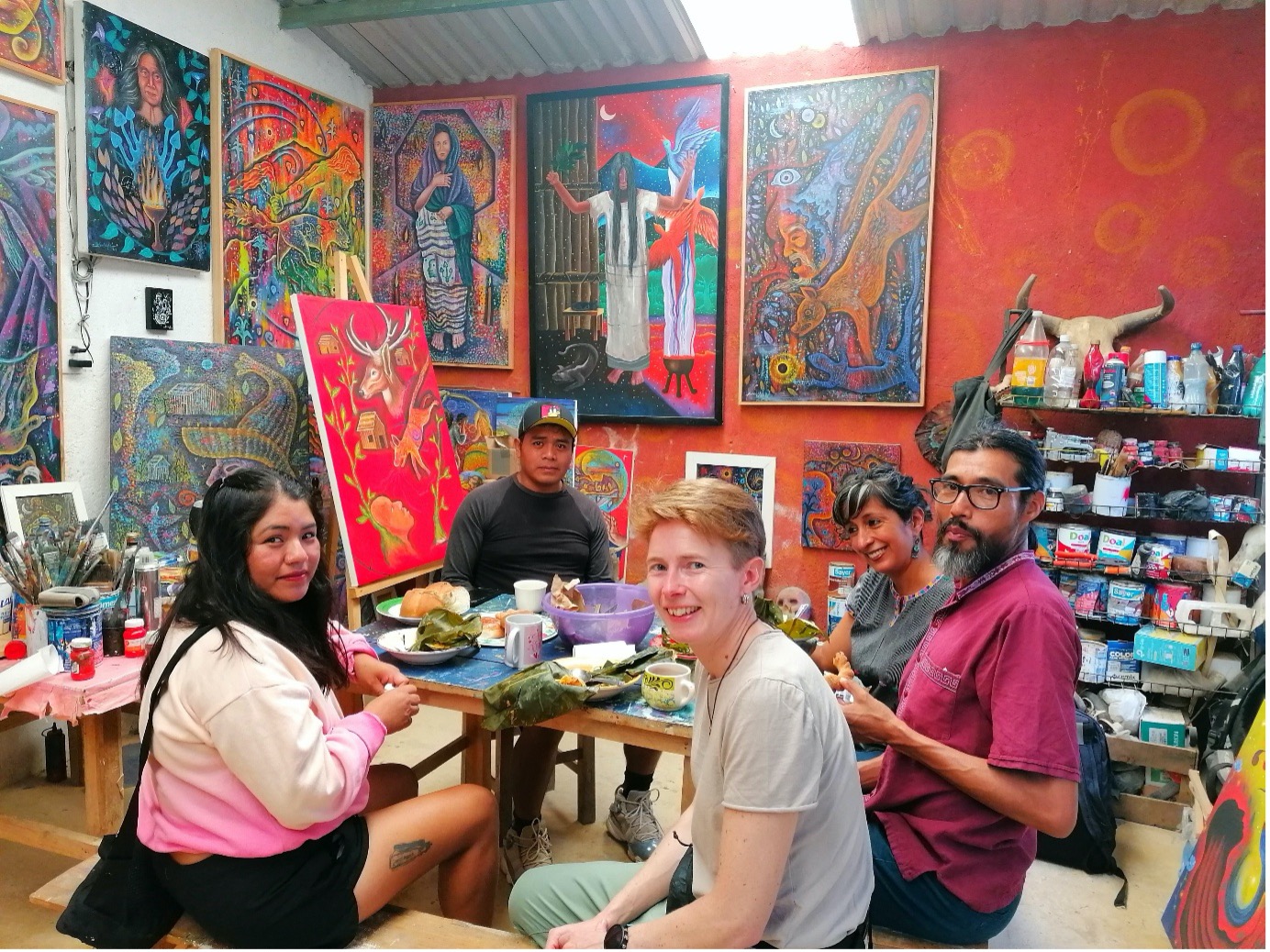
Artists and FSN meet in workshop of Asunción Alvarado
Distribution of copies of the artworks in the Mazateca
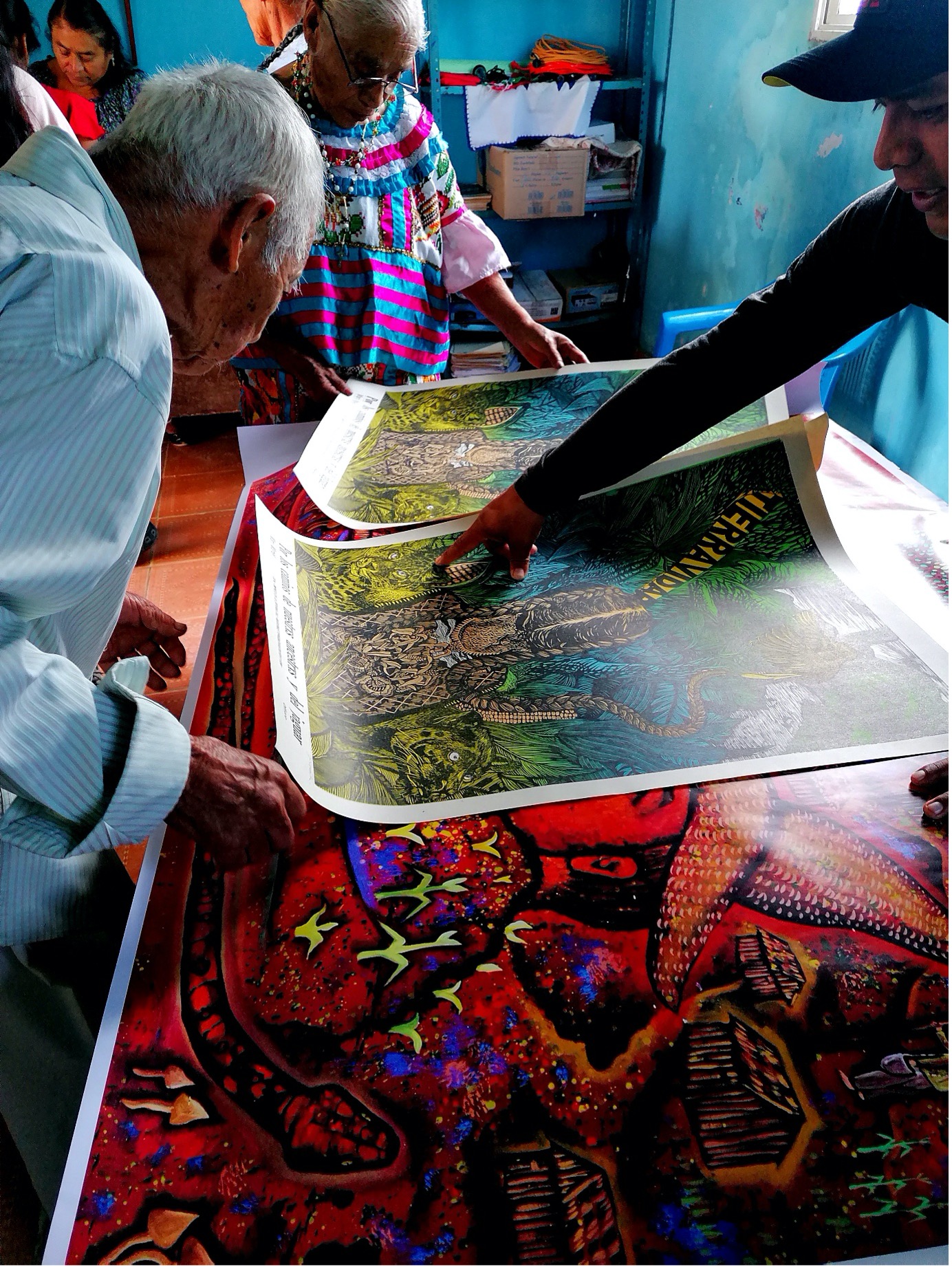
FSN workshop in Casa Adobe, Huautla de Jiménez, 2024