

Leading Burns scholar to rethink national myths at MacDiarmid centenary
Published: 5 November 2026
UofG's Professor Gerry Carruthers will mark the MacDiarmid centenary by challenging the literary myths that shaped modern Scottish identity.
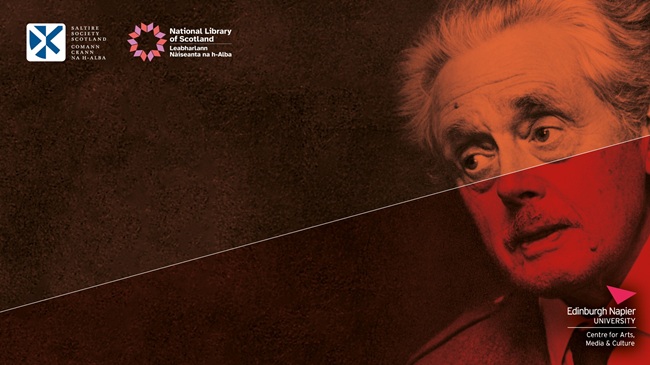
UofG's Professor Gerry Carruthers will mark the MacDiarmid centenary by challenging the literary myths that shaped modern Scottish identity.
Professor Carruthers, founder of the Centre for Robert Burns Studies, joins the MacDiarmid conference later this month to rethink the cultural invention of Scottish identity through the nation’s great authors
Weeks after Scotland's First Minister John Swinney told the SNP conference that independence is “for my son”, one of Scotland’s sharpest literary minds asks a question the independence debate rarely addresses: where did the national movement come from?
Professor Carruthers, widely regarded as the world’s leading Burns scholar, has joined the line-up for A Drunk Man Looks at the Thistle: Hugh MacDiarmid and a Hundred Years of the Scottish Renaissance, the major cultural conference reassessing the life, work and contested legacy of Hugh MacDiarmid, the 20th century’s most influential Scottish writer, in Glasgow on Saturday 21 November – the centenary of MacDiarmid’s masterpiece.
The Andrew Tannahill Fund joins the Saltire Society and the National Library of Scotland to back the MacDiarmid event – a partnership spanning a hundred years of culture
Newly appointed convenor of the Saltire Society, Professor Carruthers established UofG's internationally renowned Centre for Robert Burns Studies in 2007 and is General Editor of the vast new multi-volume Oxford Edition of the Works of Robert Burns, the Oxford University Press edition of the poet’s complete works and correspondence. He has spent a career testing Scotland’s legends against the evidence.
His address, “Burns, Scott, MacDiarmid: Inventing Scottish Identity”, takes on the three writers who made the modern idea of Scotland - and asks what they made up. In the 1920s, MacDiarmid set out to topple the Burns cult, overturn Scott’s romantic nation and forge a new identity reaching back to the medieval makars. A century on, that invention is still taken for granted in Scottish politics and culture.
Professor Carruthers, Francis Hutcheson Chair of Scottish Literature, said: “Scotland’s identity did not simply emerge: it was written. Scott created the myths, Burns was mythologised, and MacDiarmid – a character invented by Christopher Murray Grieve – was both mythologised and demonised.
"A hundred years after A Drunk Man Looks at the Thistle, it is time to ask how much of the Scotland we think we know is based in actual history, and how much was made up by brilliant but unreliable creative geniuses.”
Alexander Linklater, MacDiarmid’s biographer and co-organiser of the conference, said: “In 1973, the cast of 7:84’s The Cheviot, the Stag and the Black, Black Oil ended a performance at the Glasgow Citizens by standing to applaud a member of the audience: the eighty-year-old Hugh MacDiarmid – the heretical communist-nationalist, unwanted by the national party he helped found in 1928, expelled by the Communist Party in 1938.
“Young nationalists who assume their movement was always of the left are mistaken: the SNP of 1934 was Presbyterian, conservative and anti-Irish-immigrant, and its co-founder John MacCormick called MacDiarmid ‘one of the greatest handicaps with which any nationalist movement could have been burdened’. But as Scottish nationalism caught fire from the 1960s onward, it needed a totemic ancestor, and the ‘torchlight procession of one’ – as Norman MacCaig dubbed MacDiarmid – suddenly had a movement marching behind it.
“By the Sturgeon era, MacDiarmid’s left-nationalist contradiction was the unchallengeable norm – but MacDiarmid himself had been dropped as a Salmond-era dinosaur. His heresy had succeeded so completely that it no longer needed the heretic.”
Dr Scott Lyall, leading MacDiarmid expert and co-organiser of the conference, of Edinburgh Napier University, said: "Hugh MacDiarmid’s A Drunk Man Looks at the Thistle is far more than a Scottish literary classic. It is a world-class masterpiece that explores the messy, glorious and complex nature of being human. The poem is the definitive epic of the Scottish Literary Renaissance, a historic cultural movement whose legacy is still passionately debated today.
“While MacDiarmid remains a controversial and highly debated figure in Scotland, this event marks the centenary of his greatest work. We want to bring these debates out of the universities and open them up to the wider public.”
The Tannahill Fund
The conference’s sponsors – the Saltire Society and the National Library of Scotland – are now joined by the Andrew Tannahill Fund for the Furtherance of Scottish Literature. Administered by the University of Glasgow, the Fund commemorates Andrew Tannahill: MacDiarmid friend and correspondent, of the family of the Paisley poet Robert Tannahill.
Together with the conference’s academic partners, the Centre for Scottish & Celtic Studies at the University of Glasgow and the Centre for Arts, Media and Culture at Edinburgh Napier University, the day’s backers now span the very century it examines: the National Library founded in 1925, the poem published in 1926, the Saltire Society founded in 1936 to “foster and enrich” Scotland’s culture, and the Tannahill Fund joining for the centenary.
Conference - A Drunk Man Looks at the Thistle: Hugh MacDiarmid and a Hundred Years of the Scottish Renaissance
Sir Tom Devine opens the conference on the Scotland of 1926, the year the poem appeared and a modern national movement began to take shape. Murray Pittock, David Torrance, Pat Kane and Gerda Stevenson debate whether the movement was born in culture or politics. Maureen Beattie and W.N. Herbert perform the poem as it should be heard. Patrick Crotty introduces the new edition of MacDiarmid’s complete collected poems, Deirdre Grieve remembers the man himself, and Gerard Carruthers asks whether the Scottish Renaissance was a force of national renewal or something darker. Sally Magnusson presents the day, which closes with the story of the independence movement’s last 10 years.
Saturday 21 November 2026, Strathclyde Suite, Glasgow Royal Concert Hall
Doors open 9.00am · Programme runs 9.30am–4.30pm
Tickets £25 + booking fee (£10 concessions), including light lunch
Tickets available here: A Drunk Man Looks at the Thistle: Hugh MacDiarmid and a Hundred Years of the Scottish Renaissance - Tickets
Sponsored by the Saltire Society and the National Library of Scotland · Supported by the Andrew Tannahill Fund for the Furtherance of Scottish Literature. In partnership with the Centre for Scottish & Celtic Studies, University of Glasgow, and the Centre for Arts, Media and Culture, Edinburgh Napier University.
First published: 5 November 2026
Related Links
- Professor Gerard Carruthers - Research Profile
- Centre for Robert Burns Studies
- Centre for Scottish & Celtic Studies
- College of Arts & Humanities
- The Andrew Tannahill Fund
- A Drunk Man Looks at the Thistle: Hugh MacDiarmid and a Hundred Years of the Scottish Renaissance - Tickets
- Saltire Society - website
- National Library of Scotland - website