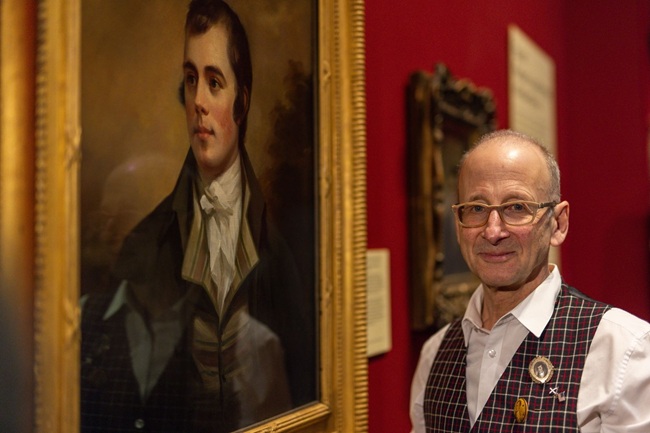
The painting will go on public display for the first time to celebrate Burns Night (25 January). It is now available to view free of charge at National Galleries Scotland: National, on the Mound in Edinburgh.
The painting of Robert Burns was found during a house clearance in Surrey and consigned to auction in Wimbledon, London in March 2025. With a starting price of between £300─£500, the winning bid was £68,000.
A triumph against all the odds, Dr William (Bill) Zachs, Director of Blackie House Library and Museum in Edinburgh and long-term Burns scholar and enthusiast, understood the potential significance of the painting and purchased the portrait believing it could be the elusive missing artwork. The painting has since been cleaned, and examined by experts, who confirm that it is, indeed, the lost Raeburn portrait.
Dr Zachs is lending the painting to the National Galleries of Scotland, to go on display for free from 22 January at National Galleries Scotland: National on the Mound in Edinburgh. It will then tour to the Robert Burns Birthplace Museum (National Trust for Scotland) in Alloway from 21 July.
Dr Zachs, said: "This week at Burns Suppers in Scotland and around the world we toast the Immortal Memory of the poet. Now we have a new immortal visual memory – a once lost painting by Sir Henry Raeburn, the Scottish great portrait artist, that depicts Robert Burns not just as a genius poet but as a celebrated (and handsome) Scotsman whose significance would endure 'till a' the seas gang dry'."
Lesley Stevenson, Senior Conservator (Paintings), at the National Galleries of Scotland said: "Raeburn’s expressive, seemingly effortless brushwork, the characteristic warm palette, soft, atmospheric lighting and sensitive rendering of the instantly recognisable Robert Burns, are a joy. This is a significant discovery and one we can all celebrate."
Professor Murray Pittock, Pro Vice-Principal University of Glasgow, and the Centre for Robert Burns Studies said "Raeburn’s portrait of Burns shines with the glow which is typical of the painter. It shows the now-dead poet moving into the realm of legendary icon, a transition he was to accomplish within less than a generation. In that sense the Burns we celebrate today is Raeburn’s Burns, though until now we did not know it."
Professor Gerard Carruthers FRSE, Francis Hutcheson Professor of Scottish Literature and the Centre for Robert Burns Studies at the University of Glasgow said: "A lost likeness of Burns and a new Raeburn to boot: this really is two red letter days in one. There have been rumours of the portrait's existence over many decades, but the recent detective work to authenticate has been simply outstanding."
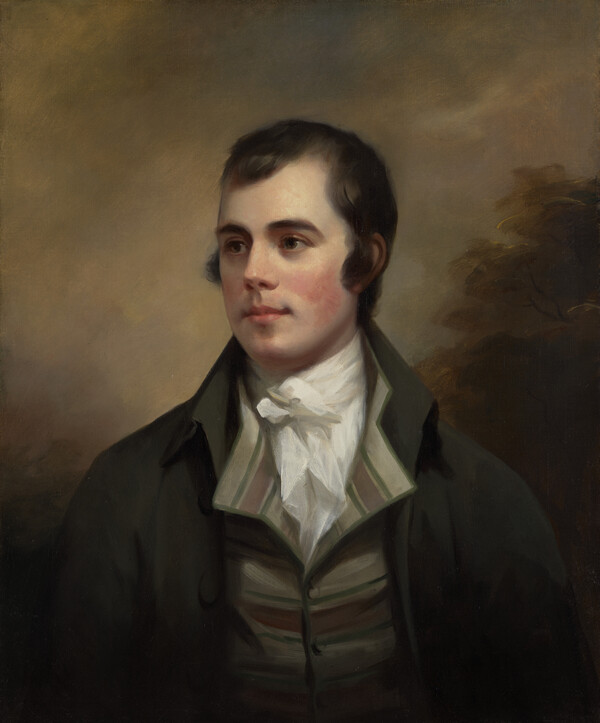
Commissioned in 1803 ─ at a fee of 20 guineas ─ by the publishers Cadell & Davies, the painting was to be engraved for future editions of Burns’s books, but, the painting has not been seen since. Its whereabouts remained a mystery for many decades. In 1924 TCF Brotchie, the Director of Glasgow Art Galleries and Museums, wrote that the painting’s discovery would be ‘an event bordering upon the sensational'.
Lovers of Robert Burns and art experts alike have long debated the painting’s location. This resulted in much press and journal coverage over the decades, as various portraits of Burns were attributed to Raeburn. However, all were dismissed and the painting remained lost until now.
Robert Burns (1759–1796), Scotland’s national poet, has had a lasting influence on literature, music and popular culture. His work continues to shape Scotland’s cultural identity and resonates with audiences worldwide.
The original 1787 portrait was painted by the Edinburgh-born artist Alexander Nasmyth as part of a marketing strategy for the second (Edinburgh) edition of Burns’s breakthrough book, Poems, Chiefly in the Scottish Dialect.
This painting, which is now recognised across the world, is part of Scotland’s national art collection. Despite Nasmyth’s move away from portraiture towards landscape painting, he took the job, declining to accept a fee, as he became a friend of Burns. For the first time, Raeburn and Nasmyth’s paintings will go on display side by side at the National gallery on the Mound in Edinburgh, to allow visitors to make their own comparisons of the two portraits.