

Urban ethnography and walking Nan Shepherd’s mountain.
Published: 4 May 2026
Natanya Mark explores a lesson from Nan Shepherd about how we might properly attend to the places we inhabit.
Two images were sent to me recently, and form the basis of reckoning for this reflection.
One picture was of the last walls standing of Old Kent Road Arts Club, where together with my co-directors of F.A.T. Studio, I co-founded a free community arts club where we ran public workshops between 2021-2023 in a meanwhile space on the busy thoroughfare of Old Kent Road, South East London. A few weeks ago, as part of the Old Kent Road Area Action Plan, the studio was bulldozed to the ground. This was after we secured a £20,000 grant from the Mayor of London in 2021 to set up the space, and match-funded this through crowdfunding. We welcomed thousands of people to the space over the years; people made friends, learnt new skills, started projects for the first time, ran their own community clubs. However ultimately site precarity and a lack of funding meant that the arts club could no longer continue.
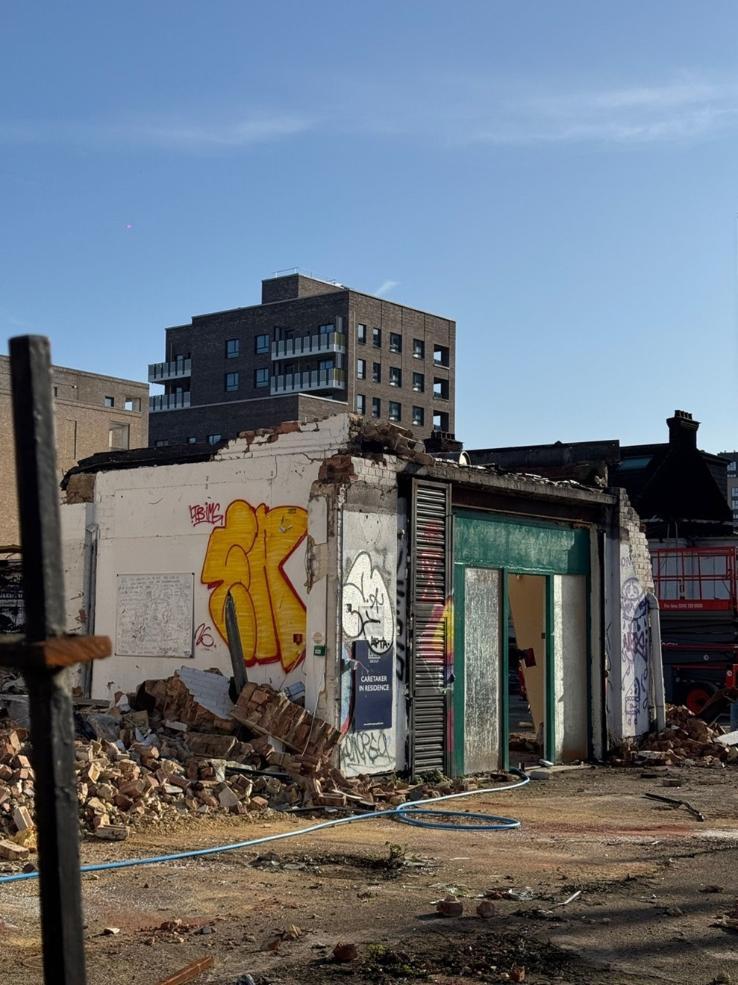
Photograph: Rachel Sale
The second image that arrived this week was a photograph of a map that Lizzie made in response to a public walk that we ran together in London as Local Senses. Local Senses was a project I started while volunteering at the Royal National Institute of Blind people and studying for my Masters at the Royal College of Art in Visual Communication. From 2017-2022 as a group of individuals with varying levels of vision we creatively responded to the experience of navigating outdoor urban environments together. We devised public urban walking workshops enabled through a Culture Seeds grant and an R&D grant for Liberty Festival 2021. Through this I learnt and shared skills of presence and engagement with the city through walking, listening, touch - diverse ways of seeing. Lizzie taught me a huge amount about being in and with the world. She passed away in December 2024 and this photograph of the tactile map she made during one of our projects was shared with me, and returned me to our time and places together.
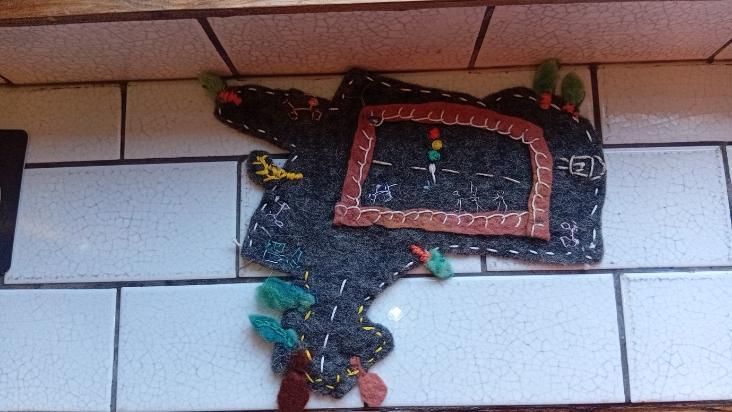
Photograph: Geoff Clark
My PhD research considers grassroots creative spaces as spaces of hope through a sensory urban ethnographic methodology attuned to the emergent present. The contributions of these spaces are hard to measure. Their value cannot be contained by walls or pavements; though the traces of what Ross Beverage might describe as their ‘resonance’ can be felt through these urban contact sites. Something about the way these projects continue to appear within what John Holloway might term the ‘cracks’ of capitalist cities suggest that something is missing from the ways that we live together. In my research I pay close attention, through a collaborative and sensorially grounded utopian method that draws on the work of Ruth Levitas, to the ways in which DIY spaces act out possible futures in the present, and how such projects work with both hope and with the failures endemic to such efforts.
I recently finished Nan Shepherd’s book The Living Mountain, which was first published in a small print run in 1934. It documents her life-long encounter with the Cairngorms and thanks in large part to Robert Macfarlane (who describes her work as a key driver of his own literature) it has become enlivened in contemporary reading.
Shepherd uses the senses as a way of engaging with the ‘total’ mountain. Shepherd observed that to listen in ‘one sense at a time is to live all the way through’. In a passage of particular clarity, Shepherd writes:
‘On another misty day – a transparent mist – I saw a peregrine falcon fly out from a precipice. There were the curved and pointed wings, the rapid down-beat of the pinions. Yet I stared incredulous. […] No peregrine could be of such as size. It was only when he stood still on the air, before sailing back to the crag, that I believed my own eyesight; and it was only then that I understood what Hopkins meant when he wrote:
To see the eagle’s bulk, render’d in mists / Hang of a treble size'.
This account suggests how we might contend with what Les Back describes as the challenge of making the ‘social’ (or more-than-human) ‘world hold still for its portrait’, whilst still keeping the thing alive. Through Shepherd’s durational and embodied ethnography of the Cairngorms, she observed, ‘the thing to be known grows with the knowing’ (like the falcon here rendered large).
Yet what happens – as in the case of these two images that returned to me – when we work with others to build spaces of discovery that we can no longer see, that are no longer there or that we cannot point to? What happens when we go out to climb the mountain and find that it no longer exists?
Written in a contemporaneous era to Shepherd, this recalls the famous lines of W.B. Yeats:
'Turning and turning in the widening gyre/ The falcon cannot hear the falconer; /Things fall apart; the centre cannot hold;'.
John Berger writes in Ways of Seeing that ‘seeing comes before words’. This summer I took a group to listen to the Stockingfield Bridge community art project in Maryhill. One of the participants reflected, following our listening exercise, grounded in Pauline Oliveros’ deep listening practice: ‘with the memory of what I’m seeing all around me, inside I’m building a spatial map.’ Shepherd writes that we can listen in to the vast presence of almost-never silence and also into ‘turmoil’. Back writes in the Art of Listening about ‘[h]ow sociology could and should play a role in returning our ears to the world’. What can this constructivist practice of listening teach us about the way we might pay attention to the building of worlds within and against turmoil?
One of the most salient moments during a Local Senses project was when one of the participants, whilst kicking through rubbish at the end of Deptford market in South East London, mistook the market detritus for fallen leaves, and group member Rikki wrote a song featuring the encounter: Love You Deptford. This was not a moment of recognition; in fact it was a moment of un-recognition and re-made the everyday anew. Shepherd too talks of moments of illusion; where lochs disappear and houses seem to float. Steven Johnstone wrote, drawing on Henri Lefbevre ‘the everyday is the site of a fundamental ambiguity: it is where we become alienated and where we can realize our creativity’.
These moments of intense presence are non-linear spaces of encounter. Such moments in the Lefebvrian sense can return to us sharply within our everyday. In doing so they punctuate the rhythms of daily life with both a recall to Yeats’ chaos and a re-invigoration of utopian possibility held in Shepherd’s moment of ‘incredulous’ recognition.
In our now hyper-connected and equally fragmented times, a practice of attention (when it feels like the centre cannot hold) is a vital craft to listen, record and connect – with each other and to moments of possibility for a life otherwise that emerge from that ‘transparent mist’ of the everyday. Noreena Hertz asks, in our ‘contactless’ and lonely age, where can we look for spaces of hope?
When the infrastructures and landscapes that support access to spaces of discovery are under threat we must continue to walk Shepherd’s mountain – alone and with others – to hone a language by which to attend to spaces of emergent possibility; to keep ways of seeing alive and perhaps re-make them together.
References
Back, L. (2007). The art of listening (English ed). Berg.
Back, L. & Beverage, R. (2024) ‘Wastelands: Is Wastelands Ever Wasted?’ Recovering Communities Podcast, 30 May 2024 Available at: https://www.gla.ac.uk/explore/glasgowsocialscienceshub/resources/all/headline_1077769_en.html
Berger, J. (1997). Ways of seeing: Based on the BBC television series with John Berger; a book made (37. pr., 1. publ. 1972 by British Broadcasting Corp. and 1977 by Penguin Books). British Broadcasting Corp.
Hertz, N. (2020). The lonely century: How isolation imperils our future. Sceptre.
Holloway, J. (2022). Hope in hopeless times. Pluto Press.
Johnstone, S. (Ed.). (2008). The everyday. Whitechapel ; MIT Press.
Lefebvre, H. (2014). Critique of everyday life: The one-volume edition. Verso.
Levitas, R. (2013). Utopia as method the imaginary reconstitution of society. Palgrave Macmillan.
Oliveros, P. (2005). Deep listening: A composer’s sound practice. iUniverse.
Shepherd, N. (2011). The living mountain: A celebration of the Cairngorm mountains of Scotland. Canongate.
W.B. Yeats. (n.d.). The Second Coming. Retrieved https://www.poetryfoundation.org/poems/43290/the-second-coming
First published: 4 May 2026
<< Blog