

Away from the faeries: the rehabilitation of Tam Lin.
Published: 2 March 2026
Fergus McNeill asks: 'what does an old Scottish folk-tale have to teach us about the meaning of rehabilitation?'
 |  |
|---|---|
| Fair use by permission of Floris Books | Linocut print by Peter Nevins |
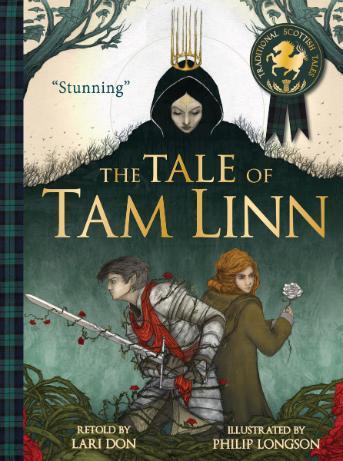
There is an old Scottish folktale – the tale of Tam Lin (or Linn). Its origins are unclear and it exists in many forms. Two of my favourite versions are found in this folk song by Anais Mitchell and Jefferson Hamer, and in this children’s book written by Lari Don and illustrated by Philip Longson.
In brief outline, the story is that, as a child or a young man, Tam ignored the instructions (given to all children) never to enter the Faerie Woods. In the woods, Tam was captured by the Faerie Queen and turned into a Faerie Knight, condemned to serve her.
Years later, a young woman called Janet ignores the same instruction and meets Tam in the woods. She escapes, but vows to return to rescue him, equipped by Tam with knowledge of the curse that binds him to the Faerie Queen. To rescue Tam, Janet endures various ordeals; clinging on to Tam Lin while the Faerie Queen turns him (in the children’s story) first into a snake, then a wildcat, then a swan, then a stag, then a wolf, and finally a burning branch. Janet refuses to let go until she throws the burning branch into a well from which Tam emerges, finally free of the Faerie Queen’s power. Janet and Tam leave the woods together.
This is, I think, the story of rehabilitation and reintegration. Tam and Janet have transgressed social rules and suffered the consequences, and they face a titanic struggle to find a way back. To succeed in that struggle, they need guile, bravery, persistence and, ultimately, love.
The story resonates with me in large part because it is one that I’ve encountered countless times in my personal, professional and academic lives. In a recent public lecture for the Howard League for Penal Reform, I spoke about my own journey with the ideals and the realities of rehabilitation over the last four decades, and how it has led me to a new 5-year project entitled ‘Rehabilitation and Reintegration in Europe’ (RaRiE), funded by the European Research Council, and undertaken in partnership with colleagues in the Universities of Leiden and Oslo.
RaRiE emerged from the observation that penal systems often do great harm when aiming to do good, not least by expanding the scale, reach and intensity of penal control (cf. McNeill, 2018). For example, recent work in the sociology of punishment suggests that ‘rehabilitation’ has become focused on managing risk than enabling reintegration and that, in consequence, it often hurts and harms those that it claims to help.
By examining evidence from three countries that are often considered (rightly or wrongly) to be progressive in penal terms (the Netherlands, Norway and Scotland), RaRiE aims to better understand whether and where rehabilitation lives up to its ideals, and to creatively, critically and comparatively interrogate its development and prospects, its coherences and contradictions, its rhetoric and its realities, its pitfalls and its possibilities.
To that end, we aim to employ a new dialogical approach to the comparison of penal systems: Rather than researchers gathering data and doing the comparison themselves, we aim to work with our participants (who will include policymakers, senior leaders in prison and probation systems, practitioners, activists and people with lived experience of rehabilitation) to develop our comparative analyses together; and we will use creative methods to explore and represent individual and collective experience and knowledge. Through this process, we hope that RaRiE will provide a uniquely comprehensive analysis of the nature and impact of rehabilitation in these three nations. It will also develop new tools and methods for critically assessing rehabilitative systems and practices, to better direct their future development – or perhaps replacement. We’ll have a project website up and running in due course.
One insight from the Tale of Tam Lin that I’ll carry into this project is this: Tam is not the agent of his own rehabilitation. Though they worked together to defeat the Faerie Queen’s power, Tam could never have found his way back alone. It is Janet – or perhaps more accurately, the relationship between them – that enables his escape, and her own. It is also Janet who, presumably bears the scars of her ordeal.
Of course, the Tale of Tam Lin needs a sequel: We need to know what sort of reception they met when they returned home, and what struggles they faced in building their subsequent lives together (or apart). To escape the faeries is one thing; to live well among us mortals is another.
First published: 2 March 2026
<< Blog