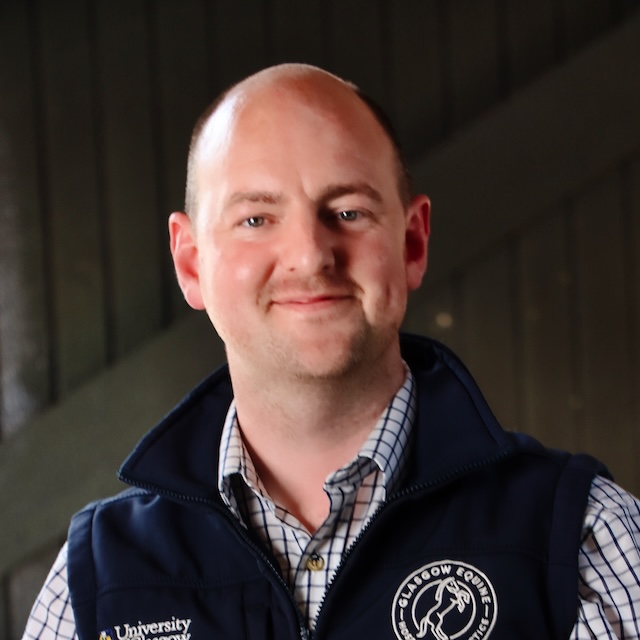
Mr James Risk
- Senior Clinician in Equine Practice (Equine Clinical Sciences )
 https://orcid.org/0009-0004-6695-1260
Biography
James Risk is Head of Glasgow Equine Practice and Deputy Director of Glasgow Equine Hospital & Practice, based at the Weipers Centre, Garscube Campus, University of Glasgow School of Veterinary Medicine. He leads the first-opinion ambulatory arm of an integrated hospital and practice system, providing primary equine care across central Scotland alongside undergraduate clinical teaching.
James graduated in veterinary medicine and surgery from the University of Edinburgh and holds an RCVS Certificate of Advanced Veterinary Practice (CertAVP). Before joining Glasgow he held clinical and management roles across mixed and equine practice in Scotland, including practice and clinical directorships, with a particular focus on advanced equine dentistry, in-house laboratory development and clinical governance.
Within Glasgow Equine Hospital & Practice his work spans ambulatory clinical practice, final-year clinical teaching, divisional leadership and clinical governance. He has supported the integration of the ambulatory service into the School's equine clinical skills teaching.
James represents the equine profession in national policy and advisory work. He is the Scottish representative for the British Equine Veterinary Association (BEVA) at BVA Scotland, sits on the Scottish Government equine stakeholder group on behalf of BEVA, and is a regional representative on the BEVA Medicines Committee. This work includes direct engagement with MSPs and equine stakeholders on equine health and welfare. He is a past Chair of The British Horse Society (Scotland).
Research interests
James's interests span first-opinion veterinary medicine. Having worked in small animal as well as equine and mixed practice, he is interested in all aspects of primary-care veterinary work and the translation of evidence into routine clinical care, with much of his current activity grounded in equine ambulatory practice.
Point-of-care diagnostics is his principal area of interest. He is interested in how diagnostics delivered at the point of care can improve animal welfare through faster, better-informed clinical decisions, and how their immediacy supports student learning — students see the results of the tests they have run in real time, reinforcing the link between sampling, diagnosis and clinical reasoning.
His wider interests include equine dentistry, including clinical standards and procedural protocols in ambulatory dentistry; responsible medicines use, encompassing anthelmintic stewardship and evidence-based faecal worm egg count testing, and responsible antimicrobial use through national stakeholder work; and veterinary education and science communication, including structured clinical teaching and public-facing equine health education.
Supervision
Open to supervising applied clinical projects in point-of-care diagnostics in equine practice, particularly work examining their impact on clinical decision-making, animal welfare and undergraduate clinical learning.
Teaching
Teaching is central to James's role at the School of Veterinary Medicine, and the integration of a working first-opinion practice into the teaching mission is a core part of why the ambulatory service exists within the School. Glasgow Equine Practice contributes across the veterinary programme, not only in the final year.
In the final year, the practice delivers clinical teaching through ambulatory work. Students join equine visits and take part in the everyday tasks of first-opinion veterinary care — vaccination, wound management, blood sampling and orthopaedic examinations — developing the practical competence and clinical reasoning they will rely on in practice. The practice retains a full final-year rotation block in-house and has expanded the number of student rotations it delivers.
Clinical skills teaching runs throughout the programme, across all years, with the practice vets heavily involved. A defining strength of the Glasgow model is the integration of clinically active practice staff with teaching-focused staff: rather than clinical and teaching roles operating separately, staff mix across all year groups, with clinical staff contributing to lectures and skills sessions alongside the teaching team. Students gain consistent exposure to current first-opinion practice while retaining the structure and depth of dedicated teaching.
The practice joins OSCE examinations and helps to deliver the equine selective teaching rotation. James oversaw and facilitated the integration of the ambulatory service into the School's teaching.
This breadth of clinical interest shapes the rotation. Student feedback consistently notes that students who do not arrive with a primary interest in equine work still enjoy and value the rotation. Staff are happy to compare and contrast approaches across species, to meet students at the level they are at, and to draw out individual interests and connect them back to equine practice.
Across this work, James emphasises clinical reasoning and value-based care — encouraging students to ask what question a given investigation answers, and whether the answer will change what they do, so that good care means doing what is indicated for both the animal and the client.
Professional activities & recognition
Professional & learned societies
- 2018: BEVA representitive, Scottish Government Equine Stakeholder Group
- 2022: Scottish Veterinary representitive, BHS Equine Health and Advisory Commitee
- 2020: Scottish regional representitive, BEVA Health and Medicines Commitee
- 2018: BEVA representitive, BVA Scotland