

Previous events
Conferences
War Studies Seminar Series 2025-26
Thursday, 23 October 2025
5:15pm, Boyd Orr Building, Room 513
Dr Aviva Guttmann (Aberystwyth), ‘The International Relations of the Secret State: European Support for Israeli Covert Actions (1971-79)’
Joint Event with the Cambridge Intelligence Seminar
In this talk, Dr Aviva Guttmann discusses her most recent book, Operation Wrath of God: The Secret History of European Intelligence and Mossad's Assassination Campaign (Cambridge, 2025), which examines the role of European intelligence in one of the most spectacular targeted killing operations of Mossad. Operation Wrath of God was organised in response to the 1972 Munich Olympics Massacre. The operation consisted of ten missions to kill Palestinians who were directly or loosely associated with Palestinian terrorism. Aviva’s research reveals for the first time that European intelligence played a vital role in the organisation and execution of Operation Wrath of God. Her research is based on unprecedented access to archival records from a secret intelligence-sharing liaison called Club de Berne. Aviva will advance two arguments. First, European intelligence was key for Israel to organise and carry out its covert actions. Second, because intelligence cooperation was so beneficial for all the parties, the Europeans let Mossad operate and tolerated the use of its shared intelligence to kill Palestinians suspected of terrorism involvement. In other words, the extensive advantages that the European agencies gained through intelligence-sharing led them to turn a blind eye towards, or even tacitly support, Israel’s Operation Wrath of God assassinations on their respective territories. This advances our understanding of the international relations of intelligence agencies.
Dr Aviva Guttmann is a Lecturer in Strategy and Intelligence at Aberystwyth University. She is the author of The Origins of International Counterterrorism (Leiden, 2018) and the just published Operation Wrath of God: The Secret History of European Intelligence and Mossad’s Assassination Campaign (Cambridge, 2025). She is the founder and chair of the Women’s Intelligence Network (WIN), which connects and promotes women scholars and practitioners in the field of intelligence studies. Before joining Aberystwyth, she was a Marie Curie Senior Researcher and a Research Associate in the War Studies Department at King’s College London. She further has four years of work experience in Security Sector Reform in Geneva (Switzerland) and Abuja (Nigeria).
Thursday, 6 November 2025
5:15pm, Humanities Research Hub, 1 University Gardens, Room 102
Dr Catriona Kennedy (York), “Remembering and Forgetting Wellington’s Irish Soldiers”
Irish soldiers were to the fore in some of the most celebrated episodes of martial heroism in the Napoleonic wars. With an estimated 150,000 Irish soldiers having served in the British army between 1793 and 1815, this constituted a significant collective experience for Irishmen, both Catholic and Protestant. As John Cookson observes, given that the military exploits of Irishmen in the Napoleonic wars were no less than those of Scots, and that Ireland continued to make a very significant contribution to the British army after 1815, it may seem puzzling that ‘Irish society made so little of these achievements’. Pursuing that conundrum, this talk will explore how Wellington’s Irish soldiers were represented and remembered in public memorials, military memoirs, and novels in the decades immediately following Waterloo, and ask why they failed to secure a more enduring place in the national imagination.
Catriona Kennedy is a Reader in Modern British and Irish History at York University. Her most recent book, Women, Politics, and the Irish Public Sphere in the Age of Revolution (Oxford University Press, 2025) explores how women from different social and religious backgrounds navigated late eighteenth-century Ireland intense ideological conflicts.
Thursday, 20 November 2025
5:15pm, Humanities Research Hub, 1 University Gardens, Room 102
Professor Anna Feigenbaum (Glasgow) “Is Tear Gas as British as Tea? An Examination of the UK’s Historical Role in the Marketing and Deployment of Tear Gas”
This paper examines the use of tear gas from the battlefields of World War I to the streets of colonial India, and from the Bogside in Northern Ireland to the Umbrella protests in Hong Kong. Drawing from military, colonial, and science archives, this talk explores policing conflict with tear gas over the past 100 years – and the politics that surrounds it.
Anna Feigenbaum is Professor of Media and Digital Storytelling at the University of Glasgow. She previously held positions at Bournemouth University, the Rutgers Center for Historical Analysis, and the London School of Economics and Political Science. She completed her PhD at McGill University. She has published in a range of outlets, including South Atlantic Quarterly, ephemera, Feminist Media Studies, Fuse magazine and Corpwatch.org. She is the co-author of The Data Storytelling Workbook (Routledge, 2020), co-editor of Protest Camps in International Context (Policy Press, 2018), and author of Tear Gas: From the Battlefields of World War I to the Streets of Today (Verso, 2017).
Thursday, 27 November 2025
5:15pm, Room TBC
Professor Peter Jackson (Glasgow), “The First World War and the Birth of Modern Intelligence”
This paper argues that the Great War brought about a revolution in intelligence practices. This revolution was driven by two pre-war technological innovations. The first was the advent of radio as a principal form of communication. The second was the evolution of manned flight. Together these developments ensured that the information war would take place in the air and at sea as well as on (and beneath) the ground. The end result was an explosion of intelligence of all kinds. To manage this new state of affairs the intelligence agencies of all belligerent powers expanded dramatically. Large numbers of civilians - especially women - were for the first time and employed in burgeoning intelligence communities that used the latest information processing technologies. Intelligence had become an industrial enterprise in what was by 1917 a truly global conflict.
Professor Peter Jackson is Chair of Global Security at the University of Glasgow. He received his PhD in History from the University of Cambridge, and previously held academic appointments at Yale, Aberystwyth, and Strathclyde as well as visiting appointments at Sciences Po and the Sorbonne. He has served as editor of Intelligence and National Security, the world's leading journal on intelligence and security issues, and is a Fellow of both the Royal Society of Edinburgh and the Royal Historical Society. He co-edited L'essor du renseignement moderne. Une histoire mondiale de l'espionnage (Nouveau Monde Editions, 2025), and is the author of Beyond the Balance of Power: France and the Politics of National Security in the Era of the First World War (Cambridge, 2013).
War Studies Seminar Series 2024-25
War Studies Seminar Series 2023-24
War Studies Seminar Series 2022-23
War Studies Seminar Series 2020-21
War Studies Seminar Series 2019-20
War Studies Seminar Series 2018-19
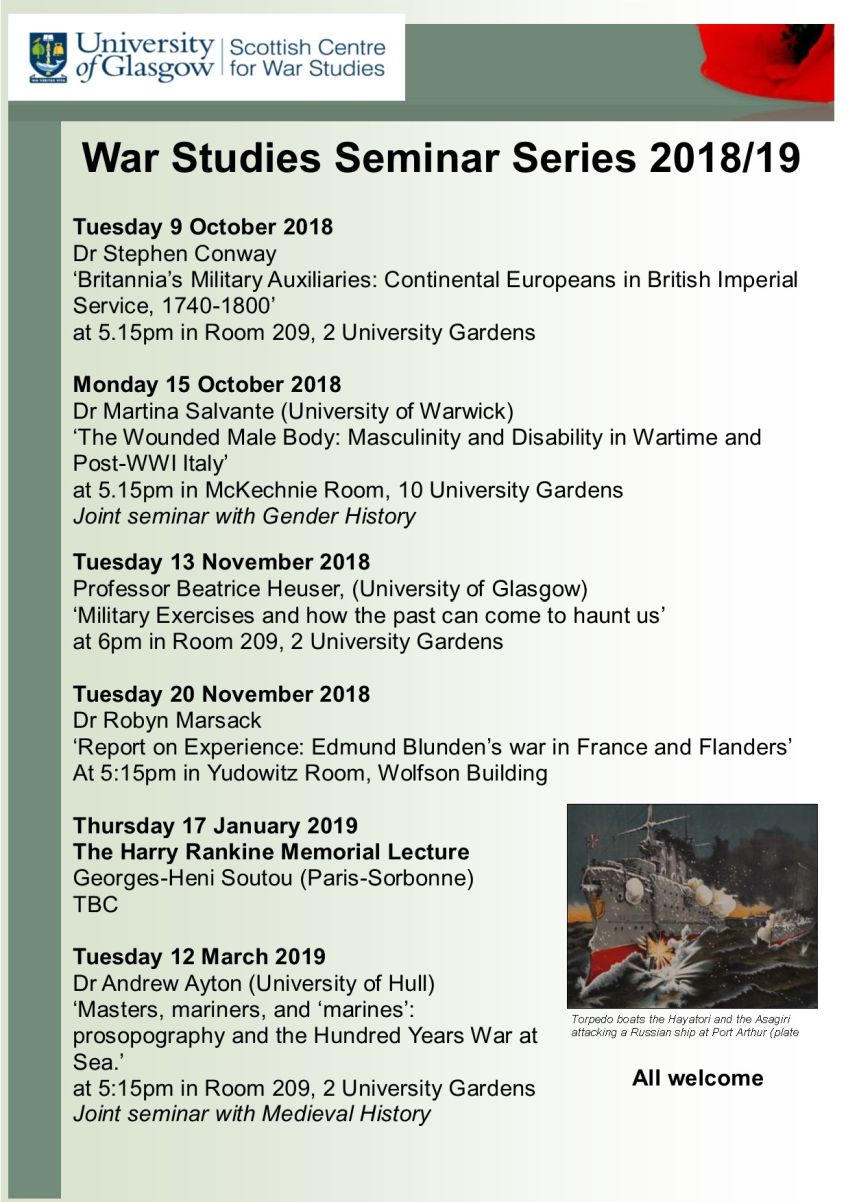
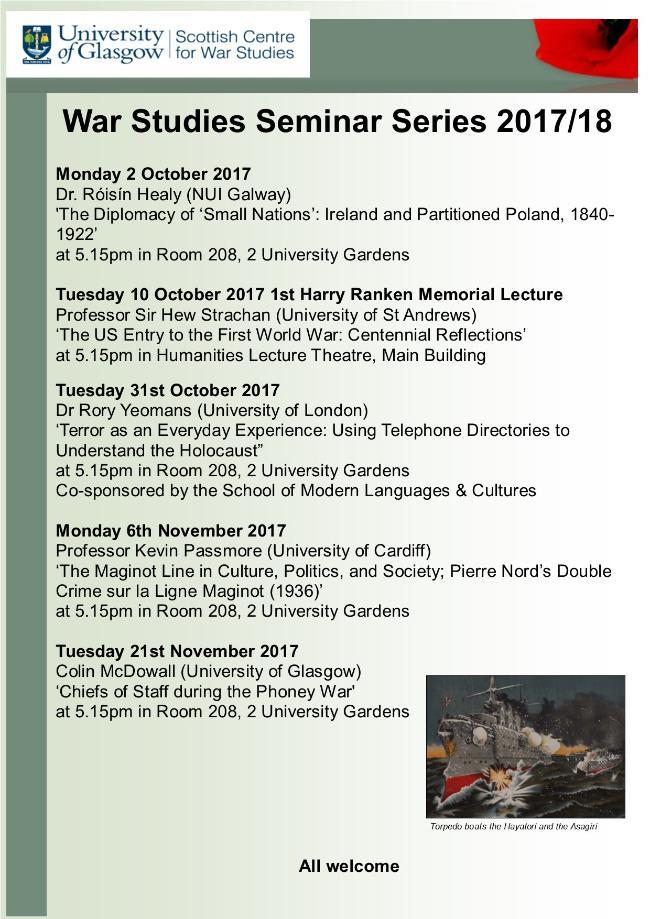
War Studies Seminar Series 2017-18
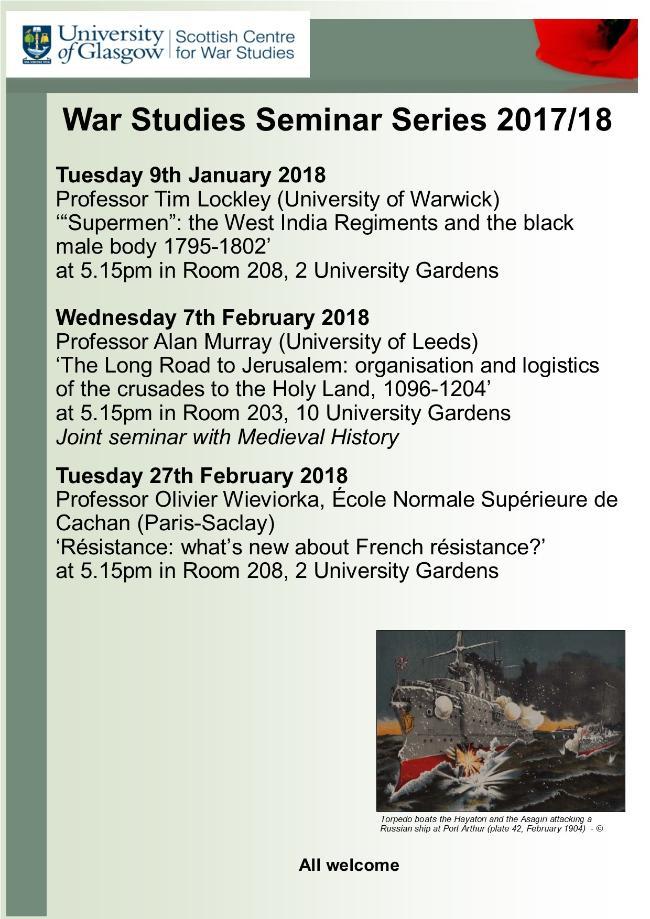
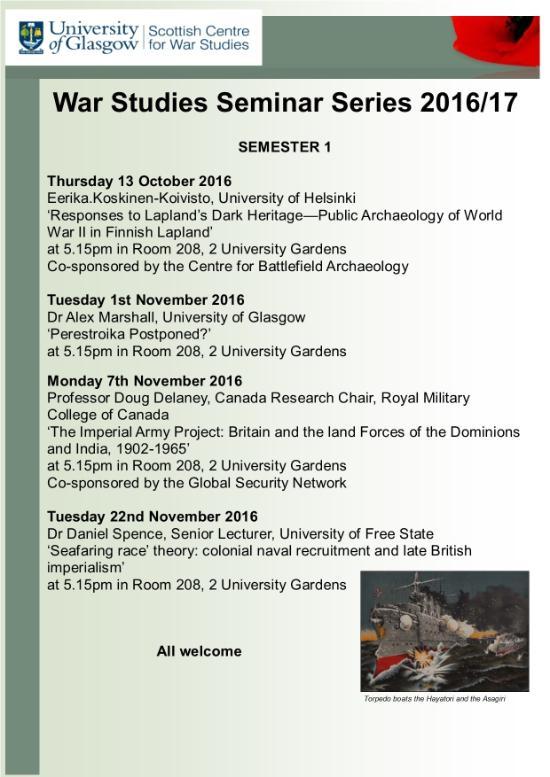
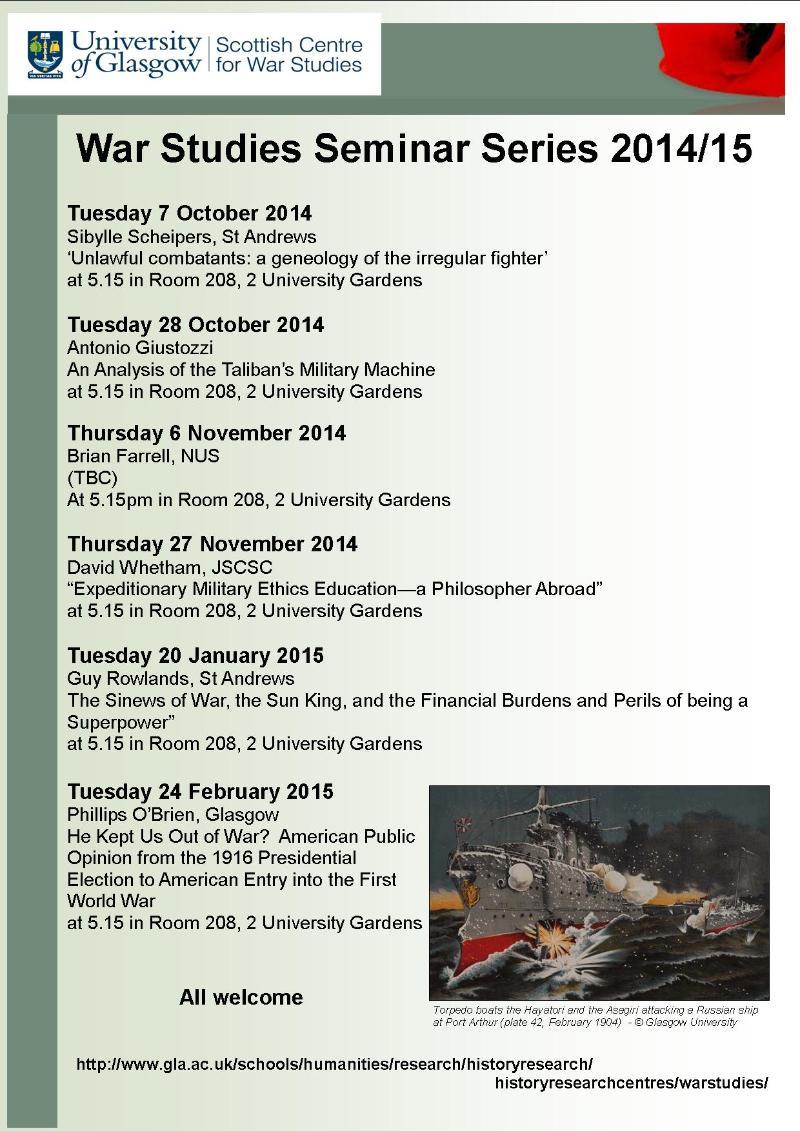
War Studies Seminar Series 2016-17
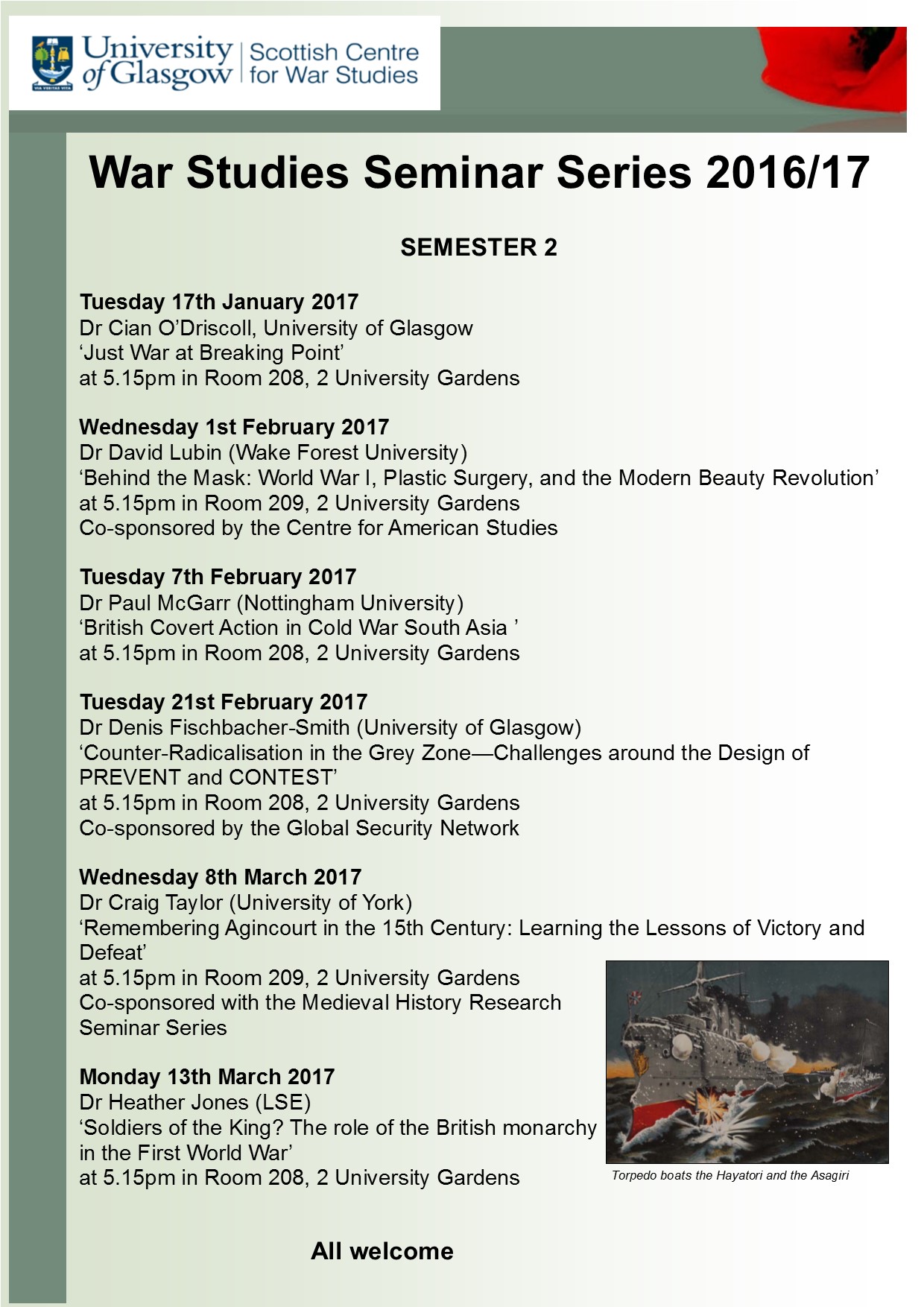
War Studies Seminar Series 2015-16
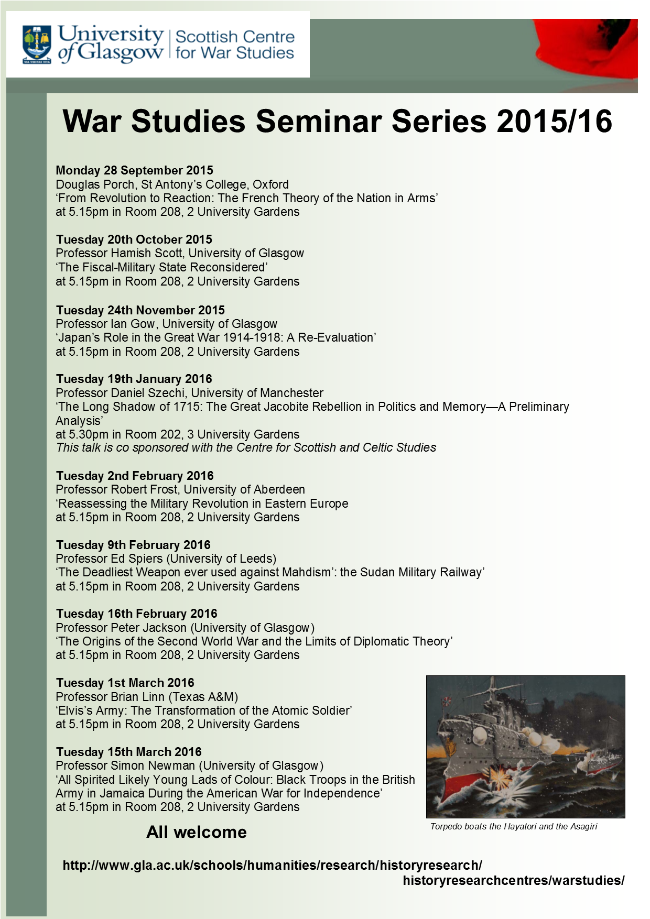
War Studies Seminar Series 2014-15
War Studies Seminar Series 2012-13
Wednesday 20 March 2013
Professor Warren Brown, Instrumental Terror in Medieval Europe
at 5pm in the Lecture Room, 10 University Gardens(tbc)
Joint War Studies/Medieval History seminar
Warren C. Brown is Associate Professor of History at the California Institute of Technology. His publications include Unjust Seizure: Conflict, Interest and Authority in an Early Medieval Societ (Cornell University Press, 2001); with Piotr Górecki, eds., Conflict in Medieval Europe: Changing Perspectives on Society and Culture (Ashgate Press, 2003); Violence in Medieval Europe (Longman, 2011); and with Marios Costambeys, Matthew Innes, and Adam J. Kosto, eds., Documentary Culture and the Laity in the Early Middle Ages (Cambridge University Press, 2013).
Tuesday 7 May 2013 - CANCELLED: rescheduled to Tues 25 Feb 2014
Professor Michael Broers (University of Oxford, Lady Margaret Hall): 'The Evolution of Counter-Insurgency Policy in Napoleonic Europe'
at 5pm, in the Lecture Room, 10 University Gardens
Tuesday 14 May 2013
(University of Glasgow): The Significance of United States Strategic Fighters in the European Theatre of Operations During WWII
at 5pm in the Lecture Room, 2 University Gardens
Tuesday 25 February 2014
Professor Michael Broers (University of Oxford, Lady Margaret Hall): 'The Evolution of Counter-Insurgency Policy in Napoleonic Europe'
at 5pm - room tbc
War Studies Seminar Series 2011-12
Tuesday 4 October 2011
Professor Jeremy Black: War, Technology and the Rise of the West 1450-2011 Reconsidered
at 5pm in the Seminar Room, 2 University Gardens
Tuesday 11 October 2011 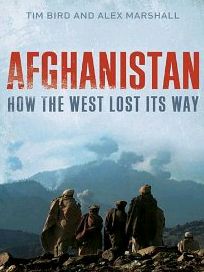
Book launch: Tim Bird JSCSC and Alex Marshall, Afghanistan: How the West Lost Its Way
In the Lecture Room of 2 University Gardens (Room 209), tea/coffee at 5:00 with the presentation starting at 5:30.
Monday 21 November 2011
Hew Strachan. Global Security Inaugural talk: The Changing Character of War
at 5.15pm in the Melville Room, main building
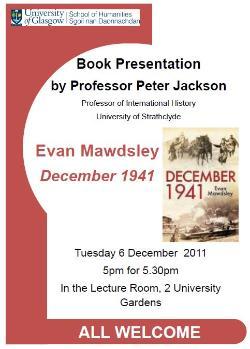
Tuesday 6 December 2011
Book presentation by Professor Peter Jackson (Professor of International History, University of Strathclyde), of Professor Evan Mawdsley's new book December 1941.
At 5pm for 5.30pm in the Lecture Room, 2 University Gardens.
All welcome. Evan Mawdsley's book presentation
War Studies Seminar Series 2010-11
Thursday 27 January 2011
Historical Ties Between Scotland and Canada. A major event involving the High Commissioner of Canada and leading academics.
Talks will begin at 530pm in the Senate Room, Gilbert Scott Building. Afterwards there will be a reception and live music. People who want to reserve a space should contact: Angela.Campbell@glasgow.ac.uk
Tuesday 25 January 2011
Dr Andrew MacKillop (Aberdeen University), Local & Global: the Evolution of Scotland’s Military Economy, 1690s-1815. at 5.15pm in Room 209, 2 University Gardens.Tuesday 18 January 2011
Dr John Gilmour, (Edinburgh University), Sweden and the Second World War.at 5.15pm in Room 209, 2 University Gardens.
Wednesday 20 October 2010
Professor Matthew Strickland, 'Strategy, Loyalty and the Imperative of Battle in the Anglo-Norman World: Henry I and the Brémule Campaign, 1119' (Medieval Research seminar, in conjunction with the Scottish Centre for War Studies)at 4.00 pm in the McKechnie Room, 10 University Gardens. All welcome.
Tuesday 12 October 2010
Book launch of Alex Marshall's new book : The Caucasus under Soviet Rule
At 5pm in the seminar room, 2 University Gardens. All welcome
Tuesday 5 October 2010
Professor Daniel Szechi (University of Manchester), Reconceptualising the Dynamics of Early Modern Rebellion: a military effectiveness study of the 1715 Jacobite risingAt 5.30pm in Room 209, 2 University Gardens. Tea will be served from 5pm.