

Advancing a Just Transition for Scotland's peatlands
Published: 27 February 2026
On Wednesday 4 February 2026, the RESPECT project (Rapid Engagement with Stressed Peatland Environments and Communities in Transformation) hosted a webinar titled ‘Advancing a Just Transition for Scotland’s Peatlands’.
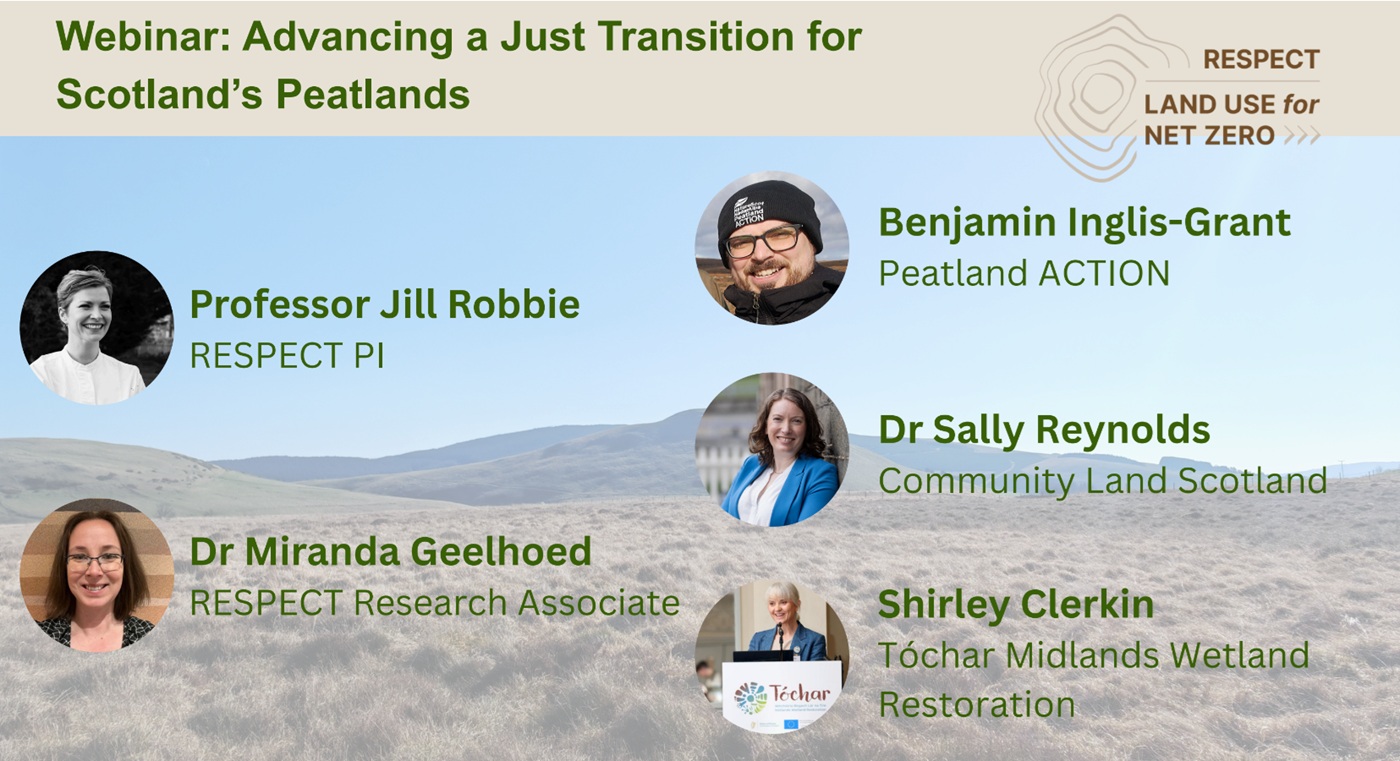
Photo credit background: Stuart Munro
The webinar titled ‘Advancing a Just Transition for Scotland’s Peatlands’ introduced new findings from the RESPECT project on the barriers and opportunities for achieving a just transition in relation to Scotland’s peatlands. To offer practical perspectives on the topic, the event also featured contributions from Benjamin Inglis-Grant (Peatland ACTION), Dr Sally Reynolds (Community Land Scotland’s Natural Capital Community Partnerships) and Shirley Clerkin (the Tóchar Midlands Wetland Restoration initiative in Ireland).
Target-driven peatland policies and just transition challenges
Scotland has committed to restore 250,000 hectares of peatland by 2030 (and 400,000 hectares by 2040 under the new draft Climate Change Plan 2026–2040). Many peatlands in Scotland are, however, under agricultural management and subject to competing environmental, economic and community priorities, making the achievement of peatland restoration targets a significant challenge.
This challenge is deeply rooted in historic policies and incentives that actively encouraged agricultural use and modification of peatlands. As described by Dr Miranda Geelhoed, Research Associate on the RESPECT project, historically, peatlands were viewed as wastelands and an obstacle to a policy agenda that favoured agricultural productivity. This led to direct legal and governance measures to reclaim and drain land, including peatlands. Measures were first put in place in the 1840s and lasted until the 1980s. When compared to the present day, the regulatory system was highly integrated, granting broad powers to landowners and to the state to undertake drainage to boost productivity, with specific provisions to support collaboration.
This system has left a huge legacy in Scotland. It is only in the last 10-15 years that the focus has turned to reversing drainage on peatland for reasons of climate change mitigation. There are now a variety of complementary and at times conflicting policy objectives relating to peatlands, as well as broader economic, social and environmental demands.
A lack of strategic and democratic direction to land use planning puts emphasis on the role and responsibilities of individuals in rural communities to manage trade-offs. The ambition and hope are that public and private financial incentives, including the voluntary carbon market, can encourage those that control the land to deliver environmental benefits and just outcomes. But unanswered questions remain about whether restoration can be pursued at scale and at pace in a fair and just way, particularly because ownership and control of land in Scotland is heavily concentrated.
Overcoming misunderstandings and improving communication
The above shows that achieving a just transition for peatlands relies heavily on securing buy-in from key stakeholders, including agricultural producers. Ben Inglis-Grant gave an insightful presentation on work he has been leading for Peatland ACTION in the Outer Hebrides to help overcome misunderstandings and improve communication between stakeholders, groups and agencies involved in decisions about peatlands.
Ben emphasised the need to understand the social and cultural history embedded in peatland restoration sites, where people were once paid to drain peatlands and now face new incentives to rewet them. This shift in policy priorities has created some scepticism within communities, in addition to concerns around the impacts of peatland restoration on, for example, grazing and peat cutting rights. Ben’s experience shows that practical engagement with peat cutters and common grazing committees can break down misconceptions and demonstrate that restoration can improve biodiversity while supporting, rather than undermining, local livelihoods.
Creating meaningful community partnerships
From a community development perspective, Dr Sally Reynolds’ presentation emphasised that meaningful partnerships are essential if natural capital projects are to deliver a just transition. Community Land Scotland’s Natural Capital Community Partnerships project aims to work with up to 20 natural capital projects in Scotland, including peatland restoration projects, to ensure that communities are constructively involved in land use decisions, and that they receive a fair share of the benefits.
Sally explained that community benefits are not just about profit-sharing agreements but cover things like jobs, skills, education, better access and improved local decision-making. However, there are at least two major barriers to establishing community partnerships and ensuring a just transition in the Scottish peatland context. A first barrier is the complexity and (legal) uncertainty around projects on common grazings which include a large proportion of peatlands, as rights to common grazings are shared between crofters and landowners. A second barrier is the lack of community resources, capacity and confidence to enter into negotiations about peatland projects.
“Stories are stickier than facts”
Offering an opportunity for international learning, the Irish Tóchar Midlands Wetland Restoration Initiative, funded by the EU’s Just Transition Fund, stresses the importance of managing land use change with care. The initiative supports peatland-based farmers, landowners and communities in the Irish Midlands to navigate the transition towards a climate neutral and biodiversity positive future. Shirley Clerkin emphasised the need for ‘stabilisers’ in this transition: people and structures that can manage the decline of old systems while nurturing new ones. This means acknowledging losses—such as jobs or traditional uses like peat as fuel—while also identifying unexpected pioneers and building supportive networks around them.
Crucially, Shirley noted the power of storytelling in supporting lasting change, as she emphasised that “stories are stickier than facts”. When local people share their own experiences of restoration, it resonates far more deeply than external narratives.
Time, trust, and transitions: shaping the long-term future of peatland restoration through the RESPECT project
A challenge that was highlighted by all presentations in this webinar is time. Peatland restoration is a long-term process with decisions currently being made for decades to come, fuelled by an urgency to address the global climate crisis. At the same time, building trust among communities, farmers and crofters is also a time-intensive and a continuous process that needs to be adaptable to changing circumstances.
How do we ensure that restoration delivers healthier ecosystems and contributes to net zero targets, keeping in mind that peat landscapes are themselves subject to change, for example, from climate change impacts? And how do we ensure that peatland use change creates more resilient communities – not only now, but also in the future?
The RESPECT project will continue to explore these questions, including through engagement with policymakers, landholders, communities and partner organisations. For more information about the project visit our website. If you would like to receive updates about RESPECT, please subscribe to our newsletter or follow us on LinkedIn.
This webinar was not recorded, but the presentation materials can be accessed through this link: slide deck.
First published: 27 February 2026