

Briefing paper: Using composite stories to support person-centred policymaking
Published: 5 November 2026
5 November 2026: This briefing paper explains how the composite stories in the State of Poverty research projects were developed. It can be used as a 'how-to for others interested in adopting this approach in their own line of work.
5 November 2026: This briefing paper explains how the composite stories in the State of Poverty research projects were developed. It can be used as a 'how-to for others interested in adopting this approach in their own line of work.
This briefing is adapted from the State of Poverty project by the Centre for Public Policy, University of Glasgow, funded by The Robertson Trust and in partnership with the Poverty Alliance.
Background
Policymakers and third-sector organisations are increasingly using lived experience alongside other forms of evidence to inform policy development and delivery.1,2 This reflects a growing recognition that people with direct experience of an issue can provide valuable insights that help make policies more relevant, effective, and legitimate.3–5
Using lived experience evidence can present challenges. For participants, engagement processes can sometimes feel tokenistic or extractive, with people asked to repeatedly share personal experiences - often without seeing how their contributions influence decisions.6,7 This can lead to consultation fatigue and, if engagement is not designed and supported appropriately, may cause distress or harm.8, 9 Policymakers also face challenges in making effective use of lived experience evidence. Individual stories can provide rich insights, but it can be difficult to connect these experiences to wider patterns.
Composite stories offer a way to address some of the challenges associated with using lived experience evidence. Rather than relying on individual testimonies, they bring together insights from data to create collective, evidence-based narratives. Drawing on existing data and findings, this approach reduces the need for people to repeatedly share personal experiences while helping to identify common themes and patterns. Stories can then be reviewed and validated by people with relevant lived experience.
When combined with systems mapping and governance analysis, as we do in our Rewiring the State of Poverty report, composite stories do more than describe individual experiences. They help to show how policies, services, and institutions interact to shape outcomes. This makes it easier to understand how challenges arise across a system, rather than viewing them as isolated issues, providing policymakers with a stronger evidence base for identifying pressures within systems, gaps in governance, and opportunities for policy and service improvement.
This policy briefing outlines a toolkit that combines composite stories, systems mapping, and governance analysis to strengthen the use of lived experience evidence in policymaking. By linking personal experiences to wider policy, service, and institutional contexts, the approach provides a deeper understanding of how outcomes are shaped and where opportunities for improvement exist. This can help policymakers develop more effective and responsive policies.
What is a composite story?
A composite story is a single, fictional character or household whose narrative emerges from real evidence, data, practitioner knowledge and input from people with lived experience. The character’s story is designed to shine a light on the challenges many in a similar situation face, and show how several systems (housing, benefits, employment, health) collide in people’s lives at once.
This guide sets out how to build a composite story, using the State of Poverty project's own composite, the El-Amin family, as a working example.
Why not just interview someone directly?
Most organisations default to first-hand interviews when they want to bring lived experience into policy work. While this may be more authentic, in practice, it can raise ethical and practical problems:
- People get asked the same questions again and again. Many people affected by poverty have told their story to researchers, journalists and campaigners many times over, often with little visible change as a result. Retelling difficult experiences on demand has a real emotional cost.9
- Most of the input is one-off. People are typically interviewed once, and the relationship largely ends there, leaving little room for an evolving, participant-shaped process.7
- Anonymity is hard to guarantee. Even with names changed, a detailed personal account can often still be recognised by someone who knows the person.1
- It can tip into tokenism. Lived experience input is increasingly expected by funders and government but is sometimes included without a clear plan for how it will actually shape decisions.2
Composite stories sidestep all four: nobody is asked to relive their own history, no single account can be traced back to an individual, and the co-production process gives people real, structured influence over the finished narrative.
At the same time, the aim isn't to remove analytical and data-led knowledge from the picture. Understanding poverty properly means seeing it both from the outside and from the inside. Insider accounts are essential but work best alongside the theoretical and system-level grounding that data and analysis provide.10, 11
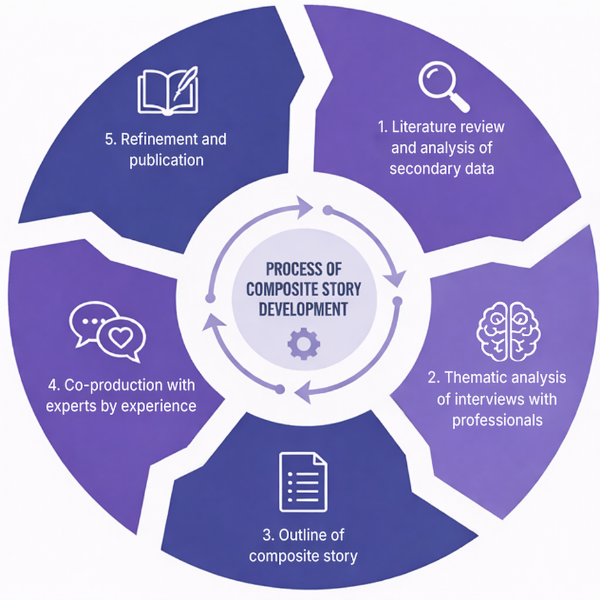
The five-step process
Step 1: Gather what you already know
Pull together the evidence you already hold or can access: government statistics, survey data, helpline records, case files, and existing qualitative research. In the State of Poverty project, this included DWP and ONS data, the Scottish Household Survey, Family Resource Survey and material shared by Shelter Scotland, Citizens Advice and digital diary entries from the Changing Realities project.12 The aim is to avoid asking people to repeat evidence that already exists, on the basis that existing lived experience findings on poverty are already reasonably consistent.13
Step 2: Talk to frontline practitioners
Supplement the documentary and survey data with short interviews with those who, in their professional capacity, see these issues daily: caseworkers, advisors, housing officers, charities. This helps to identify where systems collide in practice. The development of the El-Amin family composite story began with a practitioner describing a benefits rule that could effectively require someone to cut their working hours to keep their housing support, which they described as proof that the system wasn't designed around the person.
Step 3: Draft an evidence-grounded outline
Build a first sketch of your character: age, household, location, circumstances, but only include details you can trace to a source. For the El-Amin family, being made homeless after their landlord sold the property was grounded in data showing landlord sale as one of the most common eviction triggers.14 Their ethnicity and location reflected the groups and areas where homelessness applications were rising fastest.15 Even small details, like the condition of their temporary accommodation, were checked against official statistics on breaches of housing standards16 and corroborated against frontline evidence before being included.
Step 4: Co-produce with a panel of experts by experience
Engage with a small group with relevant lived experience; as much as possible, aim for diversity across the factors that matter for your topic (age, ethnicity, disability, household type, and so on). Rather than asking them to share their own stories, present the outline with deliberate gaps and ask: how would someone in this position experience these systems? What would happen next? A two-hour session should be long enough to develop one story. Take a back seat and enable the group to harness their collective knowledge to develop the story. Capture their input as it happens through live notes, written follow-ups from anyone unable to attend, and a shared draft everyone can see evolving. In our sessions, the group were energised by playing an active role in the creation of a dynamic research output.
Other examples where this technique - building a narrative by knitting participants' contributions together around the data, rather than reproducing any one person's account - has previously been used to explore doctor wellbeing during the COVID-19 pandemic, the experiences of Black, Asian and minority ethnic academics in UK higher education, and children and young people's experiences of the care system in Scotland.17–20
Step 5: Refine, then sign off
At the start of each new session, revisit the previous story and invite final changes. Once the panel has agreed a story, keep further edits to minor details only (a name, an exact locality); reopening the substance risks undoing work the group has already collectively signed off.
Figure 1 – State of Poverty Composite Story Process Visualised
Making the story useful
A finished story works best paired with a simple supporting chart or an infographic and a visual map showing how the different systems and services connect in that person's life. Together, these make an effective centrepiece for a workshop or policy lab: officials, practitioners and people with lived experience can gather round the same concrete example and work out, together, what needs to change, rather than starting from an abstract policy position. In the State of Poverty project, we used Policy Labs involving people working across the system to help build a participatory systems map.
Where else this can be used
The approach isn't specific to poverty. It works anywhere several organisations or services act on one person's life at once, and anywhere retelling personal history repeatedly could cause harm or fatigue. Useful settings include:
- Health and social care
- Criminal justice or housing
- Immigration and employment systems
- Education and additional support needs
- Work with survivors of abuse, people with a history of substance use, or care-experienced young people
- Any organisation sitting on case data, helpline records or survey findings that has never been turned into something non-specialist audiences, including elected members, can easily understand
Benefits for Policymakers
For policymakers, this approach offers several advantages. It demonstrates how decisions made across different departments, services, and levels of government interact in practice. This can help to identify policy conflicts and governance gaps. It also translates complex evidence into accessible narratives, making it easier for decision makers to understand how people experience policies and services as interconnected systems rather than as isolated interventions.
By combining lived experience with systems-level governance analysis, this methodology can support more joined-up policymaking and collaboration. In turn, this can help to identify opportunities for preventative and upstream interventions. As a result, the approach enables government to move beyond understanding what is happening to understand why it is happening, from a governance perspective. This approach protects anonymity, reduces the burden on participants, and produces a narrative that is simultaneously evidenced, emotionally resonant, and genuinely co-owned. This briefing offers a transferable template well beyond the poverty field in which it was first developed.
The research team would like to acknowledge the shared ownership of these stories with the lived experience panel, and to thank each panel member for enriching them. We are also grateful to the Poverty Alliance for facilitating this work.
Notes
- Gibson, Benson and Brand (2012), Talking about suicide: confidentiality and anonymity in qualitative research, Nursing Ethics.
- Hill O’Connor and Bennett (2025), Lived experience as evidence in anti-poverty policy making: a governance-driven perspective.
- UK Government Policy Lab (2024), Lived experience in policymaking guide: principles, behaviours and mindsets for lived experience work.
- Scottish Government (2025a), Equality outcomes 2025 to 2029, Outcome 2: Lived experience and participation.
- Hill O’Connor and Burn-Murdoch (2025), The role of lived experience in the Scottish Parliament, Scottish Parliament Information Centre (SPICe).
- Hill O’Connor, Smith and Stewart (2023), Integrating evidence and public engagement in policy work.
- Treanor, Patrick and Wenham (2021), Qualitative longitudinal research: from monochrome to technicolour, Social Policy and Society.
- OECD (2025), Exploring new frontiers in citizen participation in the policy cycle.
- Silverio and colleagues (2022), Sensitive, challenging, and difficult topics: experiences and practical considerations for qualitative researchers, International Journal of Qualitative Methods.
- Casey (2023), Lived Experience: Defined and Critiqued
- Montenegro and Green (2025), Engagement and qualitative sociology in health research: proximal, but incongruent, Social Theory & Health.
- Changing Realities, A Participatory Project with Parents and Carers Across the UK.
- Lindsay and colleagues (2025), Experiences and factors affecting poverty among families raising a child with a disability: a scoping review.
- Shelter Scotland (2026), Related advice: Your rights if your landlord is selling.
- Scottish Government (2025b), Homelessness in Scotland: 2024-25, official statistics.
- Scottish Government (2025c), Homelessness in Scotland: update to 30 September 2025, official statistics.
- Johnston (2024), Constructing Composite Narratives: A Step-By-Step Guide for Researchers in the Social Sciences
- Walker and colleagues (2021), To develop evidence-based interventions to support doctors’ wellbeing and promote resilience during COVID-19 (and beyond).
- Doharty, Madriaga and Joseph-Salisbury (2020), The university went to “decolonise” and all they brought back was lousy diversity double-speak! Critical race counter-stories from faculty of colour in “decolonial” times.
- Independent Care Review (2020), The Promise, Scotland’s care review.
First published: 5 November 2026
<< Outputs