

The fiscal backdrop of the Scottish Government's Programme for Government
Published: 8 September 2026
8 September 2026: After the announcement of the Scottish Government's Programme for Government by First Minister John Swinney last week, Professor Graeme Roy writes about the fiscal backdrop of the announcement and the increasing importance of public service reform to make services financially sustainable.
8 September 2026: After the announcement of the Scottish Government's Programme for Government by First Minister John Swinney last week, Professor Graeme Roy writes about the fiscal backdrop of the announcement and the increasing importance of public service reform to make services financially sustainable.
Blog by Professor Graeme Roy
The new Programme for Government contains some of the most significant proposals for public service reform since devolution.
Plans include replacing Scotland’s current territorial health boards with strategic boards and substantially reducing the more than 130 public bodies.
There are good reasons for reforming the public sector that have little to do with money. Reducing duplication, improving accountability and designing services around people rather than institutions, can all improve outcomes. But there is a fiscal backdrop too.
Back in January, when the Scottish Government published its Spending Review, the Scottish Fiscal Commission (SFC) highlighted just how challenging the outlook for the next few years was likely to be.
Funding for day-to-day spending was projected to grow only slowly, while capital funding was expected to decline in real terms.
Within that overall envelope, the pressures were uneven. Health and social security were receiving increasing shares of the budget, leaving much tighter settlements elsewhere. Local government spending, for example, was projected to fall by nearly £500 million in real terms between 2025-26 and 2028-29.
Some things have improved since January. Most notably, UK Government decisions on Special Educational Needs and Disability spending in England have generated substantial additional funding through the Barnett Formula.
But the underlying challenge has not disappeared. Much of the new monies are one-off and will not be repeated beyond this year. Capital funding is likely to be squeezed further as the UK Government shifts investment towards defence. And next year’s Scottish Budget will face a £720 million negative Income Tax reconciliation, the largest since tax powers were devolved.
Scottish Government Resource and capital Block Grant trends since 2022-23
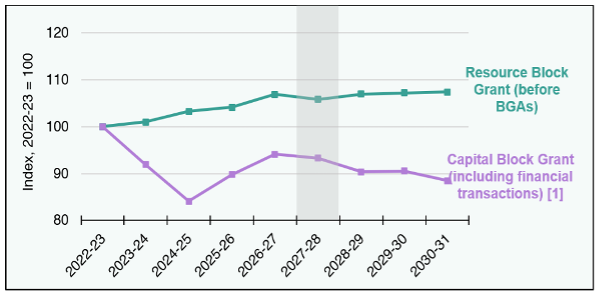
[1] Includes a reduction from the UK Government's Defence Investment Plan, based on SFC assumptions.
Source: Scottish Fiscal Commission
This matters because the Spending Review was already predicated on significant savings.
The Scottish Government identified around £1.5 billion of efficiencies over three years. This year alone, £563 million of savings are built into spending plans, with around half expected to come from NHS boards. As the Auditor General has highlighted, failure to deliver these savings does not make the problem disappear. It simply creates additional pressure elsewhere in the Budget.
Workforce costs are particularly important. The devolved public sector pay bill accounts for around 55 per cent of day-to-day spending. The Government has committed to reducing the public sector workforce by an average of 0.5 per cent a year. Yet the latest publicly available data show the workforce increasing over the past year. That means larger reductions will be required in future years if the target is to be achieved.
Pay adds another pressure. Existing agreements already mean that sticking within the Government’s three-year pay policy would imply real-terms reductions in pay for most groups in 2027-28. Higher inflation makes that challenge greater still.
Against this backdrop, it was perhaps notable that the Programme for Government, and accompanying statements, contained limited information on progress against either the efficiency or workforce targets.
A Programme for Government is, of course, primarily about setting ambition and overall direction. But the next stages of the fiscal cycle now become crucial.
The Autumn Budget Revision later this month might sound like a technical exercise, but it provides a further opportunity for the Government to inform parliament and the public on its budget plans post-election. It can explain how it intends to use additional funding received since January, where spending pressures have emerged and, importantly, whether planned efficiencies are being delivered.
Then comes the Scottish Budget itself, when the ambitions for new spending commitments and reform confront the realities of the public finances. Last week the Deputy First Minister confirmed a Budget date of 3 December.
Both the Scottish Fiscal Commission and Audit Scotland have stressed the importance of transparency. That means being clear not simply about the savings that are planned, but which have actually been delivered, which have not, and how the consequences are being managed.
Public service reform can improve outcomes. In the fiscal environment Scotland now faces, successfully delivering it is also becoming increasingly important to making public services financially sustainable.
Author
Professor Graeme Roy is Vice Principal and Head of the College of Social Sciences at the University of Glasgow. He is Professor of Economics and Chair of the Scottish Fiscal Commission, Scotland’s official independent economic and fiscal forecaster.
Image by Gannet77 from Getty Images Signature via Canva Pro
First published: 8 September 2026
Professor Graeme Roy is Vice Principal and Head of the College of Social Sciences at the University of Glasgow. He is Professor of Economics and Chair of the Scottish Fiscal Commission, Scotland’s official independent economic and fiscal forecaster.