Child Poverty and Public Debt: Doing Debt Recovery Differently
Published: 23 April 2026
On 23 March, welfare advisers, local government officers, campaigners and academics came together at the Centre for Public Policy to explore one of the most pressing and hidden drivers of poverty in Scotland: public debt.
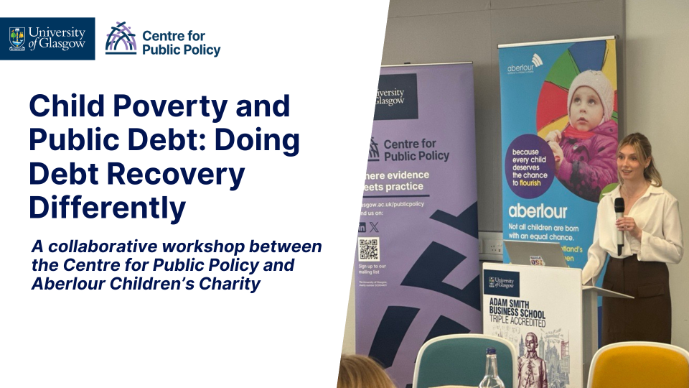
A collaborative workshop between the Centre for Public Policy and Aberlour Children’s Charity to mark Debt Awareness Week
Held in partnership with Aberlour Children’s Charity, this event brought together a wide range of perspectives for a collaborative workshop led by the Centre for Public Policy, placing citizen-centred at the centre of the discussion. The session focused on understanding how public debt affects families’ lives, how current systems contribute to these social harms, and what needs to change to break cycles of debt and poverty.
Understanding the impact of public debt
Scotland’s poorest households are increasingly caught in a public debt crisis. Evidence shows that public debt not only exacerbates financial hardship but can actively sustain and deepen child poverty, with debt recovery practices often trapping families in long-term difficulty.
The workshop explored how public debt - including council tax arrears, rent arrears and other state-related debts - interacts with wider systems such as social security, housing, and local government finance. Dr Claire MacRae facilitated a systems mapping approach, inviting participants to examine how multiple parts of the system overlap and compound pressure on low-income families.
The group also heard from Professor Morag Treanor (University of Glasgow), who presented research on the links between public debt, poverty and family wellbeing.
Crucially, the discussion was grounded in real-life experiences, with stories shared from families supported by Aberlour highlighting the human impact behind the policy and process.
Collaboration across sectors
The session brought together insights from local authorities, who shared their perspectives and frontline experience of public debt, alongside third sector organisations supporting people experiencing debt and poverty. Participants discussed both the constraints facing public bodies and the opportunities for change through collaboration, flexibility and earlier intervention.
Examples were shared of local public sector and third sector partnerships that are beginning to respond differently to public debt - demonstrating that alternative approaches are possible, and that more humane debt recovery can reduce harm while still meeting public finance objectives.
Sharing learning and next steps
This work links closely with the Centre for Public Policy’s State of Poverty programme, which examines the governance of poverty in Scotland and the role of public systems in shaping people’s outcomes. Further information about this work is available on our website.
Key materials from the workshop discussions are available below. These resources contribute to an ongoing conversation about how Scotland can do debt recovery differently - supporting families, preventing harm, and helping to end child poverty.
If you would like to follow up with Aberlour on their Public Debt work you can contact Martin.Canavan@aberlour.org.uk and/or Robyn.Moffat-Wall@aberlour.org.uk.
For more information from the Centre for Public Policy and the State of Poverty or our Systems Mapping Workshops contact Kimberley Somerside: Kimberley.somerside@glasgow.ac.uk
First published: 23 April 2026