

Publication Alert | ISAC White paper White Paper (22-09-2026)
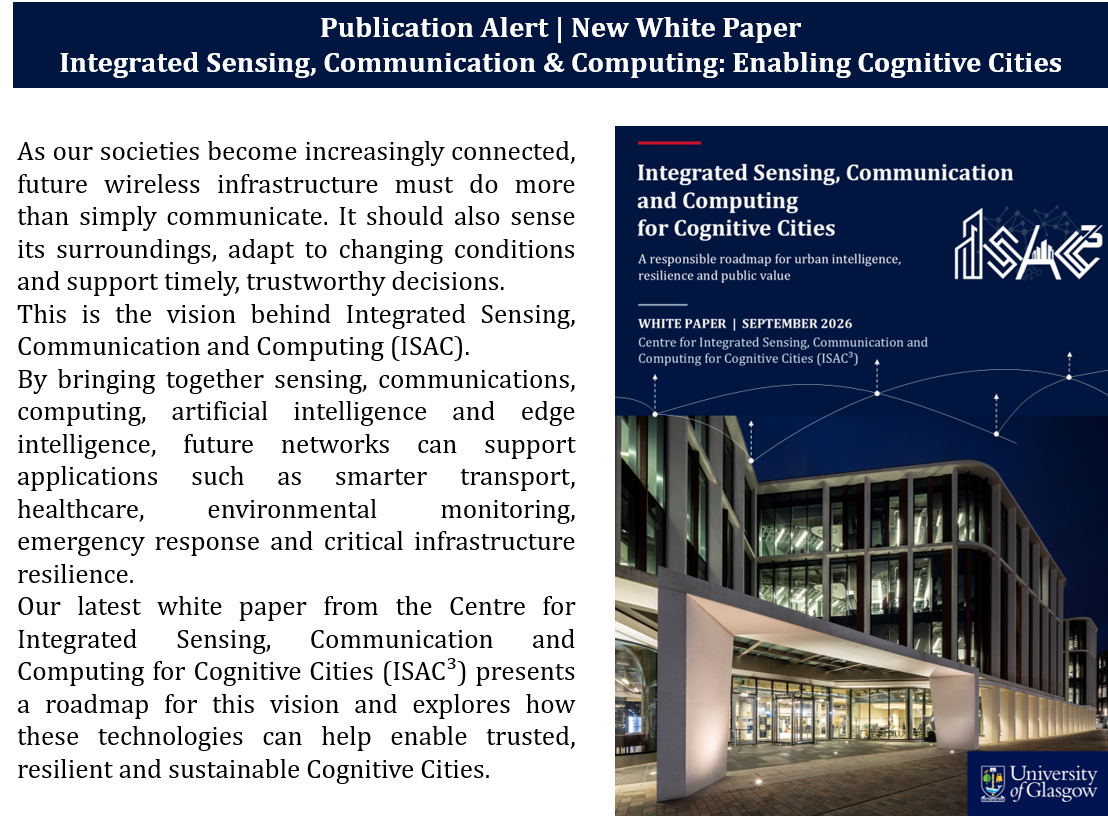 Read the white paper: https://eprints.gla.ac.uk/395612/
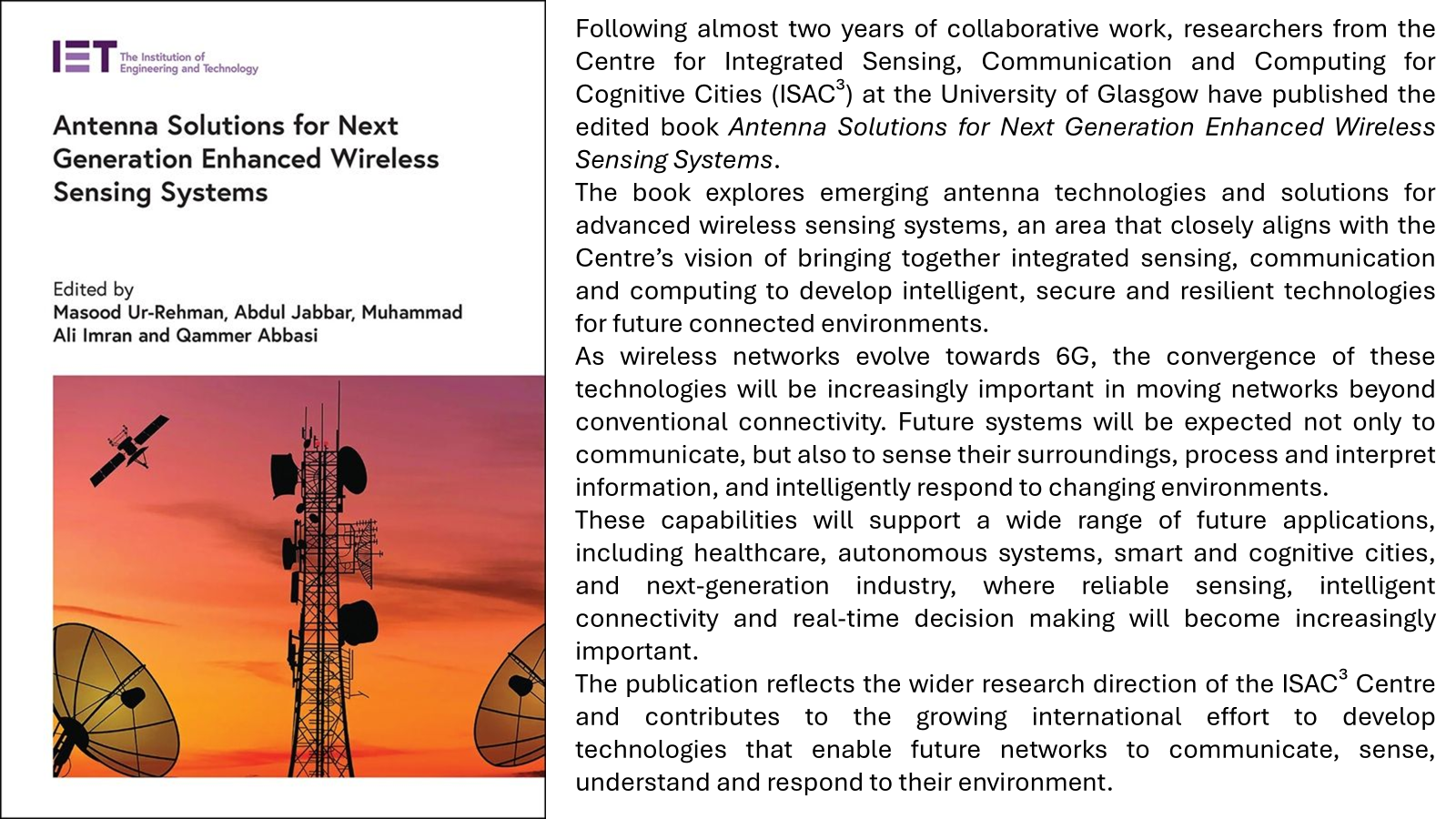
ISAC³ Centre Publishes Book on Next-Generation Wireless Sensing (29-08-2026)
ISAC³ Founding Director Recognised for Research Impact and Leadership (03-08-2026)
Read more about the Kroto Medal:
https://cheddarhub.org/professor-qammer-h-abbasi-receives-prestigious-kroto-medal/
Read more about the Star of CHEDDAR Award:
https://cheddarhub.org/cheddar-industry-day-2026-concludes-with-awards-celebrating-outstanding-research/
Recent publications advance the ISAC³ vision for secure and resilient Cognitive Cities (03-08-2026)
Researchers from the Centre for Integrated Sensing, Communication and Computing for Cognitive Cities (ISAC³) have published two studies addressing the reliability and security of future intelligent wireless environments. These contributions support the Centre’s vision of cities that can sense, understand, compute and respond intelligently to the needs of people, infrastructure and the environment.
Improving communication and localisation under electromagnetic interference
The paper “Integrated EMI-Aware RIS Framework for Robust Communication and Localization: Simulation and Experimental Evaluation” was published on 1 July 2026 in the IEEE Journal of Selected Topics in Electromagnetics, Antennas and Propagation.
The study develops an electromagnetic interference-aware framework for reconfigurable intelligent surfaces. Through simulation and experimental evaluation, the proposed framework demonstrates how an RIS can be intelligently configured to mitigate unwanted interference and improve the reliability of wireless communication and localisation.
This work contributes to the ISAC³ vision by supporting adaptive wireless environments that can respond to changing electromagnetic conditions. Such resilience will be essential for dependable communication and localisation services within future Cognitive Cities.
Reference: S. Hassouna, A. A. Nasir, J. U. R. Kazim, M. Zubair, M. A. Imran and Q. H. Abbasi, “Integrated EMI-Aware RIS Framework for Robust Communication and Localization: Simulation and Experimental Evaluation,” IEEE Journal of Selected Topics in Electromagnetics, Antennas and Propagation, vol. 2, pp. 213–233, 2026.
Strengthening cyber-physical security in RIS-enabled ISAC systems
The paper “RISCS: RIS-Aided Integrated Sensing and Communications – A Cyber-Physical Security Perspective” was published online on 13 March 2026 in IEEE Transactions on Consumer Electronics.
The study examines cyber-physical threats affecting RIS-assisted communication and RIS-enabled integrated sensing and communication systems, including jamming, spoofing, eavesdropping and data-injection attacks. It introduces a secure RIS-enabled ISAC framework and experimentally validates an anomaly-detection approach using a pilot-aided OFDM testbed and 4,096 RIS configurations.
The proposed method jointly analyses received signal quality and channel-estimation behaviour to identify potential eavesdroppers without prior knowledge of their locations. This research contributes to the ISAC³ vision by addressing the security and trustworthiness of the shared sensing, communication and computing infrastructure required by future Cognitive Cities.
Reference: S. Hassouna, M. Zubair, A. Raza, M. Ahmed, J. Kazim, M. A. Imran and Q. H. Abbasi, “RISCS: RIS-Aided Integrated Sensing and Communications – A Cyber-Physical Security Perspective,” IEEE Transactions on Consumer Electronics, early online publication, 13 March 2026.
Together, these publications address two important requirements for future Cognitive Cities: resilience against electromagnetic interference and protection from cyber-physical threats. They demonstrate how intelligent and programmable wireless environments can provide more reliable, secure and adaptive sensing, communication and localisation services.
Recent publications advancing Intelligent and Contactless Health Monitoring through RF Sensing and AI (21-07-2026)
Researchers from the Centre for Integrated Sensing, Communication and Computing for Cognitive Cities have published three studies advancing intelligent healthcare through contactless radio-frequency sensing, edge artificial intelligence and medical-image analysis.
Together, these contributions demonstrate how sensing and computing technologies can support earlier disease detection, continuous monitoring and more accessible healthcare. This closely supports the Centre’s vision of creating intelligent environments that can sense, understand and respond to the health and wellbeing needs of individuals and communities.
Real-time RF vital-sign monitoring at the edge
The paper “EdgeCaps: Pruned Capsule Networks for RF Vital Sign Measurement in Real-time” was published online on 26 May 2026 in IEEE Transactions on Artificial Intelligence.
RF sensing provides a contactless way of monitoring vital signs such as respiration. However, many existing deep-learning models require substantial computing resources, limiting their use on low-cost and portable devices.
The researchers developed EdgeCaps, a compact artificial-intelligence framework that combines structured model pruning and knowledge distillation to enable real-time RF vital-sign monitoring on resource-constrained edge devices. The proposed model reduces computational complexity while maintaining high measurement accuracy and was experimentally demonstrated through continuous respiration monitoring on a Raspberry Pi.
The study advances the Centre’s vision by bringing sensing and intelligence closer to the user. Processing health information locally can reduce communication overhead and support scalable, energy-efficient and privacy-aware monitoring in homes, hospitals and assisted-living environments.
AI-assisted early detection of glaucoma
The paper “Hybrid ResNet–Vision Transformer Ensemble for Early Glaucoma Detection from Fundus Images” was published online on 12 January 2026 in IEEE Sensors Journal.
Glaucoma is a progressive eye disease that can cause irreversible vision loss when it is not identified at an early stage. The study introduces a hybrid deep-learning framework combining a ResNet50 model with a Vision Transformer to analyse retinal fundus images.
The two architectures provide complementary capabilities: ResNet50 identifies detailed local features within retinal images, while the Vision Transformer captures broader contextual relationships. The combined model demonstrated strong glaucoma-classification performance across a large and diverse fundus-image dataset.
This work supports the Centre’s wider health-monitoring objectives by demonstrating how intelligent sensing and advanced computing can assist early clinical screening. Such technologies could improve access to diagnostic support, particularly in communities where specialist ophthalmology services are limited.
Defining the future of contactless RF health sensing
The review paper “Non-Invasive Vital Signs Sensing: Advances, Challenges, and Future Directions in Radio Frequency Based Techniques” was published online on 12 November 2025 in the IEEE Open Journal of Antennas and Propagation.
The paper provides a comprehensive review of radar and Wi-Fi technologies for contactless monitoring of respiration rate, heart rate and other physiological activity. It examines the underlying sensing principles, signal-processing methods, machine-learning techniques and performance of current RF-based monitoring systems.
The study also identifies important challenges that must be addressed before widespread deployment, including body movement, multiperson monitoring, electromagnetic interference, data privacy, security and the availability of representative datasets. It outlines future research directions involving edge computing, intelligent signal processing and lightweight machine-learning models.
By establishing the current state of RF healthcare sensing and identifying the remaining technological challenges, the paper provides an important foundation for developing dependable contactless monitoring systems for future Cognitive Cities.
Supporting healthier and more responsive Cognitive Cities
Collectively, these publications connect three important areas of future healthcare: contactless physiological sensing, efficient intelligence at the network edge and AI-assisted medical diagnosis.
The research demonstrates how integrated sensing and computing can enable environments that continuously and unobtrusively support human health. These capabilities could contribute to remote patient monitoring, elderly care, early disease screening and personalised healthcare services within future connected communities.
References
- P. Ishabakaki, M. Mollel, H. Hameed, H. Abbas, M. Imran and Q. H. Abbasi, “EdgeCaps: Pruned Capsule Networks for RF Vital Sign Measurement in Real-time”, IEEE Transactions on Artificial Intelligence, published online 26 May 2026.
- F. Tariq, H. Hameed, T. Malik, M. Mollel, M. A. Imran and Q. H. Abbasi, “Hybrid ResNet–Vision Transformer Ensemble for Early Glaucoma Detection from Fundus Images”, IEEE Sensors Journal, published online 12 January 2026.
- P. A. Ishabakaki, H. Hameed, M. Farooq, M. Mollel, H. Abbas, M. A. Imran and Q. H. Abbasi, “Non-Invasive Vital Signs Sensing: Advances, Challenges, and Future Directions in Radio Frequency Based Techniques”, IEEE Open Journal of Antennas and Propagation, published online 12 November 2025.
Media Coverage: ISAC³ Centre's Launch (10-02-2026)
The launch of the Centre for Integrated Sensing, Communication and Computing for Cognitive Cities (ISAC³) has been widely covered in the media. Here's a look at some of the key highlights:
-
Glasgow City of Science and Innovation featured the story prominently, noting that “Glasgow researchers are leading efforts to develop AI-driven cognitive cities of the future, with ISAC³ set to revolutionise urban life through predictive data systems.”
Read more:
https://glasgowcityofscienceandinnovation.com/glasgow-researchers-to-develop-ai-driven-cognitive-cities-of-the-future/ -
The Engineer reported that “Glasgow University’s new centre aims to transform cities into more intelligent, predictive environments, harnessing the power of AI and 6G data to solve real-world urban challenges.”
Read more:
https://www.theengineer.co.uk/content/news/glasgow-launches-centre-for-ai-cognitive-cities -
Digit highlighted the centre’s technological ambition, noting “plans to harness predictive AI to power cognitive cities that can learn from and adapt to urban environments.”
Read more:
https://www.digit.fyi/glasgow-uni-eyes-predictive-ai-to-power-cognitive-cities/ -
Scottish Business News emphasised the global vision for the initiative: “The launch of ISAC³ marks a significant step toward making Glasgow the first cognitive city, setting an example for future urban development.”
Read more:
https://www.scottishbusinessnews.net/glasgow-research-centre-sets-out-to-build-cognitive-cities-of-the-future/ -
Supercomputing Online highlighted the advanced science behind the centre, stating “ISAC³ is set to redefine how cities interact with data, using AI and next-generation communications to anticipate challenges before they occur.”
Read more:
https://www.supercomputingonline.com/latest/63099-glasgow-sets-its-sights-on-cognitive-cities-where-urban-systems-learn-predict-adapt -
TechCity NG underscored societal benefits, saying “By integrating AI and next-gen communications tech, ISAC³ is creating environments that could enhance quality of life through proactive urban planning.”
Read more:
https://www.techcityng.com/research-centre-sets-out-to-build-cognitive-cities-of-the-future/ -
MyScience UK described the centre’s ambition for Glasgow, writing “This initiative could help make Glasgow the first cognitive city, pioneering predictive urban systems.”
Read more:
https://www.myscience.uk/en/news/wire/research_centre_sets_out_to_make_glasgow_the_first_cognitive_city-2026-glasgow - Building the thinking city is a new initiative where researchers are exploring cognitive city systems that use AI and advanced sensing to anticipate urban challenges.
Read more:
https://gadget.co.za/thinkingcity14w/
We’re thrilled to see ISAC³ making such an impact, with its potential to reshape the future of cities worldwide.
University of Glasgow Launches New Research Centre: ISAC³ (09-02-2026)
We are excited to announce the official launch of the Centre for Integrated Sensing, Communication and Computing for Cognitive Cities (ISAC³), a pioneering initiative focused on harnessing the vast amounts of data collected by 6G communications technologies to create healthier, safer, and more sustainable cities for residents.
Unlike current smart cities, which provide real-time data on city systems, cognitive cities will utilize AI to analyze data from advanced sensors and mobile devices, transforming city systems from reactive to predictive. This data-driven approach will allow urban spaces to function with the sensory awareness of a living organism, enabling proactive responses to issues like gridlock, poor air quality, or failing infrastructure.
Moreover, the data collected from next-generation mobile devices can help detect early signs of health issues, guiding individuals to medical assistance before conditions worsen.
The launch has been covered in the media and shared across various platforms. Read the full story and explore our social media posts below:
For more details, visit the official University of Glasgow News.