

Global Gambling Control Scorecard
Global Gambling Control Scorecard
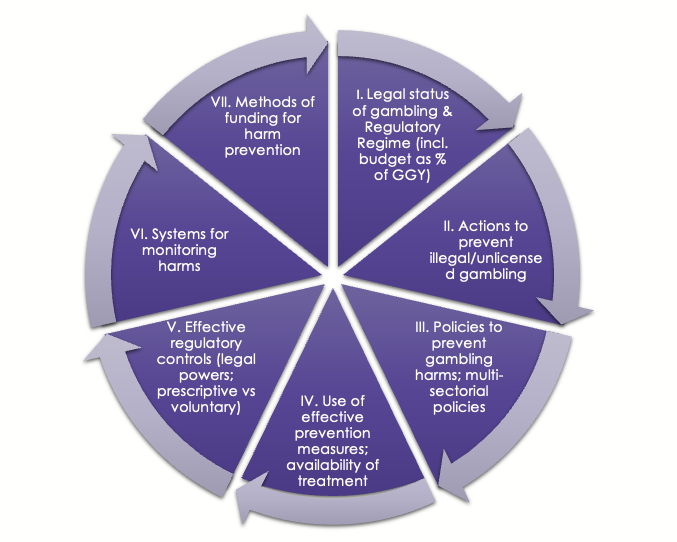
The Global Gambling Control Scorecard (GGCS) project brought together a multidisciplinary team to address the growing global challenge of gambling-related harms. Despite growing concern worldwide, there has so far been no shared framework to evaluate whether current regulation protects the public - unlike in more established public health domains, such as tobacco or alcohol.
GGCS is a new international benchmarking tool designed to help governments, regulators, researchers, and civil society organisations assess the strength of their jurisdictions' responses to gambling-related harms, including addictions, mental health impacts, suicide, and financial distress.
Central to the project was a global e-Delphi study, which facilitated co-development of the GGCS tool through structured engagement with gambling regulators, national and international policymakers (including WHO representatives), academic researchers, clinicians, and civil society organisations. This collaborative process enabled consensus-building across diverse stakeholder groups and geographies, ensuring the GGCS reflects the complexity and diversity of global gambling policy landscapes.
The GGCS offers a structured, evidence-based scorecard that covers seven key dimensions:
-
Effectiveness of regulatory controls (legal powers; prescriptive vs voluntary approaches)
A unique tool, the GGCS enables cross-country comparison, supports civil society advocacy, and provides governments with comparative evidence to guide reform.
The GGCS was funded by the UKRI via an Impact Acceleration Account (IAA) award.
You can download the Scorecard for Europe here.
The full Scorecard for Europe is available to download here.
A searchable, user-friendly version of the Scorecard can be accessed by domain:
-
Effectiveness of regulatory controls (legal powers; prescriptive vs voluntary approaches)