

Laser technique could slash emissions from solar panel recycling
Published: 10 November 2026
A new, more energy-efficient method of recovering valuable metals from solar panels at the end of their lives is gearing up to make its way to market.
A new, more energy-efficient method of recovering valuable metals from solar panels at the end of their lives is gearing up to make its way to market.
Researchers from the University of Glasgow have developed a way to use lasers to recover almost all of the silver and silicon contained in solar panels destined for the scrapheap using a fraction of the energy required by conventional processes.
Now, they are teaming up with Glasgow-based company Watt Laser ltd to explore the possibility of making the pioneering new technique commercially available.
The partnership could help tackle one of the key problems caused by the rapid adoption of solar panel technologies around the world, as the costs of building and buying panels have plummeted in recent years.
Although the solar boom has enabled the global capacity of solar generation to climb to 3 terawatts, the panels are generating an increasing amount of electronic waste as they reach the end of their lives. More than a million tonnes of waste are expected to be created by 2030, rising to more than 200 million tonnes by 2050.
Currently, the valuable metal inside solar panels, which make up 0.05% of their weight but represent two-thirds of their scrap value, are recovered using energy-intensive processes. The metals are held in place in the panels using a very strong polymer called EVA, which keeps them sealed for up to two decades and beyond but requires heating to between 450 - 600°C or soaking in toxic chemicals to crack open the seal again to recover the valuable materials.
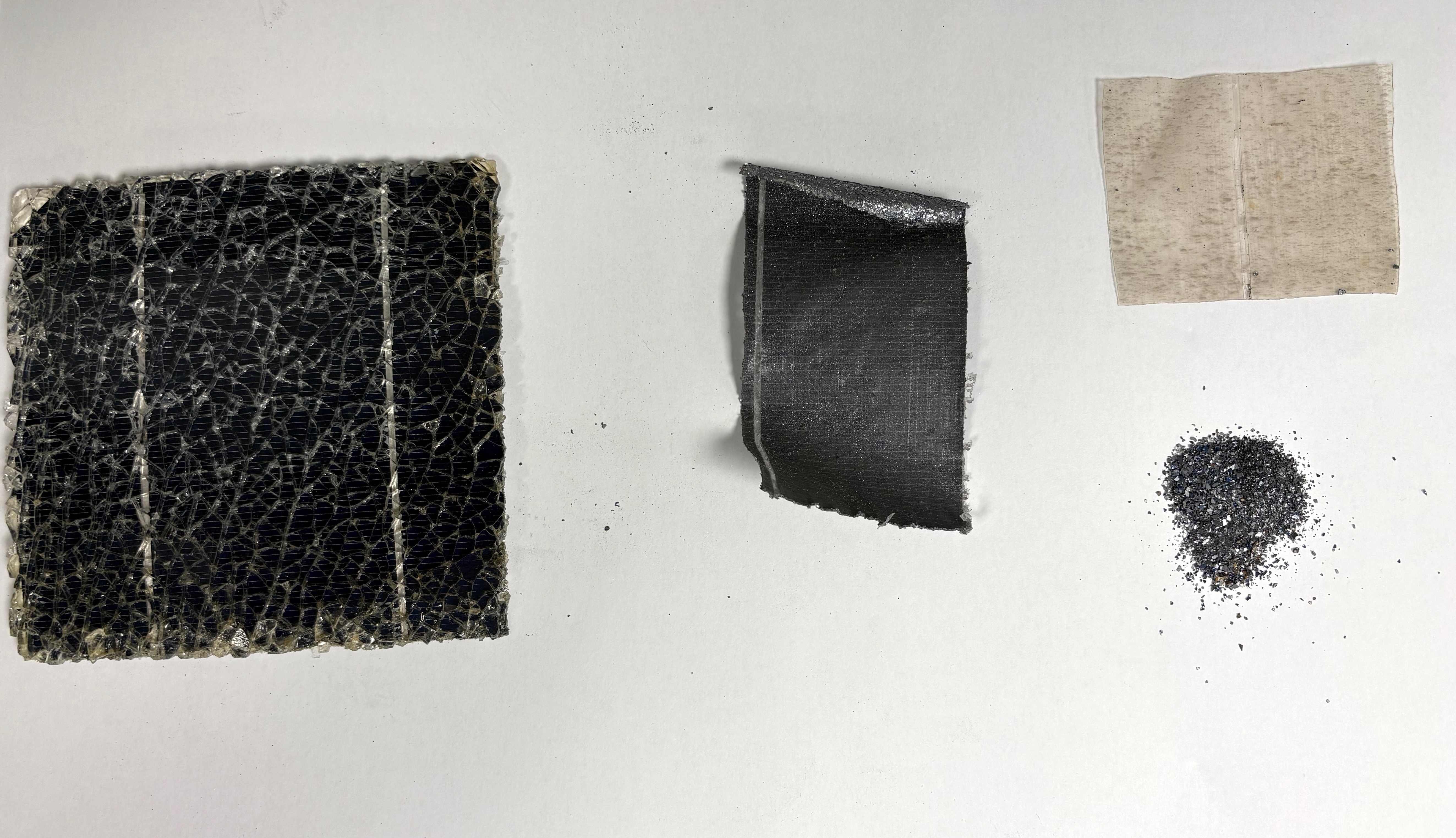
In a paper published recently in the journal Communications Materials, researchers from the University of Glasgow’s James Watt School of Engineering describe how they developed their new laser-based approach, which they say has provided the most effective method of removing silver from solar panels ever demonstrated.
Colleagues at the Fraunhofer Centre for Silicon Photovoltaics in Germany provided the team with the cell stacks from decommissioned commercial solar panels. The Glasgow researchers used a 1064 nm fibre laser to scan the cells, passing the light almost straight through the transparent EVA and is absorbed by the silicon beneath, heating the interface between the two.
Above a power threshold, the EVA released from the cell as an intact film. Metallic busbars can be physically separated, leaving powder which predominantly contains silicon, aluminium and silver. This powder can be treated first with dilute sodium hydroxide to remove aluminium, then with an iron chloride and choline chloride brine to dissolve the silver. Silver was recovered with more than 99% selectivity in one panel type.
The team’s process can be completed successfully using simple, low-impact chemicals, avoiding the hazardous and polluting nitric acid process used in conventional silver leaching.
The researchers estimate that this approach reduces the power used during recycling by 84%. The paper's first author is Bashayer Alsulami, a recent PhD student at the James Watt School of Engineering, built on her earlier research into recovering metals from end-of-life solar panels.
Dr Joseph Cameron of the James Watt School of Engineering led much of the work. He said: “The plastic that seals solar cells is designed to survive decades outdoors. It is very good at this, but this is exactly why old panels are so hard to recycle. By using a laser, we can quickly release the encapsulant in one piece rather than burning or dissolving it. That gives us much cleaner material to work with at recycling centres. The silver can be pulled out selectively with mild, simple chemistry, and the silicon is left behind ready for recovery.”
The research was carried out as part of the EU APOLLO project with researchers from REACT, the Responsible Electronics and Circular Technologies Centre, which is led by the University of Glasgow and backed by UKRI. As well as developing new ways to make and recycle electronics, REACT works with companies across Scotland to turn research into new products.
Declan Brannagan, of Watt Laser ltd, said: "Solar recycling is about to become a very large market, and the industry needs processes that are clean, selective and economic. What stands out about this work is that it uses standard industrial fibre lasers, the same kind of systems already used on production lines for marking and cutting.
"Scaling up from a single laser head to multi-head systems that can handle full panels at commercial rates is an engineering challenge we understand well. We see real potential for this technology to form the basis of new laser processing equipment for the recycling sector, and we're excited to be working with the University to explore how to bring it to market. We expect that scale-up of this technology will take less than a year, but needs an industrial end player to firm up throughput at this stage."
The James Watt School of Engineering’s Professor Jeff Kettle, REACT’s principal investigator, is the paper's corresponding author. He said: "This project shows what REACT is for. We've taken a global problem and developed a process that a Glasgow laser company can help take towards commercial equipment.
“We’re pleased to be working with Watt Laser to help refine the technique and make it more suitable for use in industry. Our hope is that we will soon see this technology ready for commercial use, making it part of the low-emissions, circular economy that REACT is aiming to help build."
Researchers from Princess Nourah bint Abdulrahman University in Saudi Arabia and the Fraunhofer Centre for Silicon Photovoltaics in Germany contributed to the research and co-authored the paper.
The team's paper, titled 'Laser-Induced Delamination of Aged Silicon Photovoltaic Modules to Achieve >95% Selective Silver Recovery', is published in Communications Materials.
First published: 10 November 2026