

New project set to demonstrate potential of underground thermal energy storage
Published: 5 November 2026
University of Glasgow researchers are set to lead a new international collaboration to explore the potential of underground thermal energy storage (UTES) to help cities decarbonise heating and cooling.
University of Glasgow researchers are set to lead a new international collaboration to explore the potential of underground thermal energy storage (UTES) to help cities decarbonise heating and cooling.
The Integrated Thermal Energy Storage for Urban Sustainability project, or INTENSE-US, is supported by €9m (£7.38m) in new funding from Horizon Europe and brings together 18 partner organisations from across the continent.
The research programme, which starts on 1 January 2027 and will run for three and a half years, will demonstrate how geothermal resources, waste heat recovery, district heating networks, energy geostructures, mine workings, and underground infrastructure can be integrated to create a new generation of sustainable urban energy systems.
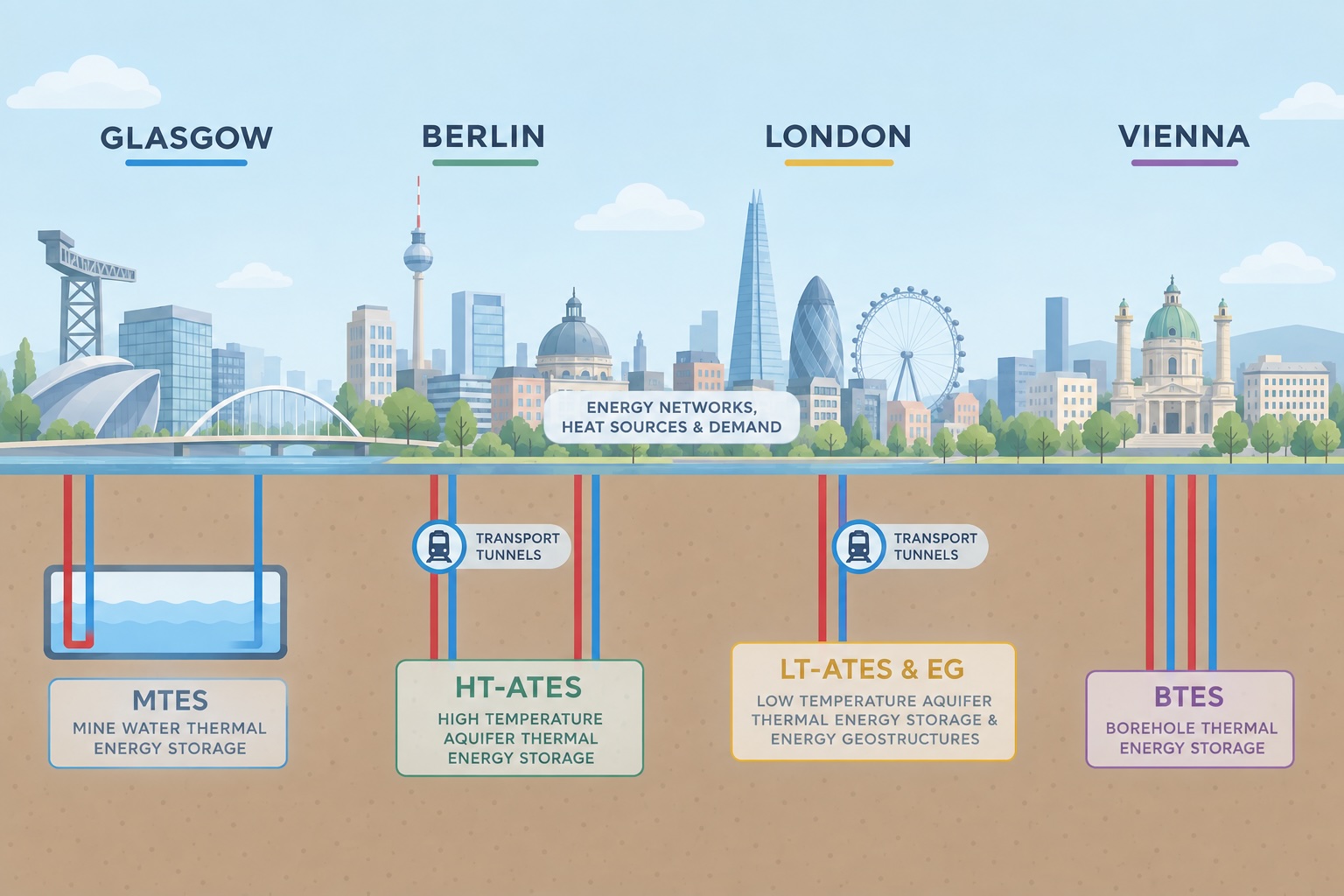
The cities of Glasgow, Berlin, London, Vienna and Zagreb will provide new insight into unlocking the potential of the urban subsurface as a strategic asset for the energy transition, helping cities become more resilient, sustainable, and energy secure.
The project aims to demonstrate for the first time in Europe how promising UTES solutions can be used in real-world environments as a core component of the decarbonisation of urban heating and cooling, a key hurdle which remains to be overcome to reduce the emissions that contribute to climate change.
The partners will use the complex environments of the cities in the UK, Germany, Austria and Croatia to test how UTES can be integrated into their existing and future district heating and cooling networks, and wider energy systems.
They will consider how existing subsurface infrastructure like metro tunnels, legacy mine workings and building foundations can play a role in storing and exchanging heat at a range of temperatures without disrupting transport, groundwater or drinking-water supplies.
Professor Gioia Falcone, Rankine Chair of Energy Engineering at the James Watt School of Engineering and Director of the Glasgow Centre for Sustainable Energy, is INTENSE-US’ principal investigator and will coordinate the partners’ contributions to the research.
She said: “I am delighted that INTENSE-US has this support from Horizon Europe to help us tackle the decarbonisation of heat, which remains one of the toughest challenges on the road to net zero. Through INTENSE-US, we have a unique opportunity to demonstrate how the subsurface can become a key part of future urban energy systems.
“I am excited to begin working with this exceptional consortium of academic, industry, public-sector and innovation partners to advance thermal energy storage for Europe’s cities. We look forward to engaging with cities, utilities, infrastructure owners, policymakers and fellow researchers once the project begins at the start of next year.”
Alongside the University of Glasgow, the participants in INTENSE-US are: University of Edinburgh, London South Bank University, Technische Universität Berlin, Leuphana University of Lüneburg, University of Zagreb Faculty of Mining Geology and Petroleum Engineering, GFZ Helmholtz Centre for Geosciences, RIFS Research Institute for Sustainability at GFZ, Glasgow City Council, London Borough of Islington, PNO Consultants Limited, Townrock Energy Limited, Berliner Verkehrsbetriebe, BVG Projekt GmbH, Energreen Erneuerbare Energiesysteme GmbH, GeoSphere Austria – Federal Agency for Geology, Geophysics, Climatology, and Meteorology, Clyde Gateway Urban Regeneration Company, ECOLOG Institute for Social-Ecological Research and Education and ClimateView AB.
INTENSE-US is also supported by Berliner Energie Und Wärme GmbH, BTB Energie GmbH, City of Zagreb, European Centre for Advanced Studies, European Geothermal Energy Council, International Energy Agency Energy Storage Technology Collaboration Programme, International Geothermal Association, Scottish Climate Intelligence Service, Scottish Partnership in Energy and Engineering Research & Innovation, and Stadtwerke Hennigsdorf GmbH.
First published: 5 November 2026