

Students scoop top prize at international healthcare design competition
Published: 7 September 2026
GLAsense, a multidisciplinary team of University of Glasgow students, have scooped a top prize for their entry to an international healthcare design competition.
GLAsense, a multidisciplinary team of University of Glasgow students, have scooped a top prize for their entry to an international healthcare design competition.
The 10-strong GLAsense team won the Innovation Award at this year’s SensUs competition for their novel concept for a new approach to monitoring Parkinson’s disease.
Their idea is for a new type of mechanical biosensor, which is designed to continuously measure levodopa, the primary medication used to manage Parkinson's disease. Their design takes a completely different approach from conventional biosensing methods.
The team’s success follows a string of previous achievements for University of Glasgow students at the competition, which is now in its 11th year.
SensUs, which is is organised by students from the Eindhoven University of Technology in the Netherlands, sets a challenge to each year to showcase the benefits that biosensing can bring to patients and healthcare.
This year's competition, held during the Innovation Days in Eindhoven from the 24th -28th of August 2026, brought together 17 student teams from across Europe, North America, and Asia to develop biosensors for continuous levodopa monitoring in Parkinson's disease.
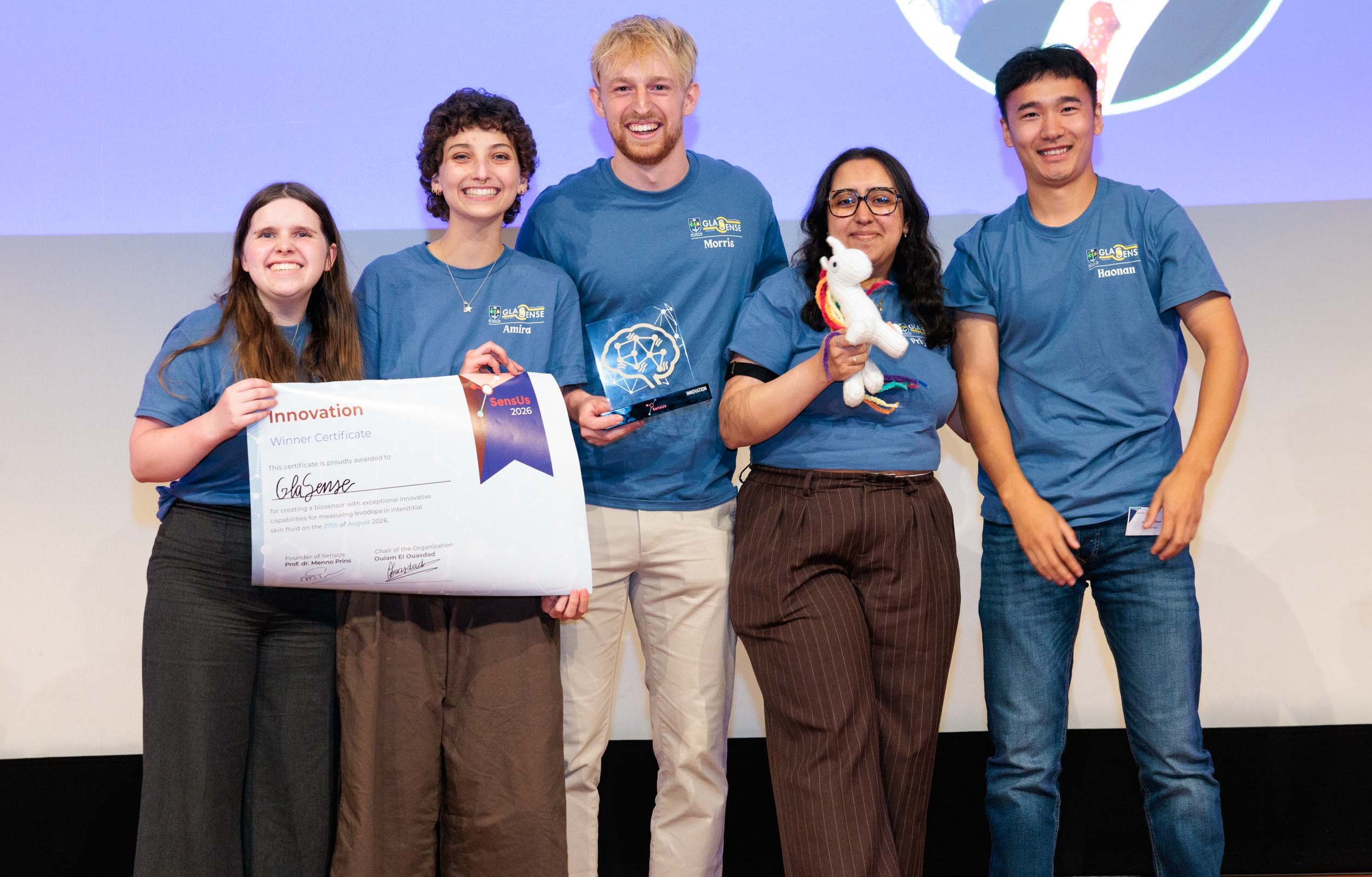
Members of the GLAsense team receive their award: (l-r) Hannah White, Amira Mistkawi, Morris McDiarmid, Priyanka Virdi and Haonan Zhao
For people living with Parkinson's, the same dose of medication can work one day and fail the next, and there is currently no way to see how much of the drug is in the body at any moment.
GLAsense developed a wearable sensor concept that uses a specially engineered hydrogel to recognise levodopa and convert its presence into a measurable pressure signal, using a novel mechanical sensing approach that distinguishes it from conventional methods. The design also allows key components to be replaced economically, supporting long-term, low-cost use.
Beyond proposing the concept, the team carried out an extensive analysis and characterisation of their system, validating its selectivity, reversibility, and ability to track levodopa across a range of concentrations. The thoroughness of this work was specifically highlighted in the competition and was central to the team securing the Innovation Award.
Throughout the project, the team worked closely with Glasgow’s Young Onset Parkinson’s Group, co-designing the device around their real needs and daily experiences to ensure it would be genuinely useful rather than only technically novel. This patient-centred approach shaped the design from the earliest stages. The team plans to continue this work, publishing their non-profit app to help patients manage their condition, and to further explore the potential of their new mechanical sensing concept beyond this competition.
Team captain Morris McDiarmid said: “I'm so proud of what this team achieved. We set out to do something never seen before, and it took many long nights in the lab to prove our sensing approach was not only novel but also had a real place in biosensing. But it wasn't just down to us, it was the patients' input that motivated us throughout the journey and made us realise how much what we were building really mattered."
The team was supervised by Professor Julien Reboud and Dr Chunxiao Hu of the James Watt School of Engineering. Supporting the team were Glasgow’s Young Onset Parkinson’s Group, RS Components and the University of Glasgow’s Chancellor’s Fund.
Last year, the GLAsense team were placed third in the Translation Potential Award category at the competition, and took home the Innovation Award and the Translation Potential Award in 2024.
Professor Reboud said: "It’s fantastic to see the GLAsense team continue their run of successes at SensUs, and I’m very proud that their hard work and creativity has paid off with the Innovation Award this year. More than 10 million people around the world live with Parkinson’s Disease, and the team’s design shows real promise for helping them manage their medication more effectively. It’s a great example of how Glasgow students are setting their sights on tackling real-world challenges using the knowledge and skills they have developed during their time at the University."
The GLAsense team are:
Morris McDiarmid – Mechanical Engineering
Hannah White – Biomedical Engineering
Amira Mistkawi – Biomedical Engineering
Priyanka Virdi – BioSciences (MSc)
Haonan Zhao – Electrical and Electronics Engineering (MSc)
Olivia Skinner – Biomedical Engineering
Najaree Janjerdsak – Biomedical Engineering
Zeiad Alkandari – Electrical and Electronics Engineering (MSc)
Feryaal Main – Biomedical Engineering
Lina Roy – Biomedical Engineering
First published: 7 September 2026