

Attention-grabbing virtual agents could help improve safety of self-driving cars
Published: 20 August 2026
Animated ‘virtual agents’ could help keep the roads of the future safer by alerting people behind the wheel of semi-autonomous cars to oncoming hazards, new research suggests.
Animated ‘virtual agents’ could help keep the roads of the future safer by alerting people behind the wheel of semi-autonomous cars to oncoming hazards, new research suggests.
Researchers from the University of Glasgow have been exploring whether the social cues that humans instinctively read in one another could be harnessed to effectively direct drivers’ attention back to the road when required.
Their research, recently published as a peer-reviewed paper, shows for the first time that using AR glasses to display an animated representation of a robot which turns to look and point drivers towards potential dangers may be just as effective as a more conventional visual warning.
https://youtu.be/G2P5WK5-sVE
They also discovered that there may be a limit on how much personality a virtual agent can have before its visual cues start distracting drivers instead of supporting them.
The team’s findings could help car manufacturers find more effective ways to deal with one of the biggest challenges of the planned transition to autonomous vehicles. Drivers of conditionally-automated cars, which are mostly but not completely self-driving, must remain aware of road conditions while their eyes are elsewhere in case they need to take back full control in an emergency.
Thomas Goodge, of the University of Glasgow’s School of Computing Science, is the paper’s first author and worked on the research as the final part of his PhD project. He said: “My PhD has been about probing the seeming paradox at the heart of conditionally-automated cars - how can we keep drivers aware of dangers on the road when they’re distracted by a task like reading, answering emails or playing games on their phone?
“In real life, people know where the other person in a conversation is paying attention just from the way they turn their heads. If one person looks over the other’s shoulder, it suggests there’s something there worth turning your head to see. Previous psychological research has firmly established that humans process social cues more efficiently than visual cues, yet almost none of our safety-critical systems make use of that. Instead, they use lights, flashes and beeps which can be hard to immediately understand. We were keen to explore whether something we’re hardwired to do could help us spot danger more effectively.”
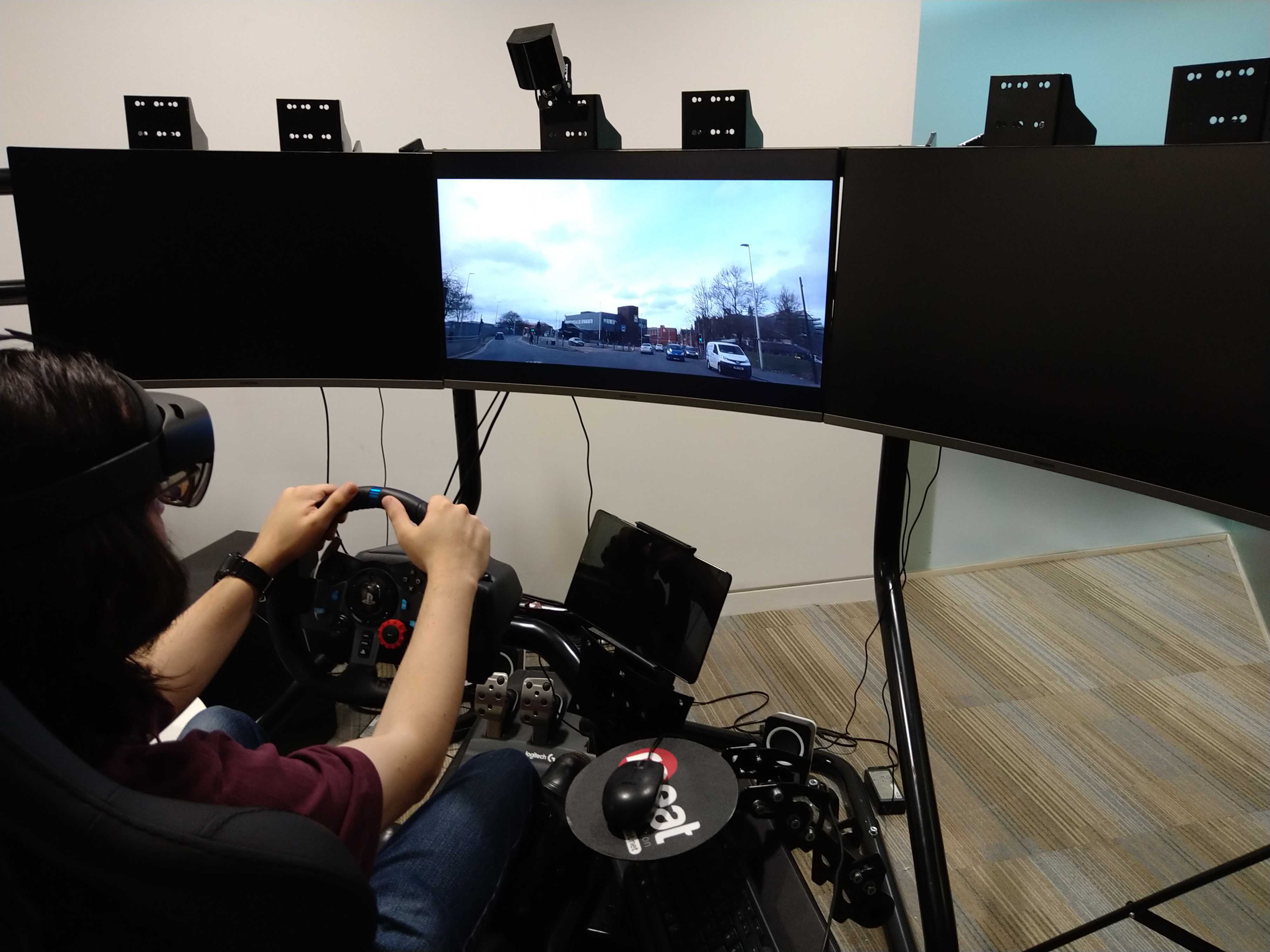
In order to investigate the potential of harnessing social cues, the team set up two lab experiments. They enlisted 48 volunteers to sit in a mockup of a driver’s seat in front of a monitor displaying a series of pre-recorded dashcam videos of real-world driving scenarios.
During the lab tests, the volunteers wore AR glasses and played a simple mixed-reality game which required them to look at gems to ‘pop’ them with their gaze. At the same time, the dashcam footage played in front of them, simulating the level of attention a driver occupied by non-driving related tasks might pay to the road.
A visual warning in the glasses alerted the participants to a potential hazard in the road footage just before it cut to black. They were then asked questions about what the hazard was, and to predict what might happen next. The same experiments were also repeated with a a control group who watched the footage without playing the game.
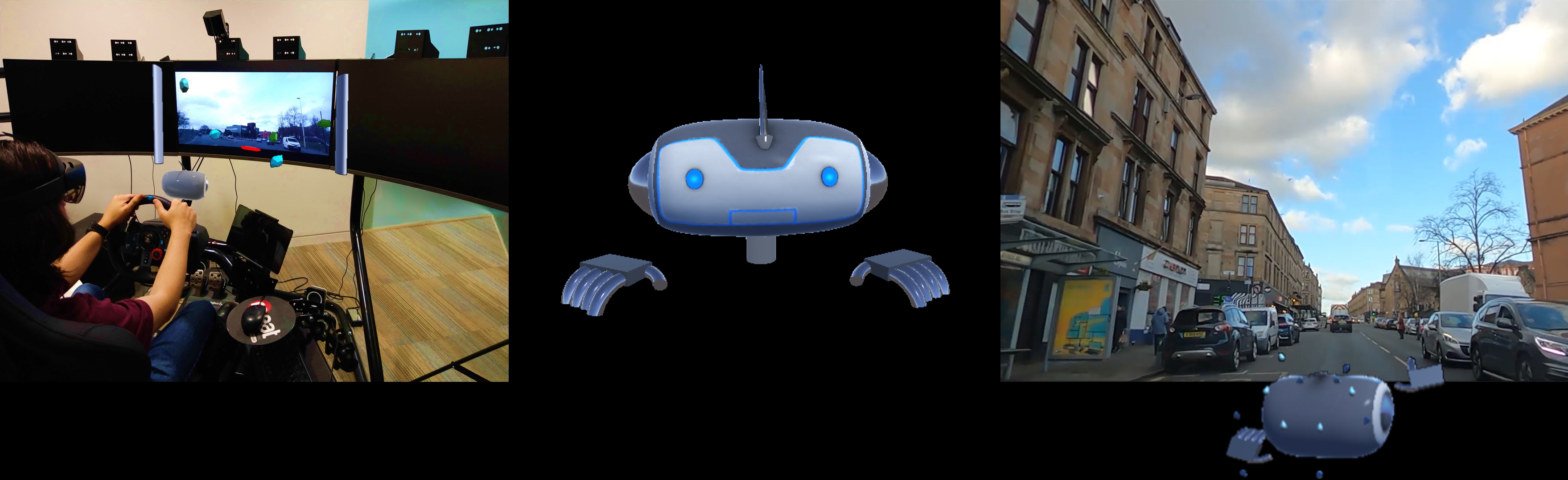
The visual warning took two distinct forms – a coloured bar that moved to sit under the hazard, and a robot head designed by the team that turned to look towards danger.
In the first experiment, the team found that the distracted drivers performed significantly worse than the control group with both warnings, regularly missing the dangers in the footage.
A second experiment added extra cues to the visual warnings. In addition to pointing, the marker turned red, and the robot’s head turn was accompanied by the reddening of the sides of its head. In both of these tests, the participants correctly predicted the hazards around 80% of the time – the same level as the undistracted control group.
The team also investigated whether the robot’s apparent emotional state would have an effect on the results. When they added visible signs of stress like sweating and trembling to the robot, the study’s participants became distracted by trying to accurately read the robot’s feelings, and regularly failed to correctly spot the road hazards.
Professor Stephen Brewster of the University of Glasgow’s School of Computing Science, a co-author of the paper, leads the ERC-funded ViAjeRo project which is investigating how VR and AR technologies can be used to improve the experience of travelling in self-driving cars. He said: “This is a striking result, suggesting that simulated body language can help alert drivers to danger effectively and pointing the way to a potentially very useful way to empower people to co-pilot a self-driving car.
“As cars move towards becoming autonomous, manufacturers are also integrating features like AI-enabled speech recognition to make the experience of driving feel more social. Our research suggests that adding social cues to hazard awareness could help drivers and their cars work as a team to maximise the safety of self-driving vehicles.
“However, it also highlighted a potential problem that will need to be addressed as these systems are developed. Some participants offloaded more responsibility than expected to the visual cues, trusting that they could wait for the marker or the robot to turn red instead of paying closer attention to the road. Finding ways to properly calibrate driver trust to ensure that humans don’t just hand over awareness entirely to their cars will be critically important.”
The team are already planning to expand their research to explore more deeply the potential of virtual agents to maximise driver safety.
Thomas added: “There are very few safety-critical systems currently in use that make use of social information. In this study, we deliberately chose to investigate presenting visual information to the participants. The next step is to bring in other modalities, like sound and conversation, and to test how drivers respond to a more conversational agent rather than one they simply watch.”
Professor Frank Pollick of the University of Glasgow’s School of Psychology contributed to the research and co-authored the paper.
The team’s paper, titled ‘The effects of using a Virtual Agent to Signal Danger on Hazard Prediction ability in Conditionally-Automated Driving’, is published in ACM Transactions on Computer-Human Interaction. The research was supported by funding from the UKRI Centre for Doctoral Training in Socially Intelligent Artificial Agents and the European Research Council.
First published: 20 August 2026