

Atacama Desert's extreme aridity initiated 20m years earlier than previously thought
Published: 2 June 2026
Researchers from SUERC Centre for the Isotope Sciences are co-authors of a study which casts new light on the history of the Earth’s driest region, the Atacama Desert in Chile.
Researchers from SUERC Centre for the Isotope Sciences are co-authors of a study which casts new light on the history of the Earth’s driest region, the Atacama Desert in Chile.
A collaborative study with University of Cologne, recently published in Nature Communications, provides compelling evidence that the extreme aridity in the hyperarid core of the Atacama Desert began over 40 million years ago - significantly earlier than previously assumed.
The findings require a reconsideration of how deserts form and offer a new perspective on the long-term evolution of the Earth’s most extreme environments.
It is widely believed that the Atacama Desert formed in the Early to Mid-Miocene, approximately 15-20 million years ago in response to changing oceanic currents and formation of the Andes mountain chain. In a new study SUERC and Cologne University researchers shows that hyperarid conditions were established at least 40 million years ago. This appears to coincide with a period of global cooling immediately following a short-lived hot period termed the Early Eocene Climate Optimum (EECO). This implies that the previously proposed mechanisms for climate drying only served to intensify drying rather than initiating it.
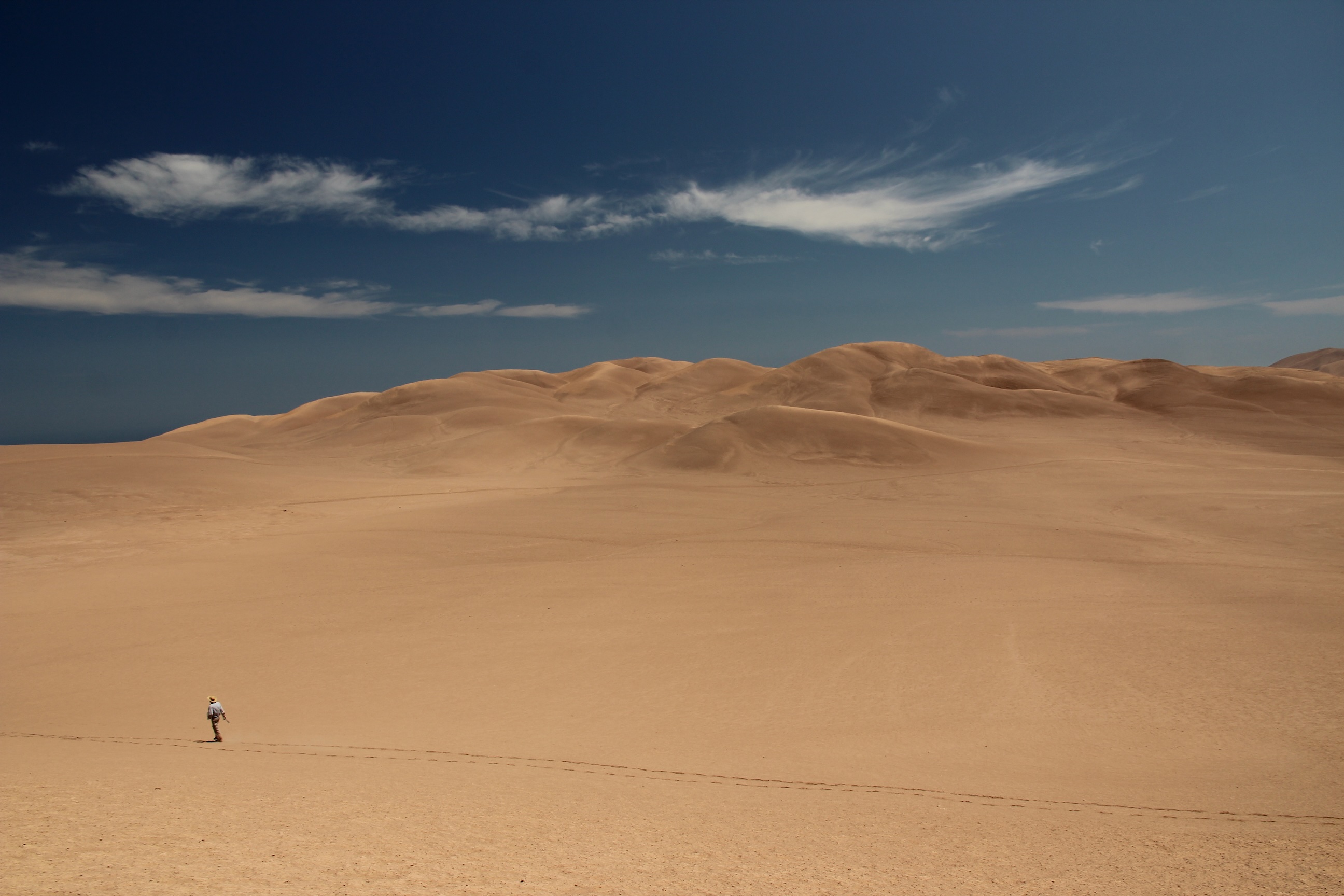
The Atacama Desert. Photo credit: Dr Benedikt Ritter-Prinz
Dr Benedikt Ritter-Prinz of the University of Cologne, the study’s lead author, said: “Our results indicate that the hyperarid core of the Atacama Desert was established in the Mid- to Late-Eocene, indicated by extremely low surface activity. This makes it the longest continuously dry region on Earth and forces us to reconsider how and when such extreme environments develop.”
The study is based on the analysis of cosmogenic nuclides in quartz pebbles from flat surfaces in the core of the Atacama Desert. Cosmogenic nuclides are rare isotopes that are formed when extremely high energy cosmic rays interact with minerals at Earth’s surface. High sensitivity mass spectrometers at SUERC in East Kilbride were used to measure 21Ne and 10Be in a huge number of pebbles. The extremely high concentrations are consistent with the surface having remained largely undisturbed for tens of millions of years.
Professor Fin Stuart of SUERC said: “Rainfall in temperate regions constantly reshapes landscape by eroding bedrock and transporting sediments into basins. The extremely dry core of the Atacama Desert has less than 2 millimetres of rainfall per year, thus surface processes operate extremely slowly. Consequently, the landscape has effectively been preserved on geological timescales since the climate became hyperarid. The ability to determine the extremely long surface residence of the pebbles provides a new chronometer of long-term climate change.”
Water is the defining feature of a habitable planet, yet large parts of Earth exist under severe water scarcity. In such environments, both biological activity and surface processes are strongly constrained, and their interactions remain poorly understood. The Atacama Desert, as one of the driest places on Earth, provides a natural laboratory to explore these relationships.
The findings establish a new climatic framework for one of the most water-limited regions on Earth. This is essential for linking landscape evolution and the adaptation of life under extreme conditions.
In hyperarid regions, rare and short-lived increases in water availability can leave lasting imprints on the landscape. These transient events can also influence biological colonisation and evolution, although such links are still not fully resolved. By extending the record of hyperaridity back to 45 million years, the study provides a crucial temporal context for investigating how fluctuations in climate, surface processes, and life interact at the limits of habitability.
The soils that develop in the Atacama Desert possess remarkable properties: not least they can absorb weak rainfall, effectively preventing runoff and fluvial activity. The team’s new chronology constrains how long it takes to develop soils thick enough to enable this buffering effect. The development of the soils creates a positive feedback, where extreme aridity promotes soil development that further stabilises and protects the landscape, contributing to its apparent long-term hibernation.
The results contribute to a broader effort to identify thresholds for biological colonisation, understand tipping points in Earth surface systems, and reconstruct long-term climate histories in extreme environments. They also support emerging research into evolutionary lag times, species adaptation to changing climates, and the interplay between geological processes and biodiversity.
The large dataset and record-breaking surface ages, the study establishes a new benchmark for investigating long-term landscape stability and climate evolution.
The study highlights how extremely slow Earth surface processes can operate over tens of millions of years, and it opens new avenues for understanding the relationships between climate, landscape and life in the most extreme environments on our planet.
The team’s paper, titled ‘Evidence for Eocene aridification of the Atacama Desert’s hyperarid core’, is published in Nature Communications. The research was supported by funding from the German Science Foundation and Natural Environmental Research Council.
First published: 2 June 2026