

Breaking the Optical Barrier: terahertz tech could help enable quantum internet security
Published: 27 May 2026
A new method to distribute cryptographic keys using terahertz waves could help enable secure communication in the quantum-powered internet of the future, researchers say.
A new method to distribute cryptographic keys using terahertz waves could help enable secure communication in the quantum-powered internet of the future, researchers say.
Engineers from the University of Glasgow are pioneering the development of a new method of quantum key distribution (QKD) using terahertz waves transmitted with a wireless communications system adapted from mobile and wifi networks.
Their results, published in IEEE Transactions on Quantum Engineering, demonstrate that the proposed system could provide a high-fidelity, energy-efficient alternative to conventional QKD platforms based on laser beams and fibre-optic infrastructure, highlighting the potential for secure quantum communication to extend far beyond the optical domain.
Currently, internet communications are secured using a variety of methods including the Transport Layer Security protocol, which helps ensure that any messages between machines can’t be easily decrypted if they are intercepted in transit.
However, the ongoing development of quantum computers, which harness the power of quantum physics to enable performance far beyond conventional digital machines, also poses a threat to conventional encryption.
Quantum computers are expected to be able to use their advanced power to crack open many forms of encryption with ease. Cybersecurity researchers have been working for some time on the development of QKD, a much more secure method of encryption which will help keep communications private once quantum computers start sending data to each other over the internet.
In the paper, the Glasgow team show how they have simulated and modelled the performance of a new system which uses coherent terahertz waves to enable quantum key distribution across three environments chosen to illustrate distinct real-world use cases for the technology.
Dr Kaveh Delfanazari, of the University of Glasgow’s James Watt School of Engineering, is the paper’s corresponding author. He said: “Building the quantum internet is a major scientific and engineering challenge because quantum computers are highly sensitive to thermal fluctuations, electromagnetic noise, and environmental disturbances.
“These effects can rapidly destroy fragile quantum states, making reliable and secure communication between quantum systems extremely difficult. Overcoming this challenge is essential for enabling large-scale quantum networks, distributed quantum computing, and next-generation secure communications.
“Here at the University of Glasgow, we’ve been working on terahertz quantum communication technologies for some time. With this project, we were keen to explore the potential of terahertz tech as a building block for the quantum future that scientists around the world are laying the foundations for today. This is a concept paper, but it’s backed by thorough simulation, and we’re excited by the results.”
The paper and the underlying simulation propose a hardware system built around superconducting Josephson junction coherent emitters, a class of compact, low-powered devices which generate quantum terahertz waves.
The modelled waves created by the simulated emitters are transmitted using a process called Orthogonal Frequency-Division Multiplexing, or OFDM, originally developed for use in 4G and 5G mobile networks and wifi. OFDM splits the signal across many parallel subcarriers, enabling more QKD-secured data to be sent in a single burst.
The researchers simulated the performance of the system over open air, in space, and in supercooled cables. In ordinary indoor or outdoor locations, where atmospheric water vapour can limit the performance of terahertz technologies, the system could transmit coherently for around four metres – far enough to enable high-quality communications in data centres or inside quantum computers themselves.
In space, where satellites may in the future share quantum communications without being affected by an atmosphere, the team show that the system could enable secure communications over distances in excess of 100 kilometres.
In cryogenically-cooled cables like those which may be used inside quantum hardware, the team’s simulations suggest secure messages could travel up to 26 kilometres using terahertz waves.
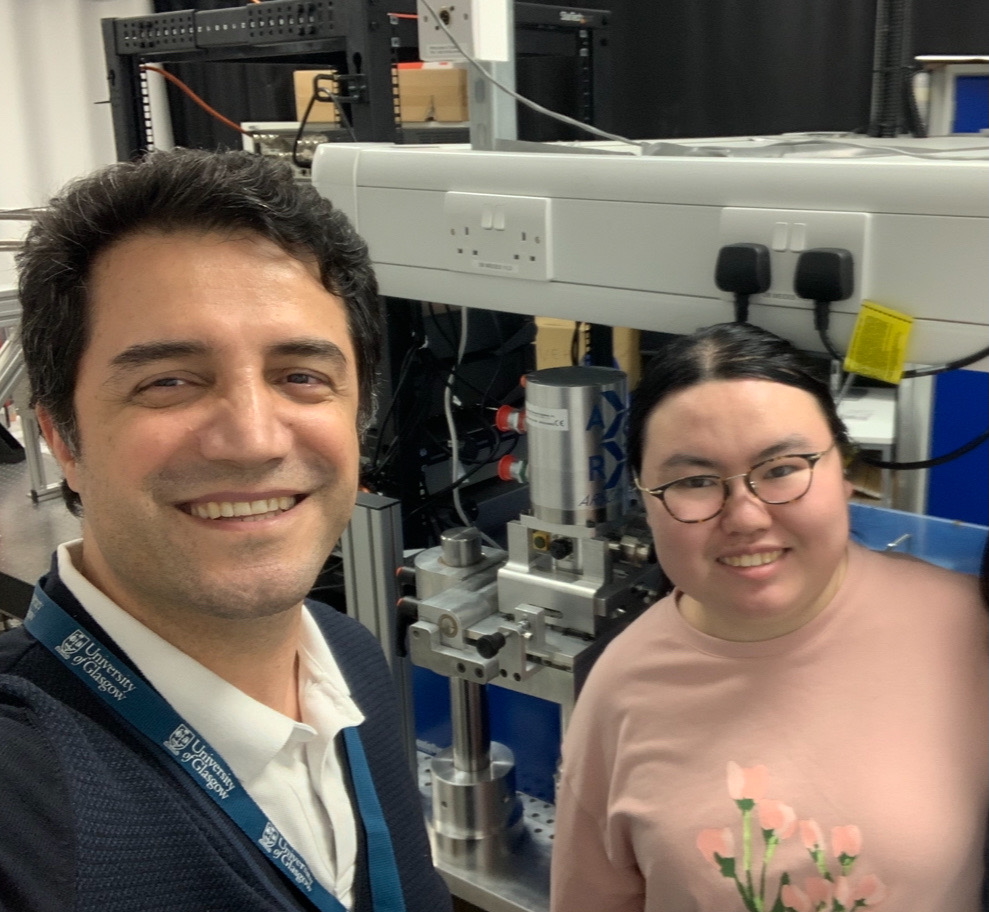
(l-r) Dr Kaveh Delfanazari and Mingqi Zhang
University of Glasgow PhD student Mingqi Zhang is the paper’s first author. She said: “We’re confident that our modelling work shows clearly the potential of terahertz technologies to enable high-performance quantum key distribution in three challenging environments.
“The next steps for us are to start building physical systems which we can test in the lab and out in the real world, helping us to validate our results and start to overcome some of the limitations we’ve identified in our simulations. We’ve already started taking steps to making that happen, and we’re looking forward to continuing our research in this promising area.”
The team’s paper, titled ‘Orthogonal Frequency-Division Multiplexing Continuous-Variable Terahertz QKD for Large-Scale Wireless Quantum Communication’, is published in IEEE Transactions on Quantum Engineering. The research was supported by funding from the Royal Academy of Engineering, the Royal Society of
Edinburgh, and the Royal Society.
First published: 27 May 2026