

Simulation breakthrough could spark aerial firefighter training revolution
Published: 11 May 2026
Sophisticated new flight simulation software capable of accurately modelling the performance of firefighting helicopters could help train pilots to tackle wildfires more effectively in the future.
Sophisticated new flight simulation software capable of accurately modelling the performance of firefighting helicopters could help train pilots to tackle wildfires more effectively in the future.
Researchers from the University of Glasgow developed the prototype software as part of the Daedalus I flight simulation framework, which is showcased in a paper published in the CEAS Aeronautical Journal.
The software runs on affordable, consumer-grade GPU components to accurately model the complex interactions between helicopter rotors, flames on the ground, and water dropped on the blaze from above.
Specialised aircraft are one of the key components of efforts to tackle wildfires, enabling firefighters to quickly reach the flames to drop water or fire retardant from the air. However, pilots must fly at low speeds close to the ground through smoke and rapidly shifting winds, making their jobs difficult and dangerous.
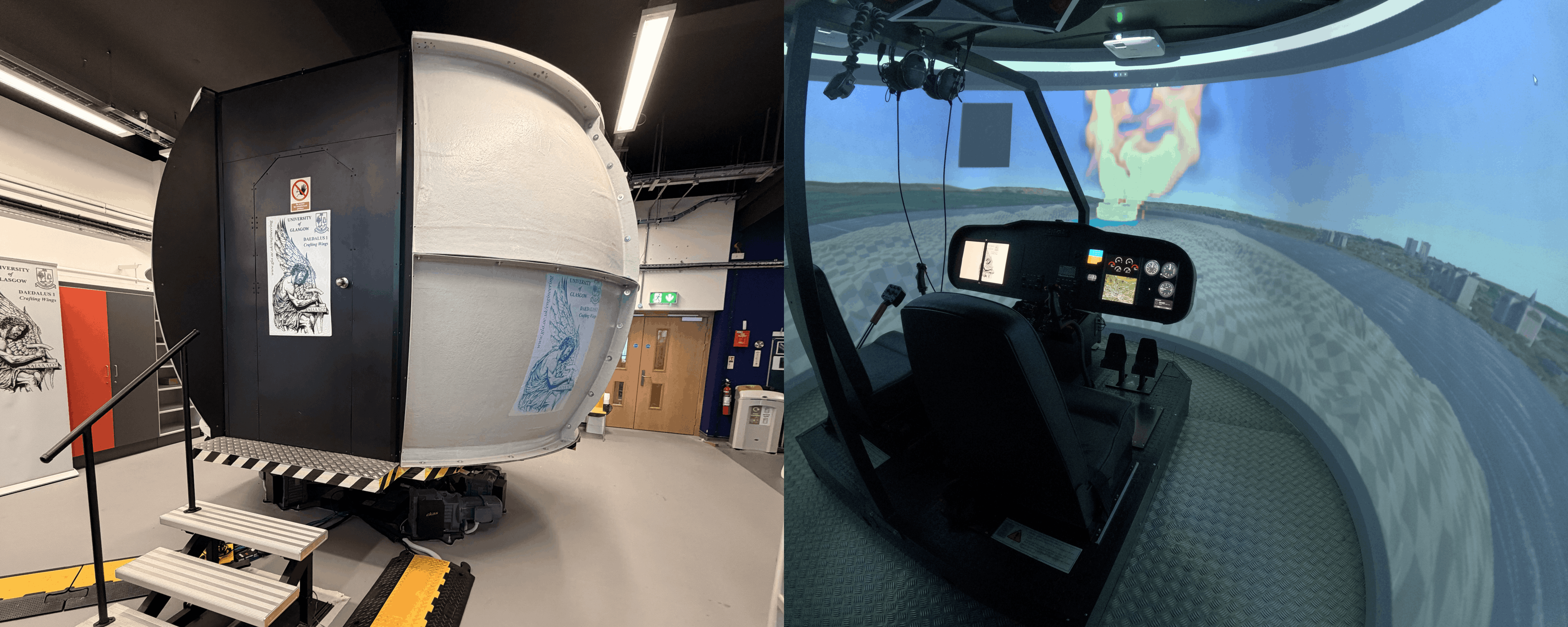
Conventional flight simulators often use a series of pre-determined conditions to help trainee pilots learn to take off, fly and land. However, the unpredictable nature of wildfires, which spread quickly, respond unpredictably to wind, and are also affected by the downdraft from helicopter blades, make them challenging to simulate using traditional software models.
The team say their software is the first to model the complete dynamics of aerial firefighting in real time instead of relying on ‘pre-baked’ models. It could be a vital step towards making realistic firefighting simulations more accessible, helping helicopter pilots more effectively build the skills they will need to tackle wildfires as global heating increases their frequency and intensity.
Postgraduate student Oyedoyin Dada, of the University of Glasgow’s James Watt School of Engineering, is one of the paper’s lead authors. He said: “Aerial firefighting is a very specialised vocation, and there aren’t many pilots who have the unique combination of skills and experience that helicopter firefighters require. The world will need many more aerial firefighters in the years to come, but it’s currently very hard for them to build the necessary skills in simulators and it’s very dangerous to run tests using real aircraft in controlled fire conditions.
“Supercomputers are capable of simulating fluid behaviour, but it’s not practical to use that level of power in flight simulators. What is urgently needed instead is more accessible simulations which harness the power of GPU processors to model the interactions between the plume coming from the fire and the wake of the aircraft. Modelling that unique two-way coupling effect in real time is what we were aiming to do when we started the development of this software, and our results are very encouraging."
The team’s software, which they ran on an Nvidia RTX 4090 graphics card and tested on the University of Glasgow’s Daedalus 1 flight simulator, models the physics of the atmosphere, the fire, the water being deployed to fight the blaze, and the helicopter itself.
The key to the model’s performance is an in-house aerodynamic solver HLBM2 based on the Lattice Boltzmann Method, a technique which enables the rapid calculation of fluid physics via massive parallel processing of many pieces of the simulation at once - a task which today’s GPGPU hardware like the team’s Nvidia card is particularly good at.
The method underpins the software’s atmospheric modelling, calculating how the air moves, creates updrafts, and is affected by the downwash from the helicopter’s rotors.
The software’s model of the fire itself, meanwhile, draws data from the atmospheric model, enabling it to calculate how the fire will be affected by the changing atmospheric conditions and the helicopter wakes, and sending information back to the atmospheric module. This modelling of the two-way coupling between ground and air enables a uniquely detailed simulation of ever-changing flight conditions.
At the same time, a third model works to calculate the path and effect of each individual water droplet as it falls from the helicopter to land on the fire. As the ground is moistened and the virtual fire is quenched, updated simulation data is fed back into both the fire and atmospheric models, reinforcing the realism of the simulation.
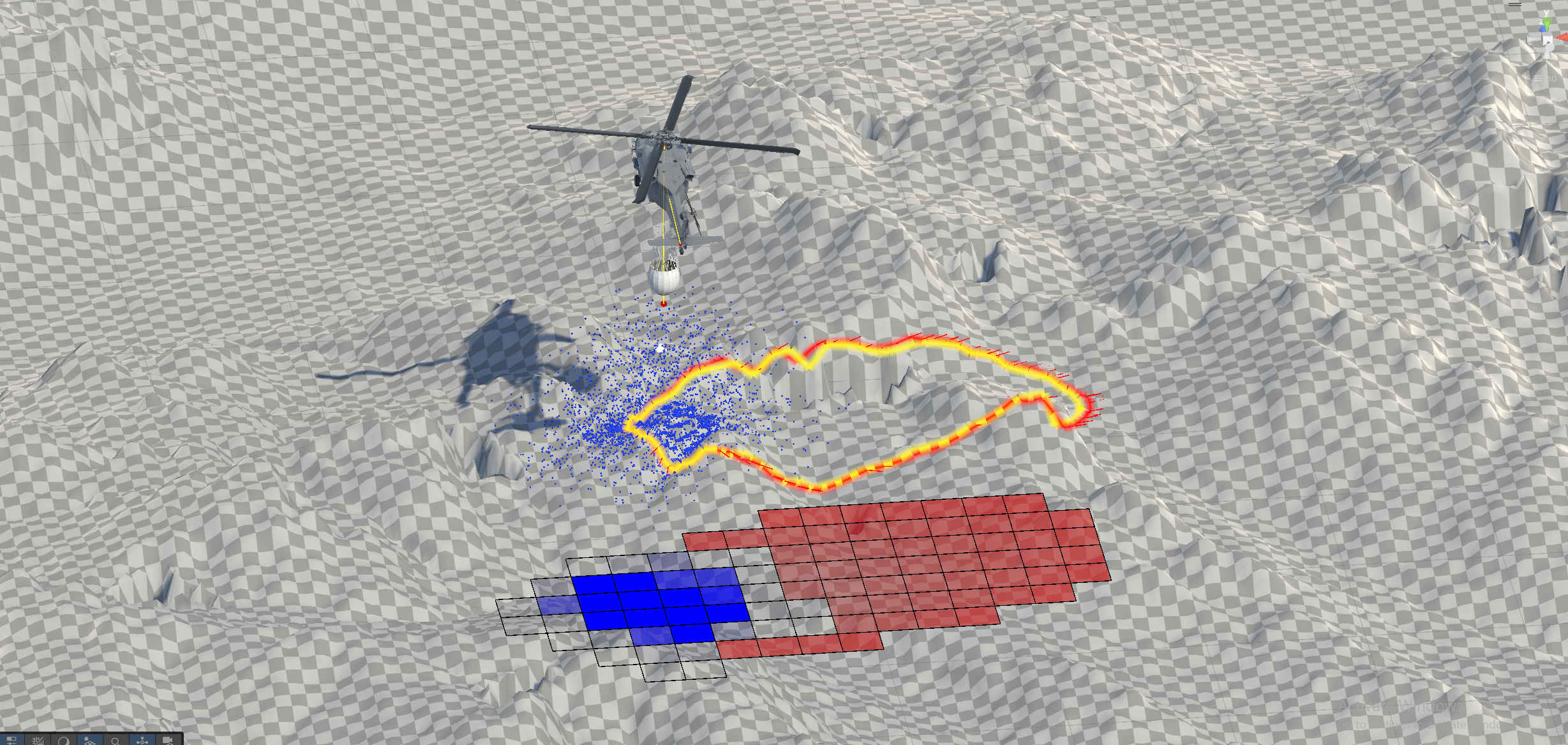
The James Watt School of Engineering’s Professor George Barakos is the paper’s corresponding author. He said: “Our software performs fast enough to calculate the fluid dynamic interactions at 60 frames or more per second, a refresh rate fast enough to enable seamless communication between the simulation components and the motion platform housing the pilot.
“Comparisons against a more conventional one-way coupling model showed a clear advantage for our system. In one case, for example, we flew a simulated helicopter at 20 knots towards a fire, sending some of its rotor wake ahead. The wake reached the fire before the helicopter, intensifying the blaze and generating a fresh plume which the helicopter flew through a few seconds later. That kind of interaction is impossible for a pre-computed simulator to create and shows the potential that a more real-time realistic system could for pilot training.”
The team are continuing to work to refine their model and are keen to start testing their simulations with the aid of experienced pilots.
"The next step is using the simulation system to conduct real-time testing with pilots in the loop, and we’re actively exploring options to recruit them to help put the system through its paces,” added Dada. “After that, the idea is to develop an intelligent low-level control system that is able to learn from the data we generate. The control system will work in the background to stabilise the aircraft despite the disturbances, thereby reducing the workload of the pilot and enable them to focus more fully on fighting wildfires.”
Dr Tao Zhang of the University of Glasgow and Dr Lu You of Guizhou University in China contributed to the research and co-authored the paper. The team’s paper, titled ‘A framework for aerial firefighting simulation’, is published in the CEAS Aeronautical Journal. The research was supported by funding from the University of Glasgow and the Engineering and Physical Sciences Research Council (EPSRC).
First published: 11 May 2026