

A traditional diet could be key to combatting the rise of type-2 diabetes: Nepal is showing us the way
Published: 10 February 2026
An international team of researchers, led by the University of Glasgow in collaboration with Dhulikhel Hospital, Nepal, is investigating whether reverting to a traditional diet could help to reduce the growing number of people with type-2 diabetes in Nepal.
An international team of researchers, led by the University of Glasgow in collaboration with Dhulikhel Hospital, Nepal, is investigating whether reverting to a traditional diet could help to reduce the growing number of people with type-2 diabetes in Nepal.
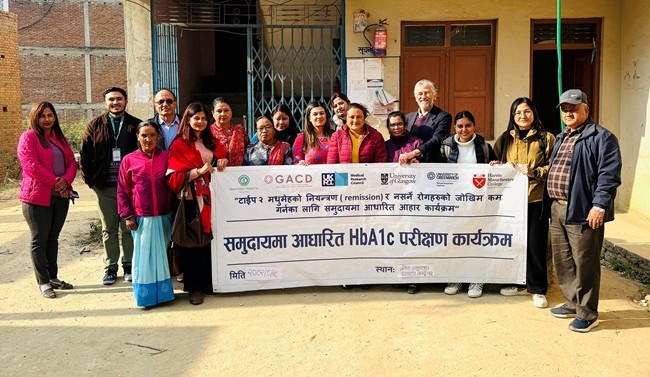
The four-year study, which will run from 2026 to 2030, is funded by an award of £1.78m from The Howard Foundation and is led by diabetes and human nutrition expert Professor Michael Lean from the School of Medicine, Dentistry & Nursing at the University of Glasgow.
The CoDIAPREM project aims to demonstrate the effectiveness and sustainability of consuming a traditional diet, as both a treatment and prevention method for type-2 diabetes. The diet plan, delivered and supported mainly by local volunteers in a community-based programme with minimal demand on health professionals, achieves modest weight loss by specifically excluding energy-dense processed foods.
Researchers hope their data will support low-cost community interventions for type-2 diabetes in other countries around the world.
Until recently type-2 diabetes was rare in Nepal. Nepalese people, along with other Asian and indigenous peoples, are genetically predisposed to type-2 diabetes but the disease only emerged after energy-dense processed foods were introduced to the country, and people started to gain weight. Now, the country has a high prevalence of the disease and its disabling complications – about one in five people aged over 40 have it, and medication-based diabetes treatments are unaffordable for most people.
In response, the CoDIAPREM project will test a community-led drive to re-adopt Nepal’s traditional foods to achieve and maintain lower body weight, which appears to have prevented most diabetes in the past. The research team will assess the diet’s ability to prevent the onset of type-2 diabetes, and also its ability to achieve long-term remissions, without the need for medications, in people discovered to have already developed the disease. Pilot research in Nepal demonstrating remissions of diabetes has been very promising, offering a solution to type-2 diabetes at very low cost and with minimal health professional input.
Professor Lean said: “The CoDIAPREM project is an exciting and important opportunity to understand whether a low-cost, traditional food-based intervention could work to prevent the onset of type-2 diabetes and help achieve remission for those who already have the disease.
“The impact of manufactured foods on weight gain and diabetes rates in countries such as Nepal is worrying. This project will give us vital, real-world data to demonstrate the effectiveness of a low-cost traditional food intervention for type-2 diabetes and could potentially save significant costs for global healthcare systems.
“We are immensely grateful to the Howard Foundation for recognising the importance of this project and supporting our work.”
The CoDIAPREM project was originally approved by the UK government as part of its Global Health Research Programme. However, subsequent budgetary changes resulted in programme funding being withdrawn in 2025.
For the last 15 years Professor Lean has been working on research into type-2 diabetes and its remission using a structured diet programme developed in Scotland and used in the landmark Diabetes Remission Clinical Trial (DiRECT), funded by Diabetes UK. This management approach has now been adopted for routine care in every Scottish NHS Health Board, and by NHS England, Wales and Northern Ireland, and in other countries around the world.
Research in DiRECT showed that type-2 diabetes is mainly driven by body fat accumulation damaging vital organs, and is best treated through weight loss as early as possible. Sufficient weight loss stops the disease process in its tracks, potentially achieving remission (defined as no longer diabetic and not requiring medication).
Halting the progression of type-2 diabetes, alongside preventing it from developing, are goals not only for patients but also healthcare systems around the world. Type-2 diabetes is now one of the most expensive diseases, through the escalating costs of new medications and the costs of its chronic complications which include blindness, kidney failure, amputations, infections and premature dementia.
Dr. Biraj Karmacharya, from Dhulikhel Hospital, Nepal, said: “This work will be a major milestone in creating a model of success on how nutritional interventions in low-income settings like Nepal can transform diabetes prevention and management. This will also create novel platform for future works on nutrition and health in Nepal and beyond.”
The results of CoDIAPREM, which also has input from the Universities of Greenwich and Oxford, are expected to be of high importance to lower-income countries, potentially offering a model for low-cost intervention against type-2 diabetes.
Julie Lambert, Chair of the Howard Foundation, said: “The Howard Foundation is delighted to be able to support the CoDIAPREM project in Nepal over the next 4 years.
“My father, Dr Alan Howard, who set up the Howard Foundation in 1982, led research into obesity and weight loss in the 1960’s and 1970’s leading to the creation of a dietary approach to treating obesity. When Professor Lean approached the Foundation we saw that this research has now come full-circle.
“We believe that funding this project will have a major public health value. It will highlight the role of diet in both the prevention and treatment of diabetes in Nepal and in other low-to-medium economies.”
enquiries: ali.howard@glasgow.ac.uk or elizabeth.mcmeekin@glasgow.ac.uk
First published: 10 February 2026