

Terahertz device sets performance record and opens new tech horizons
Published: 3 December 2025
A prototype device which has demonstrated record-breaking longevity could help open up new frontiers in next-generation communications and computing technologies.
A prototype device which has demonstrated record-breaking longevity could help open up new frontiers in next-generation communications and computing technologies.
An international team of researchers from Scotland, the USA and Japan are behind the development of the terahertz-wave device, which was fabricated more than 11 years ago and still works as well as it did the day it was made.
The team’s tiny terahertz emitter device, which has elements with less than the width of a human hair and can be powered by a single volt, could help overcome one of the key challenges holding back the widespread adoption of terahertz-wave technologies.
Although terahertz-wave technologies are already in use in sectors including security and screening, prototypes of communications and computing devices have shown the potential to enable remarkable performance in controlled laboratory environments.
The team credits the device’s exceptional longevity to its specialised fabrication techniques and the intrinsic resilience of its materials. Built from the high-temperature superconductor, the device consists of atomically thin layers engineered to remain stable and resist degradation when exposed to air or moisture.
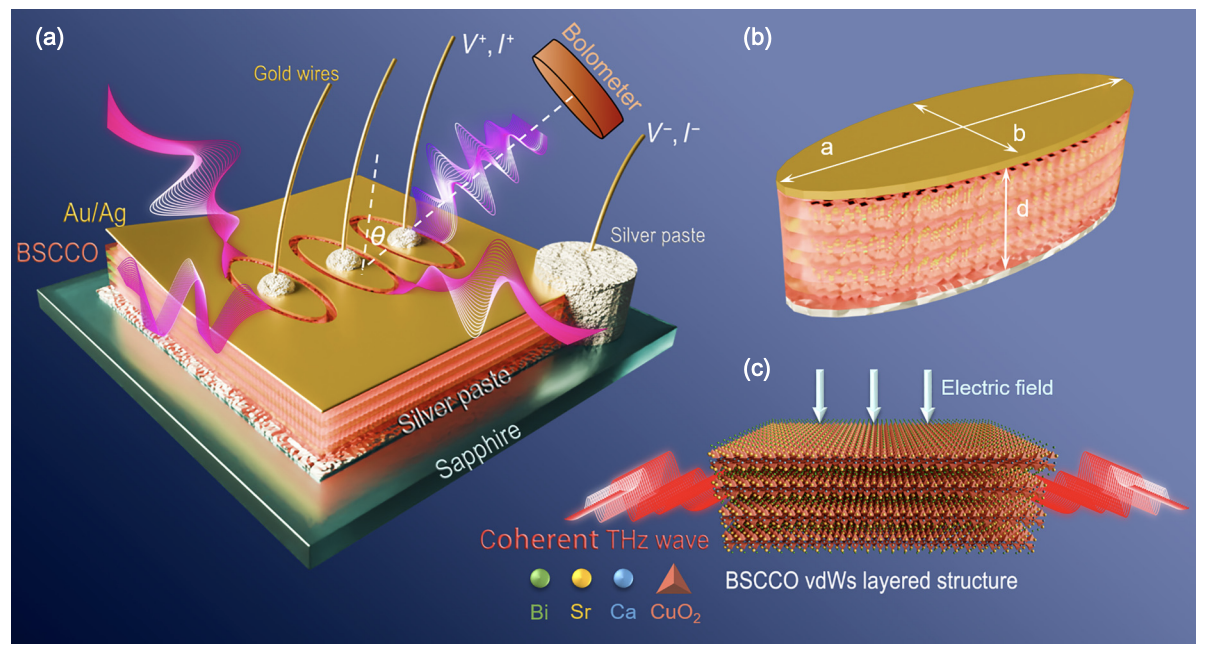
The device contains tiny elliptical cavities with special properties called Josephson junctions. They enable the phase-locked coherent generation and transmission of terahertz waves. In this architecture, the emitted waves can be tuned across a wide frequency range, from 100 GHz up to 1 THz, providing a powerful platform for compact and controllable THz signal generation.
The device maintains robust performance across extreme temperatures, operating as a superconductor near 90 K—well above liquid nitrogen’s 77 K boiling point—while emitting coherent light effectively up to 60 K, enabling the deployment of critical technologies at significantly reduced cost.
Dr Kaveh Delfanazari of the University of Glasgow’s James Watt School of Engineering is the project lead and paper’s corresponding author. He said: “One of the key challenges of developing terahertz-wave technologies for critical technologies, like communications and quantum computing, is ensuring device stability, efficiency, and longevity. Prototype devices often last for only a single measurement cycle, but what we have achieved here is a device that has outlasted the spectrometer and PC used for its initial tests, more than a decade ago.
“What we’ve been able to demonstrate in this paper is a device that has retained full functionality after more than a decade in storage—outlasting even the spectrometer and PCs used for its initial tests in the mid-2010s. Its reliable performance under low-power and cryogenic conditions makes it suitable for a range of applications, from space-based and mid-range free-space communications to the supercooled environments required by quantum computing chips.
“We are now building on this prototype to develop even more robust terahertz devices, with potential applications in commercial communications, computing and sensing technologies in the years to come.”
Mingqi Zhang, a PhD student at the University of Glasgow’s James Watt School of Engineering, is the paper’s first author. Researchers from the University of Tsukuba in Japan and the University of Central Florida in the USA contributed to the research and co-authored the paper. The team’s paper, titled ‘Tunable terahertz source on a chip with decade-long stability using layered-superconductor elliptical microcavities’, is published in Physical Review Applied, 24, 054012 (2025).
The research was supported by funding from the Royal Academy of Engineering Fellowship, the Royal Society of Edinburgh, the Monbukagakusho Scholarship, and JST-CREST, Japan.
First published: 3 December 2025
<< December