

Health & Communities
What is Health & Communities?
The Health and Communities theme invites students to explore how wellbeing, resilience, and global challenges shape the lives of individuals and societies. These courses empower students to understand health not just as an individual concern, but as a shared, community‑driven responsibility.
Below, you can find a sample list of C4L courses within the Health & Communities theme. Please note that they are subject to change. The finalised list of courses and details (including course descriptions, assessment and timetabling information) will be available ahead of enrolment opening in August 2026. Keep an eye on this page for more information!
Reimagining Global Health: From Local Challenges to Global Solutions
'Reimagining Global Health: From Local Challenges to Global Solutions' at a glance:
This course is available in Semester 1. Course code: MED1024 Credits: 20.
What will I learn from this course?
Students will learn to analyse how policies across sectors such as trade, education, environment, housing, and transportation influence health outcomes locally and globally. Through multidisciplinary perspectives, the course emphasizes collaboration, equity, and sustainable development as core components of effective global health practice. This course prepares students to critically assess policy environments and contribute to advancing health equity in diverse global contexts. Students will be supported to develop critical analysis and interpretation skills to inform decisions by proposing innovative solutions to a specific global health challenge.
Skills which will be developed include the ability to innovate and generate ideas and to be able to contextualise problems. Students will also be able to demonstrate that problems and decisions cross subject boundaries by exploring concepts such as health in all policies. Students will build skills working both collaboratively and independently and will have the opportunity to practice both oral and written communication skills. Students will learn how to formulate recommendations for improving their learning through reflection and feedback from the course team and peers. The course aims to combine theoretical foundations with active, experiential, and participatory learning, preparing students to drive meaningful change in diverse global health contexts.
How will I be assessed on this course?
|
Sequence |
Assessment type |
Group or Individual Assessment |
Weighting |
|
Formative |
Formative Assignment |
Individual |
N/A |
|
Summative |
Bulletin/Editorial |
Individual |
30% |
|
Summative |
Policy Brief Group Presentation |
Group |
40% |
|
Summative |
Written Reflections on Group Presentation |
Individual |
30% |
The course ILOs:
- ILO1. Recognise how the global health landscape has social, political, economic and environmental determinants that influence current challenges
- ILO2. Bring together information from individual, community, national and global sources to guide decisions on how to address a current global health challenge, considering responses that address social justice and health inequity principles
- ILO3. Create outputs in both written and oral formats, such as written policy briefs and editorials, and oral presentations that mirror professional global health practice, for example carrying out needs assessments, identifying priorities and managing competing needs
- ILO4. Demonstrate core professional skills such as teamwork, problem solving, evaluating solutions and making decisions as well as reflecting on personal and collective successes and limitations of your practice.
What unique learning experiences will I have on this course?
During this course students will have the opportunity to embed a range of opportunities to enhance their knowledge and skills to be ready for professional work. This will include learning through work using authentic scenarios to understand where they fit in the global health context, to understand the global health landscape and to reflect on where their discipline can contribute to reducing social inequities.
Who are the course leaders?
Sue Campbell is leading this course.
Life Lab: The Art and Science of Thriving
'Life Lab: The Art and Science of Thriving' at a glance:
This course is available in Semester 1. Course code: PSYCH1014 Credits: 20.
What will I learn from this course?
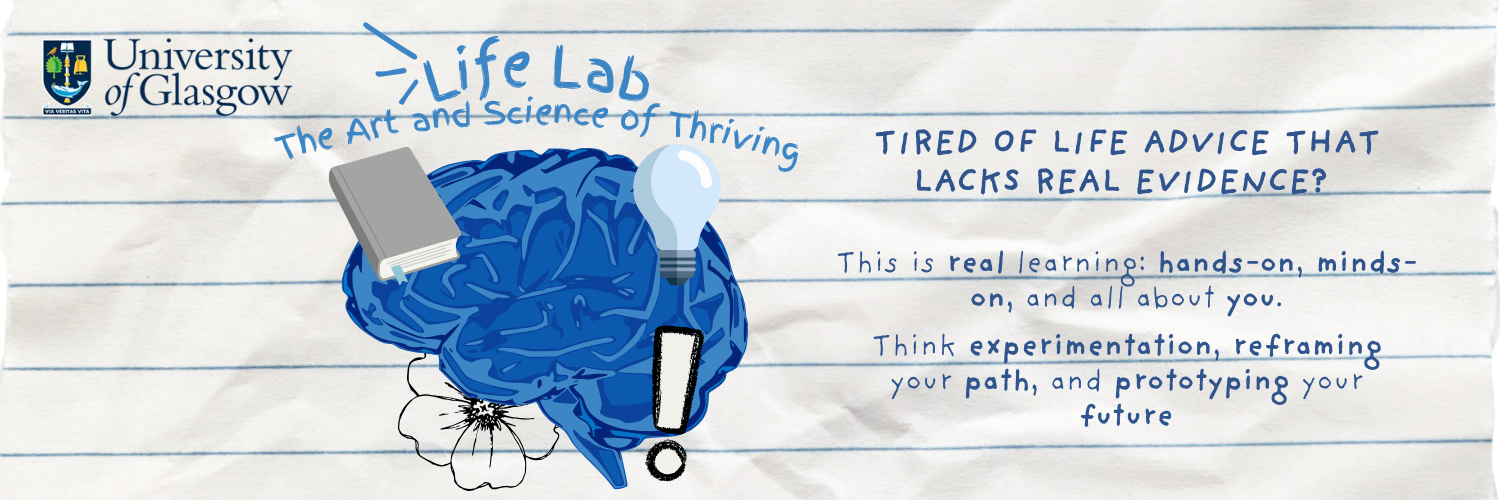
Life Lab is an evidence-based course grounded in research from Psychology and Neuroscience. Designed by experts and students, it is aimed to equip students with durable skills and the mindset and capabilities to navigate the uncertainty and change in today's world.
Forget passive lectures. This is real learning: hands-on, minds-on, and all about you. Through active experimentation and the Life Design approach (think experimentation, reframing your path, and prototyping your future) - You’ll build the skills to thrive.
Along the way, you’ll grow your self-awareness through a personal reflection portfolio and apply learning through creating a real student success project that boosts well-being and sustainability right here on campus.
This isn’t just a course—it’s your launchpad for confidence, creativity, and real-world impact.
How will I be assessed on this course?
|
Sequence |
Assessment type |
Group or Individual Assessment |
Weighting |
|
Formative |
Reflective Log |
Individual Assessment |
N/A |
|
Summative |
Graphic Reflection |
Individual |
40% |
|
Formative |
Intervention Proposal Outline |
Individual |
N/A |
|
Summative |
Student Success Intervention |
Individual |
60% |
The course ILOs:
- ILO 1: Critically evaluate a selection of evidence-based strategies for enhancing well-being, adaptability, and resilience, using guided materials and structured discussion.
- ILO 2: Implement evidence-based tools for self-regulation, communication, and problem-solving through guided activities and personal experiments.
- ILO 3: Reflect on personal growth in adaptability, resilience, and agency, and integrate these insights with relevant theory in a structured portfolio, using provided template.
- ILO 4: Design and refine a simple intervention to improve student success within the university community, using a given template to guide development.
What unique learning experiences will I have on this course?
Do you hear endless advice about how to "be successful" or "improve your life" but don't know what is actually grounded in solid research?
Life Lab: The Art and Science of Thriving is your chance to find out. This is not a self-help course with quick fixes, but an evidence-based approach grounded in research from Psychology and Neuroscience.
You will learn to apply practical, proven tools to build durable skills like:
-
Critical thinking
-
Resilience
-
Adaptability
-
Effective communication.
Through active experimentation, peer collaboration, and personal reflection, you will try out strategies and see what works for you. These capabilities will set you up to thrive at university, navigate the uncertainties of an ever-changing uncertain world, and ensure long-term success in your future professional life.
Discover the science of human flourishing and gain the agency to intentionally design a life you value.
Who are the course leaders?
Carolina Kuepper-Tetzel & Stephany Biello are leading this course.
Making sense of problem substance use in Scotland
'Making sense of problem substance use in Scotland' at a glance:
This course is available in Semester 2, 2027. Course code: MED1020. Credits: 20.
What will I learn from this course?
Substance use is a complex, ‘wicked’ problem that disproportionately affects Scotland, reflected in the high rates of alcohol and/or drug related deaths, and wider ranging impacts on health and wellbeing. However, alcohol and/or drug use is an integral part of Scottish culture, and responses to tackling associated harms must balance a person’s right to enjoy life, with their right to health and wellbeing. Responses to reducing the harms resulting from problem substance use (PSU) span across disciplinary boundaries – including health, law, education, economics, engineering, and beyond.
In this course, you will explore the different ways that substance use can be understood and how PSU affects individuals, families, communities, and societies. You will be supported to reflect on your relationship to substance use, and the connection it may have with your disciplinary ‘home’ (e.g. geography, history, engineering). Through collaborative working, you will develop skills in communicating complex issues with compassion.
How will I be assessed on this course?
|
Sequence |
Assessment Type |
Group/ Individual |
Weighting |
|
Formative |
Discussion about plans for the vlog or podcast. Occurs in Week 3. Feedback type
|
Group |
N/A |
|
Summative |
Podcast / Vlog – Submitted at end of course. Students will work in groups of 4-5. Presentation should be collaboratively curated, but not all members need to have a speaking part. No longer than 10 minutes (pro-rata for smaller groups, approx. 2 mins per person). [ILO 1, ILO2] The podcast or vlog must be accompanied by a one-page document containing the following information:
Feedback will be provided on Moodle and will focus on ‘feeding forward’ – highlighting skills and avenues for growth as students progress in their disciplines. |
Group – can accommodate individual for accessibility reasons |
20% |
|
Summative |
|
Individual |
80%
|
The course ILOs:
- ILO1: Demonstrate how problem substance use is understood from different perspectives.
- ILO2: Explain, to a variety of different audiences, key issues associated with problem substance use.
- ILO3: Reflect on their relationship to substance use on a personal and professional level.
What unique learning experiences will I have on this course?
Currently, there are no courses at an undergraduate level focusing on substance use – therefore you will be engaging with an under-explored area within the University of Glasgow curriculum. The teaching team on this course have experience in teaching and researching on substance use and mental health and will be joined throughout the course by guest experts to help enhance your learning. Given the close links to (situated within the , and a link to the local community) and the Substance Use in HE project, there will be additional opportunities to get involved with emerging work in the university around substance use and how to actively promote safety and wellbeing. We hope where appropriate, student outputs can be displayed in the Clarice Pears Building – open to the wider UofG staff, UofG student community, and the public. There may be the opportunity for students who are passionate about this issue to put their learning into practice and join our intern team.
In addition, students will have the option of undertaking training on overdose prevention, intervention, and Naloxone – a medication that can temporarily reverse the side-effects of an opiate overdose to provide time to seek professional, medical help.
Who is the course leader?
Dr Sharon Greenwood & Prof Julie Lanlan-Martin are leading this course.