


Surfacing skills… in the course Moodle (The Complete Graduate)
|
Title of case study |
Surfacing skills… in the course Moodle (The Complete Graduate) |
|
School/Subject:
|
Life Sciences Portfolio |
|
Lecturer(s): |
Dr Laura McCaughey, Dr Anna McGregor, Dr Lesley Hamilton |
|
Course: |
Applicable across all core Life Sciences undergraduate courses |
|
Student Level: |
Undergraduate (Years 1–5: SCQF level 7-11) |
|
Class size: |
~ 2000 students |
|
Location: |
Online |
Brief summary
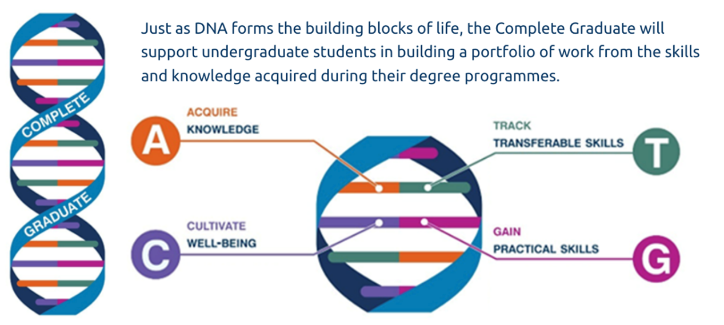
The ‘Complete Graduate’ is a Moodle-based resource designed to help students recognise, reflect on and articulate their learning experiences. Centred around four pillars, Knowledge, Transferable Skills, Practical Skills and Wellbeing, it supports students throughout their degree in a meaningful and ongoing way. Through features such as searchable content, guided activities, downloadable certificates and a personalised Digital Diary, students can build a portfolio showcasing their academic, professional and personal growth. Although its use is optional, the programme is embedded into the curriculum to encourage self-directed engagement and empower students to confidently articulate their development to future employers and within their communities.
Objectives
The main aim of the Complete Graduate is to support students in identifying and articulating the skills and knowledge they obtain throughout their degree. This in turn enhances students’ employability by making skills development visible, accessible and embedded across the curriculum.
What is done?
All Life Science students and staff are automatically enrolled on this Moodle course. It has searchable databases for students to look up ILOs, transferable skills or practical skills for any year of any Life Sciences degree. Students can therefore look forward to investigating what is yet to happen on their degree (which might be useful for Year 2 students choosing their future degree plan) or they can look back to remind themselves what they have learned. Students are also able to create their own checklists to track their personal development in each of the four sections.
On the Complete Graduate homepage, each student has their own private Digital Diary (similar to a blog), in which they can populate as many entries as they like. Students are encouraged to write on each of the four sections at the end of each semester. To help with this there is an interactive worksheet to guide them through their reflections. There is also a short, written guide on reflective writing in the Resources section.
Staff are encouraged to integrate the tool into teaching and advising. Staff can encourage the use of the Complete Graduate either through their role as lecturer, course coordinator and/or Advisor of Studies. For example, during sessions that involve reflective writing, staff can encourage students to upload their reflections to their Digital Diary and/or encourage use of the reflective writing tools on the Complete Graduate to help with their work. Course coordinators/lecturers can also point out any specific skills developed during a course and encourage students to reflect on these.
The resources section contains brief outlines and links to further information on many opportunities that students ask about in advisor meetings, for example summer internships, study abroad, student-staff partnerships and a simple overview of Good Cause. These can be useful to signpost students to for further information. The wellbeing section also contains links to a range of university services and has a workbook with advice on time management and stress reduction (created by a student partner).
Note: The Complete Graduate does not duplicate information on the Life Sciences Moodle Hub, instead it gives a very simplified outline and directs students to appropriate sources within Moodle or on the university webpages for more detailed information. Presentation of only the simplified outline was to circumvent the information overload that students report and as such is structured as to ‘What is it, How can it benefit me, When is it applicable in my degree’ with only a sentence or two under each heading.
What works well?
- Students can visualise progress and personalise their development
- Reflections can be exported for job applications and HEAR transcripts
- Easy integration into existing Moodle infrastructure
- Students and staff are familiar with Moodle
Benefits (students & staff)
- Encourages self-directed learning and reflection
- Supports staff in highlighting skills during teaching
- Provides a centralised, accessible tool for employability development
Challenges (students & staff)
- Maintaining student engagement across years as it is self-directed
- Ensuring staff consistently reference the tool in teaching
- Engaging staff to embed the use of the Complete Graduate into the curriculum
- Avoiding duplication with other Moodle resources
- Ensuring the Moodle Course is updated yearly with any changes to courses and content
What advice would you give to others?
- It’s a big initial undertaking, but it is worth it for the value it brings to the students.
- Use the tool during reflective writing sessions and advising meetings.
- Encourage students to use the Digital Diary and checklists and point out skills developed in your course.
- Refer students to the Resources and Wellbeing sections for additional support.