
• Skip to main content

The University of Glasgow uses cookies for analytics. Find out more about our Privacy policy.

We use cookies

Necessary cookies

Necessary cookies enable core functionality. The website cannot function properly without these cookies, and can only be disabled by changing your browser preferences.

Analytics cookies

Analytical cookies help us improve our website. We use Google Analytics. All data is anonymised.

ON OFF

Clarity

Clarity helps us to understand our users’ behaviour by visually representing their clicks, taps and scrolling. All data is anonymised.

ON OFF

Privacy policy


    • Projects
    • Infrastructure Projects
    • Transformer Replacement Programme
  • Lift Replacement Programme
  • Transformer Replacement Programme
  • Study
  • Research
  • Explore
  • Connect
Search icon
Close menu icon
Menu icon bar 1 Menu icon bar 2 Menu icon bar 3
University of Glasgow logo small University of Glasgow logo
  • Home
  • MyGlasgow
  • Estates
  • Projects
  • Infrastructure Projects
  • Transformer Replacement Programme

Estates

  • Projects
  • Infrastructure Projects
  • Transformer Replacement Programme
  • Lift Replacement Programme
  • Transformer Replacement Programme

Transformer Replacement Programme

The University owns and operates 5 high voltage electrical networks across the Gilmorehill and Garscube campuses. The HV networks are responsible for delivering power to a large proportion of our buildings.

The University currently have 40 transformers as part of the HV network.

13 of these transformers were cooled by oil and had a recommended replacement age of 25 years. 

The intent of the project was to renew the transformers, reduce risks, and improve sustainability by replacing these items of primary electrical equipment across the estate.

Project Benefits: 

Increased Electrical Resilience – replacement of transformers decreases the likelihood of faults and unplanned electrical downtime.

Increased Fire Resilience – the new transformers are MIDEL filled as opposed to oil filled transformers. MIDEL has a higher flash point, making it less flammable and reducing the risk of fire hazards.

Improved energy efficiency and reduced carbon footprint - Reduced energy bills and payback the equipment capital costs over the lifetime of the transformer.

Locations: 
- Rankine Building
- James Watt North
- 42 Bute Gardens
- Garscube Vet School
- Davidson Building
- Stevenson Building
- Library Building
- Sir Alexander Stone Building

Construction Start Date: January 2024
Construction End Date: 
July 2025

Project Costs: 
£2.1 Million

Project Manager: Mark Falconer
Clerk of Works: Gordon Watson
Contractor: Taylor & Fraser
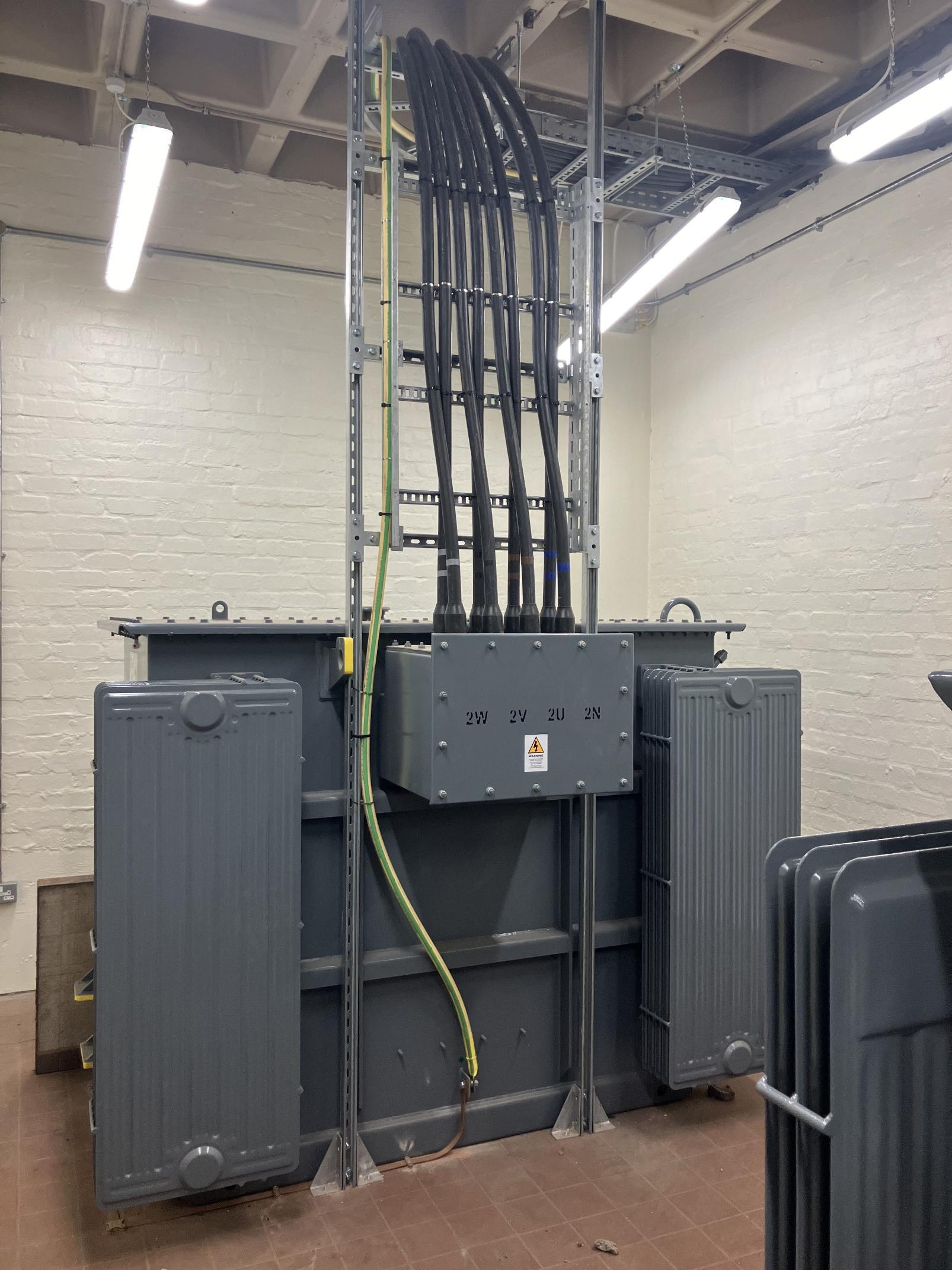
Rankine TransformerKelvin Building Transformer

Back to the top

STUDY

  • Subjects A-Z
  • Undergraduate
  • Postgraduate
  • Online study
  • Short courses
  • International students
  • Student life
  • Scholarships and funding
  • Visit us / Open Days

RESEARCH

  • Research units A-Z
  • Research opportunities A-Z
  • Glasgow Research Beacons
  • Research strategy & policies
  • Research excellence
  • Our research environment

EXPLORE

  • Meet World Changing Glasgow
  • City of Glasgow
  • Visit us
  • Accessibility
  • Maps and travel
  • News 
  • Events
  • Schools
  • Colleges
  • Services
  • Library
  • University strategies

CONNECT

  • Staff A-Z
  • Information for our alumni
  • Support us
  • Business & innovation
  • Community and public engagement
  • Ask a student
  • Complaints

JOBS AT GLASGOW

  • Current vacancies

University of Glasgow

  • Facebook
  • Bluesky
  • Instagram
  • YouTube
  • Twitter
  • tiktok
  • Linkedin
  • bilibili
  • Little Red Book
  • WeChat
  • Weibo

The University of Glasgow is a registered Scottish charity: Registration Number SC004401

Estates

  • Contact us

Legal

  • Accessibility statement
  • Freedom of information
  • FOI publication scheme
  • Modern Slavery Statement
  • Privacy and cookies
  • Terms of use

Current students

  • MyGlasgow Students

Staff

  • MyGlasgow Staff
together against gender-based violence