

A University for the world
Rethinking Higher Education: the paradox of freedom and habit in modern learning
Higher education is often celebrated as a unique space where ideas, concepts, and societal norms can be taken “off the table” - meaning they can be examined away from their usual contexts and assumptions. This idea suggests universities offer a kind of intellectual "free time", a break from everyday habits and structures that shape our world.
In this project, partners from Glasgow and Sweden build on their research to explore a deep paradox: can education truly be this free space when it is so deeply connected to the habits and systems that shape modern life?
The paradox of Education as Free Time vs. Social Habit
The paradox has two sides. First, there’s the current reality many universities face worldwide. Society expects universities to solve big social and political problems while also preparing students for specific roles and careers.
"Understanding the paradox of higher education is vital globally, as education influences both local futures but also how societies navigate our interconnected modern world.
This collaboration has already made important in-roads into exploring these critical issues.”
Education is often seen as a tool to shape future citizens who fit predetermined occupational categories and meet specific qualifications. This approach emphasizes training and competencies over broader ideals like personal growth, creativity, or transformative change.
Rather than empowering students to contribute new ideas, education is pressured to produce graduates ready to slot into existing professional and social structures. This can limit the potential of education to be truly liberating or innovative.
The second side of the paradox relates to the nature of learning itself. Even when education strives to be about open inquiry or critical thinking, the subjects and disciplines students engage with are rooted in long-established habits, histories, and social orders. The ways scientists work, politicians debate, theologians interpret, and moral laws operate are all built on traditions and repeated practices that have developed over centuries.
These familiar ways of being, doing, and knowing are deeply built into the subjects students study, so even when educators encourage fresh perspectives or difference, higher education often becomes a process of socializing students into existing ways of living and thinking. In this sense, universities can unintentionally reinforce the political, social, and moral orders they might hope to critique.
This means that although education might offer "free time" to explore ideas beyond qualification or career goals, it cannot fully escape the societal contexts that shape those very ideas. What is "put on the table" for discussion in universities is already part of these societal patterns.
A new lens: understanding Higher Education through modes of existence
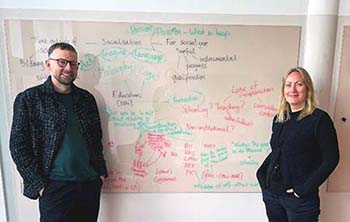 To better understand this paradox, this international and collaborative project draws on the work of Magnússon, Rytzler and Unsworth, and develops a theoretical model for exploring how higher education pedagogy and modern existence entwine.
The project examines how the student experience is intertwined with these various modes of existence that define the modern world. The goal is not to judge or assess higher education but to open up new ways of thinking about how education relates to modern life and how this relationship might change.
The funding was used to support two intensive workshopping weeks (in Sweden and in Scotland) where the above theoretical model was developed. The model is now in the process of publication through the International Teacher Education Research Collective (ITERC) and the collective’s series of international anthologies of research.
An early stage of the model was presented at the European Conference for Educational Research in Belgrade (September 2025) and further presentations are planned through seminar networks and international conferences. Funding for empirical work based on the model is currently being explored.
Why this matters
 This discussion is important because it challenges us to think beyond the common view of education as just a pathway to a job or a tool for social problem-solving. It asks us to consider how deeply education is embedded in the world’s existing habits and structures - and whether it can break free from them or not.
In an era when universities face pressure to both conform and innovate, this paradox points to a critical question: how can education remain a space of freedom and new possibilities when it is also tied to deeply ingrained social practices?
By reflecting on this tension and exploring new ways of seeing education’s role through philosophical lenses like Latour’s, we can better understand both the limits and potentials of higher education today. This understanding might help educators, students, and society rethink how learning can genuinely open up new horizons without simply reproducing old patterns.
In 2025, Dr Ruth Unsworth began a collaboration with Gunnlaugur Magnusson (Uppsala University) and Johannes Rytzler (Mälardalen University).
An unexpected outcome of the project was the appointment of Ruth Unsworth (UofG) and Gunnlaugur Magnússon (Uppsala) as coordinators of the International Teacher Education Research Collective during the visit, a five‑continent network supporting international research collaborations.
Funded UofG staff: Ruth Unsworth
College: Social Sciences
Partners: Uppsala University and Mälardalen University, Sweden
Fund: Glasgow's Global Partnership Fund (formerly IPDF)
Year of activity: 2025
Uppsala University and the University of Glasgow are both members of the Guild of European Research-Intensive Universities. They are also a partner in the Erasmus Mundus Joint Master Degree: Global Markets, Local Creativities